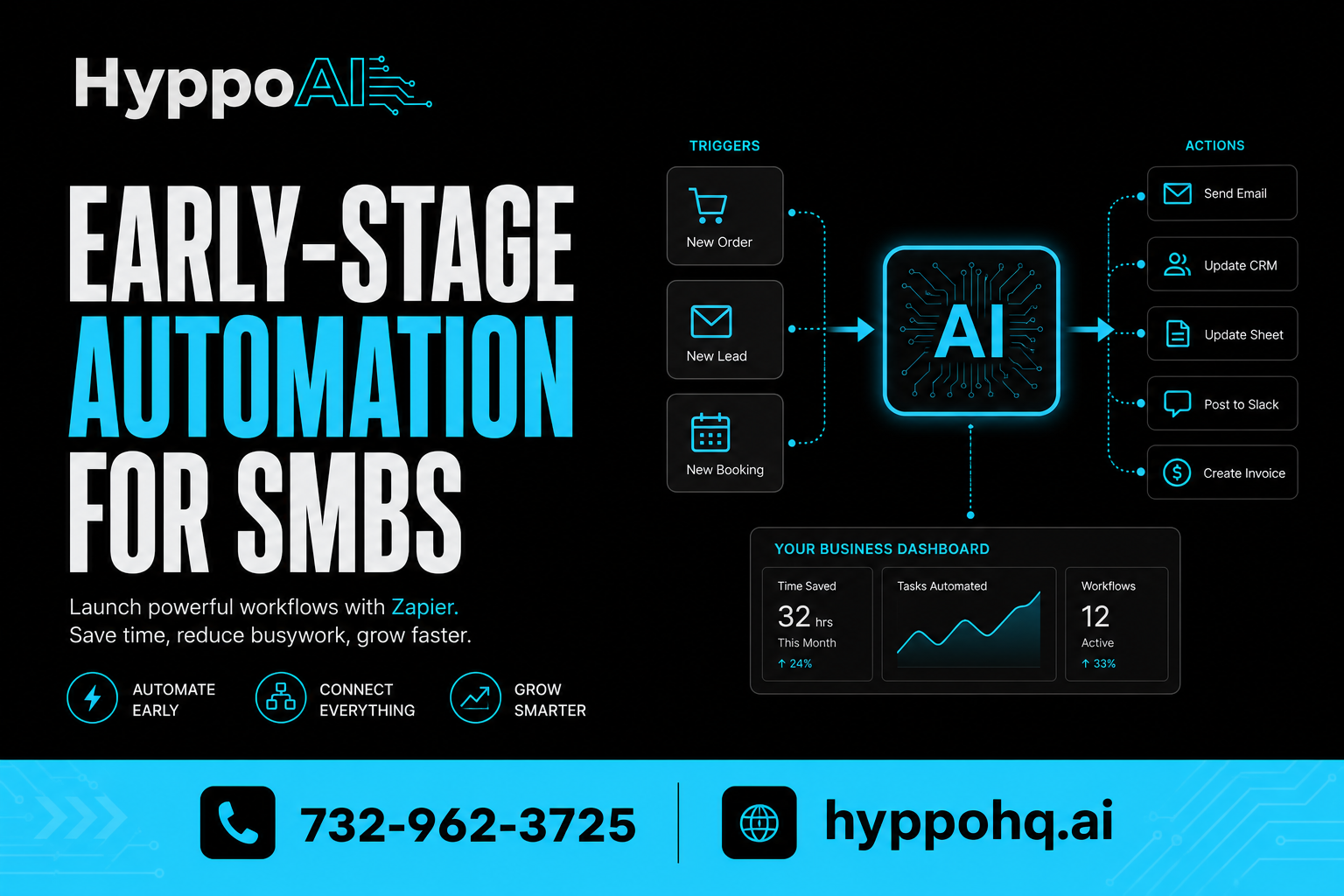
How Zapier fits into early-stage automation for SMBs
Early-stage automation is not about building a perfect system on day one. It is about removing repeat work fast, reducing errors, and creating enough structure to help your business scale without adding chaos.
That is where Zapier often fits.
For small and midsize businesses, Zapier can be one of the simplest ways to connect the tools you already use. It helps bridge gaps between apps without requiring custom development, which makes it a strong option when you need momentum more than complexity.
At HyppoAI, we think about automation in practical terms: what saves time, what improves follow-up, and what creates a cleaner operating system for growth. Zapier can play an important role in that early stage.
What Zapier actually does
Zapier is an integration platform that connects software tools through automated workflows, often called "Zaps." A trigger in one app causes an action in another.
A simple example looks like this:
- A website form is submitted
- Zapier sends the lead into your CRM
- Your team gets a Slack or email alert
- The lead is added to a spreadsheet or pipeline
Instead of relying on someone to move data manually, the handoff happens automatically.
That matters more than most businesses realize.
Manual processes do not just waste time. They create delays, missed leads, duplicate records, and inconsistent customer experiences.
Why Zapier makes sense early
In the early stage, most businesses are dealing with a messy mix of tools.
You may have:
- A website platform
- A CRM
- An email marketing tool
- A scheduling app
- A payment system
- Internal communication tools
The problem is not usually a lack of software. The problem is that the software does not talk to each other well.
Zapier helps solve that without forcing a full rebuild.
Key advantages for early-stage automation
1. Fast to launch
You do not need a long implementation cycle to get value. Many workflows can be set up quickly, tested, and improved over time.
2. Lower technical barrier
For many use cases, you do not need a developer. That makes it easier for lean teams to start automating before they are ready for custom engineering.
3. Good for process validation
Before investing in a more advanced system, you need to know the workflow is worth automating. Zapier lets you test that.
4. Connects a broad app ecosystem
If your tools are common SMB platforms, there is a good chance Zapier already supports them.
5. Helps standardize operations
Even simple automations can create more consistent lead handling, task creation, and internal notifications.
Best use cases for Zapier in an early-stage business
Zapier is strongest when the workflow is clear, repetitive, and based on structured data.
Here are some practical examples.
Lead capture and routing
When a prospect fills out a form, speed matters. Zapier can:
- Send the lead to your CRM
- Notify sales instantly
- Create a follow-up task
- Add the contact to an email sequence
This reduces the risk of slow response time, which is one of the biggest causes of lost opportunities.
Appointment and scheduling workflows
If someone books a meeting, Zapier can:
- Create or update a contact record
- Notify the assigned rep
- Add the appointment to a tracking sheet
- Trigger reminder workflows in connected tools
Internal task automation
Many teams waste time creating the same tasks repeatedly. Zapier can automate:
- New client onboarding checklists
- Project creation after payment
- Team alerts when a status changes
- Support handoffs between departments
Marketing handoffs
Marketing and sales alignment often breaks down because data lives in different places. Zapier can help by:
- Syncing lead source data
- Pushing form submissions into campaigns
- Tagging contacts based on actions
- Alerting teams when high-intent behavior happens
Reporting support
While Zapier is not a full analytics platform, it can move data into reporting tools or spreadsheets so leadership has better visibility.
Where Zapier is not the full answer
Zapier is useful, but it is not a complete automation strategy.
That distinction matters.
Some businesses start with Zapier and assume they have solved operations. In reality, they may have only added a layer of connection on top of broken processes.
Zapier is not ideal for:
- Complex logic with many branches
- Heavy data transformation needs
- High-volume enterprise-grade workflows
- Systems that require deep custom backend control
- Poorly designed processes with unclear ownership
If the underlying workflow is inconsistent, automation can multiply the inconsistency.
In other words, do not automate confusion.
How to know if Zapier is the right next step
A simple rule: use Zapier when you already know the process and just need the tools to hand off information reliably.
Ask these questions:
- Is this task repeated often?
- Is it rules-based?
- Does it involve moving data between apps?
- Does manual handling create delays or mistakes?
- Can the workflow be clearly mapped in a few steps?
If the answer is yes to most of these, Zapier is probably a strong early-stage option.
A smart way to implement Zapier
The best automation rollouts are focused, not scattered.
Start with one high-value workflow
Do not try to automate everything at once. Begin with a process that is:
- Frequent
- Easy to define
- Tied to revenue, response time, or client experience
Lead intake is usually a strong starting point.
Document the before-and-after process
Write down:
- What triggers the workflow
- What data is required
- What actions should happen
- Who owns exceptions
This prevents silent failures and confusion later.
Keep naming and field mapping clean
A lot of automation issues come from poor field structure across tools. Standardize naming conventions early.
Test edge cases
Do not only test the ideal scenario. Test incomplete forms, duplicate contacts, and unusual inputs.
Review performance regularly
Automation is not set-and-forget. Check:
- Failure rates
- Delays
- Duplicate records
- Missed notifications
- Workflow relevance as the business changes
Zapier and AI are not the same thing
This is another important point for early-stage businesses.
Zapier is an automation connector. It helps apps pass information and trigger actions.
AI adds reasoning, interpretation, language handling, and decision support.
Used together, they become more powerful.
For example:
- Zapier can move a new lead into a workflow
- AI can classify the lead, draft a response, summarize a call, or support follow-up logic
That combination is where many SMBs start moving from basic automation into real operational leverage.
The bigger goal: build systems that scale
Early-stage automation should not be judged by how advanced it sounds. It should be judged by whether it reduces friction and improves execution.
Zapier fits best as a practical layer in that journey.
It helps businesses:
- Move faster without hiring immediately
- Reduce manual admin work
- Improve consistency
- Connect disconnected tools
- Validate workflows before deeper investment
That is why it remains relevant.
Not because it does everything, but because it solves the right problems at the right stage.
Final takeaway
If your business is still relying on people to copy, paste, forward, update, and remind across multiple tools, Zapier can be a strong early-stage automation move.
The key is to use it intentionally. Start with a clear process, solve one bottleneck at a time, and build toward a more integrated system as your needs grow.
If you want help figuring out where automation should start in your business, HyppoAI can help you map the right workflows and identify where tools like Zapier fit best. Visit https://hyppohq.ai or call +17329623725 to start the conversation.
