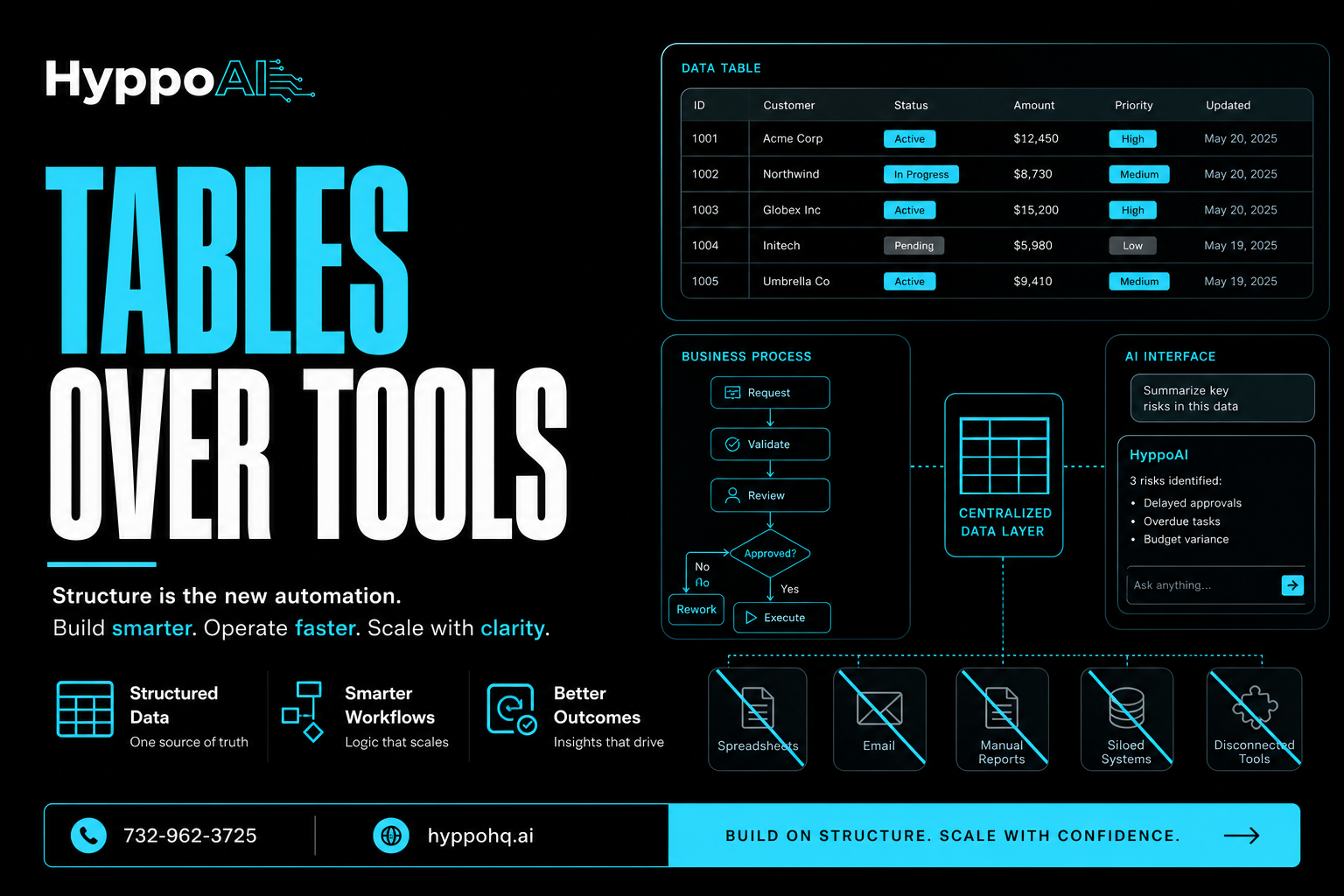
Why tables matter more than tools for SMB AI success
AI gets a lot of attention for what it can do. Write content. Answer calls. Automate follow-up. Summarize meetings. Route leads.
But for small and midsize businesses, the biggest difference between AI that helps and AI that frustrates often comes down to something less exciting: tables.
Not tools. Not dashboards. Not another app.
Tables.
If that sounds too simple, it is exactly why it gets overlooked. Businesses often assume the next software purchase will fix their workflow. In reality, weak data structure is usually the bottleneck. When your customer data, lead records, service history, and internal processes are not organized in a usable way, even the best tools struggle.
For SMBs, tables matter more than tools because structure creates leverage. Tools only amplify what is already there.
What “tables” really means
When we say tables, we are talking about structured data organized in a consistent format. Think rows and columns that clearly define what each record means.
Examples include:
- A lead table with name, source, status, last contact date, and assigned rep
- A customer table with contact info, service type, renewal date, and account notes
- A jobs table with appointment date, technician, location, and completion status
- A communications table logging calls, texts, emails, and follow-up outcomes
This is not just a database discussion. It is an operations discussion.
Well-built tables create a shared source of truth. They make reporting easier, automation more reliable, and decision-making faster. They also reduce the chaos that comes from scattered spreadsheets, disconnected apps, and inconsistent naming.
Why tools get too much credit
Tools are visible. They are easy to demo. They promise quick wins.
That is why many teams buy software before they define the structure underneath it. The result is predictable:
- Duplicate records
- Broken automations
- Inaccurate reports
- Missed follow-ups
- Low trust in the system
A new tool can improve speed, but it cannot fix messy inputs on its own. If your lead stages are inconsistent, your AI assistant will not know when to follow up. If customer records are incomplete, your automation will send the wrong message. If job data is stored in five different places, reporting becomes guesswork.
In other words, the tool is not the strategy.
The table is closer to the strategy.
Why tables matter more than tools in AI workflows
AI depends on context. Context depends on data. And data becomes useful when it is structured.
That is the core reason why tables matter more than tools.
When your business has clean tables, AI can:
- Personalize responses based on real customer history
- Trigger follow-up based on actual status changes
- Route leads using clear rules
- Surface trends from consistent fields
- Support teams with faster, more accurate answers
Without that structure, AI has to guess. And guessing is expensive.
For SMBs, this matters even more because lean teams do not have time to babysit broken systems. They need automation that works in the real world. That only happens when the underlying records are dependable.
Good tables reduce operational friction
Every business has friction points:
- Leads come in but nobody owns the next step
- Calls are missed and never logged
- Customers ask repeat questions because history is hard to find
- Managers cannot tell where deals or jobs actually stand
Good tables reduce that friction by making information available and actionable.
For example, a simple lead table with standardized stages can power:
- Instant lead assignment
- Timed reminders
- Automated email or SMS follow-up
- Pipeline reporting
- Re-engagement campaigns
That is a much stronger foundation than buying another tool and hoping adoption solves everything.
The hidden cost of bad structure
Messy data does not always fail loudly. Sometimes it fails quietly.
That is what makes it dangerous.
A business may think its systems are “mostly fine” while losing opportunities in small, repeated ways:
- A lead is marked differently by each employee
- A customer phone number is saved in the wrong field
- A closed job never updates the billing workflow
- An AI workflow triggers because one field was left blank
These issues add up. Over time, they create:
- Slower response times
- Lower conversion rates
- More manual cleanup
- Less confidence in reporting
- Poor customer experience
The business then blames the tool, when the real issue is the table design behind it.
What strong tables look like for SMBs
The goal is not complexity. The goal is clarity.
Strong tables usually have a few things in common:
1. Clear field definitions
Everyone should know what each field means. “Status” should not mean one thing to sales and another to operations.
2. Consistent formatting
Dates, phone numbers, names, and categories should follow the same format every time.
3. Required fields where needed
If a workflow depends on a field, that field should not be optional.
4. Logical relationships
Leads should connect to customers. Customers should connect to jobs. Jobs should connect to communications or outcomes where relevant.
5. Minimal duplication
One source of truth beats five versions of the same record.
This is where many SMBs unlock major gains. Not by adding complexity, but by reducing ambiguity.
Start with the workflow, then build the table
A common mistake is designing data structure in isolation. The better approach is to start with the business process.
Ask questions like:
- What happens when a new lead comes in?
- What information is needed at each stage?
- What should trigger the next action?
- Who needs visibility into the record?
- What outcome are we trying to measure?
Once those answers are clear, the right table design becomes easier.
This is especially important for AI and automation. If you want an AI receptionist, follow-up system, or internal assistant to perform reliably, you need to define the records and fields that support those actions.
Tools still matter, but in the right order
This is not an argument against tools. Good tools absolutely matter.
But the order matters more.
First:
- Define the workflow
- Structure the records
- Standardize the fields
- Clean the data
Then:
- Layer on automation
- Add AI support
- Improve reporting
- Expand integrations
When businesses reverse that order, they often end up with expensive software sitting on top of operational confusion.
When they get the structure right first, tools become far more valuable.
A practical mindset shift for growing businesses
If you are an SMB owner or operator, here is the shift:
Stop asking, “What tool do we need next?”
Start asking, “What table needs to exist for this process to work consistently?”
That question leads to better systems, because it forces clarity.
It helps you identify:
- What data actually matters
- Where handoffs break down
- Which automations are realistic
- What your team needs to see and update
- How AI can support the process without creating more noise
This is how businesses move from patchwork operations to scalable systems.
The bottom line
Why tables matter more than tools comes down to one simple truth: structure drives performance.
Tools can accelerate a business. Tables help organize it.
And for SMBs adopting AI, organization is the difference between automation that saves time and automation that creates more cleanup.
If you want better follow-up, cleaner reporting, stronger customer experiences, and more reliable AI workflows, start with the table. Build the structure. Define the fields. Make the data usable.
Then let the tools do what they do best.
If your business is evaluating AI and automation, HyppoAI helps SMBs build practical systems that actually work. Visit https://hyppohq.ai or call +17329623725 to learn how better structure can unlock better results.
