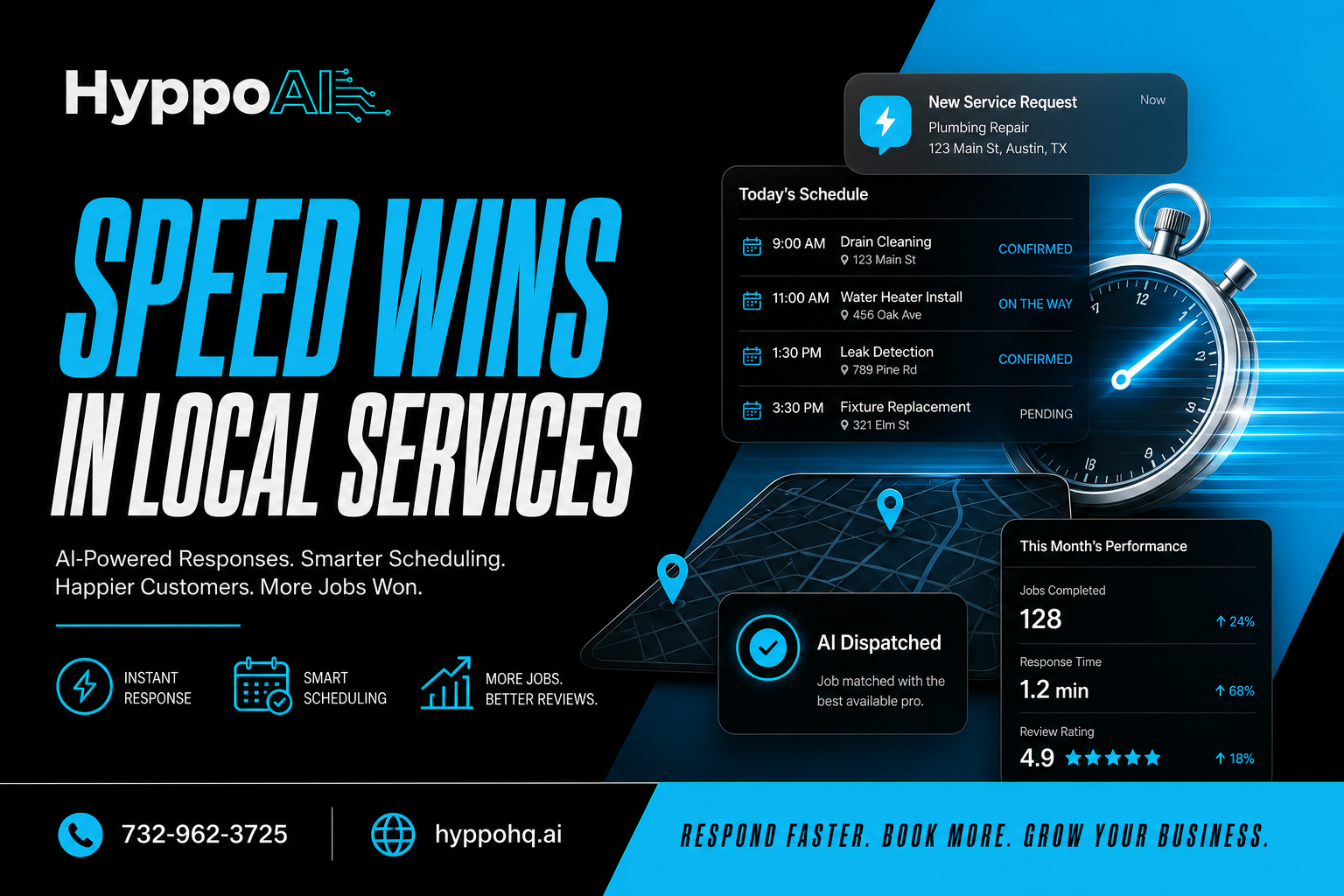
Why speed matters more than price in local services
In local services, most owners assume price is the deciding factor. It matters, but usually less than they think.
When a pipe bursts, an AC unit fails, or a customer needs urgent help, people do not start by hunting for the absolute cheapest option. They start by looking for the fastest reliable solution. In many cases, speed is what gets you the call, the appointment, and the revenue.
For small and midsize businesses, this is a major advantage. You do not always need to be the lowest-priced option in your market. You need to be the easiest business to reach, the quickest to respond, and the fastest to move a customer from problem to solution.
Speed changes how customers make decisions
Local service buyers are usually not making leisurely purchasing decisions. They are often dealing with inconvenience, stress, or urgency.
That changes the way they evaluate providers.
Instead of asking only, "Who is cheapest?" they ask:
- Who answered first?
- Who can help today?
- Who seems organized?
- Who followed up quickly?
- Who made booking simple?
In real-world buying behavior, speed signals competence. A fast response suggests your business is active, professional, and ready to solve the problem now.
A slow response creates doubt. Even if your pricing is better, the customer may never wait long enough to find out.
The first response often wins
In local services, there is a short window between interest and action. If someone calls, fills out a form, or sends a message, they are already motivated.
But motivation fades fast.
If they do not hear back quickly, they move to the next provider. That is not because they are disloyal. It is because they need progress.
This is why the first useful response often wins more than the best quote.
Fast follow-up beats delayed perfection
Many businesses lose leads because they are trying to respond perfectly instead of quickly.
A simple, immediate response like this can outperform a delayed custom reply:
- We got your request
- We are reviewing it now
- Here is when you will hear from us
- Here is how to book or confirm next steps
Customers do not need a polished speech in the first minute. They need reassurance that someone is on it.
Price is easy to compare. Speed is harder to copy.
Competing on price is risky because it compresses margins and attracts shoppers who may not stay loyal.
Competing on speed is different.
Speed is operational. It comes from better systems, faster communication, cleaner handoffs, and fewer delays. That makes it more defensible than discounts.
When your business responds faster than competitors, you create value that customers feel immediately.
That value shows up in several ways:
- Less waiting
- Less uncertainty
- Faster scheduling
- Faster resolution
- Better overall experience
People will often pay more to avoid delay, especially when the issue affects their home, business, time, or peace of mind.
Speed builds trust before the job starts
Trust in local services is not built only through reviews or referrals. It is also built in the first few minutes of contact.
If a prospect reaches out and gets:
- An instant acknowledgment
- A clear next step
- A fast scheduling option
- A prompt answer to common questions
that business feels trustworthy.
On the other hand, slow replies create friction. Missed calls, delayed texts, and unanswered web forms make customers wonder what the service experience will be like after they book.
They start thinking:
- If they are hard to reach now, what happens later?
- Will they show up on time?
- Will I need to chase them for updates?
Speed reduces that uncertainty. And in local services, reduced uncertainty is often more persuasive than a lower price.
Where local businesses actually lose on speed
Most service businesses do not lose because they lack demand. They lose because demand hits broken processes.
Common speed problems include:
- Missed calls after hours
- Slow responses to website forms
- No text follow-up
- Delayed estimate scheduling
- Manual lead routing between team members
- Inconsistent inbox monitoring
- No clear process for urgent requests
These are not branding problems. They are systems problems.
That is good news, because systems can be fixed.
Speed is an operations strategy, not just a customer service tactic
Owners often think faster response means hiring more people. Sometimes it does. But often it means designing smarter workflows.
A few operational improvements can dramatically reduce lead loss:
1. Capture every inbound lead
If calls go unanswered or forms disappear into an inbox, speed is impossible.
Every inquiry should trigger an immediate process.
2. Acknowledge instantly
Even if a human cannot respond right away, the customer should know the request was received.
3. Route by urgency
Not every lead is equal. Emergency jobs, high-intent calls, and repeat customers may need priority handling.
4. Automate routine communication
Appointment confirmations, follow-ups, FAQs, and intake questions do not always need manual effort.
5. Reduce handoff delays
Every extra step between inquiry and action slows conversion.
The faster your workflow, the faster your revenue.
Why this matters even more for SMBs
Large companies often have bigger budgets, but SMBs can still win on speed.
In fact, speed is one of the best competitive levers for smaller businesses because it does not always require massive overhead. It requires discipline, systems, and the right tools.
A smaller local business that responds in under a minute can outperform a larger competitor that takes hours.
That is especially true in categories like:
- Home services
- Legal intake
- Medical and dental inquiries
- Real estate follow-up
- Automotive services
- Cleaning and maintenance
In these markets, the customer often chooses the provider who creates momentum first.
AI can help businesses move faster without adding chaos
This is where AI becomes practical.
For SMBs, AI is not just about novelty. It is about response speed, consistency, and coverage.
Used correctly, AI can help local service businesses:
- Answer inquiries faster
- Handle missed calls after hours
- Qualify leads automatically
- Send immediate text follow-up
- Route requests to the right person
- Book appointments faster
- Keep communication moving
The result is not just efficiency. It is better conversion.
When a customer gets immediate engagement, your business stays in the conversation while competitors are still catching up.
The real takeaway: speed protects margin
If your only strategy is to be cheaper, you will keep getting pushed lower.
If your strategy is to be faster, clearer, and easier to work with, you create a stronger reason to choose your business.
That protects margin.
It also improves:
- Close rates
- Customer satisfaction
- Team productivity
- Reputation
- Repeat business
Price will always matter. But in local services, speed often decides who gets the opportunity in the first place.
And if you never get the conversation, your price does not matter at all.
Final thought
The businesses that win locally are often not the cheapest. They are the ones that remove friction fastest.
If you want to improve conversion without racing to the bottom on price, start by looking at your response time, follow-up process, and lead handling systems. That is where growth is usually hiding.
If your business wants to respond faster and convert more leads using AI systems built for SMBs, visit HyppoAI at https://hyppohq.ai or call +17329623725 to learn more.
