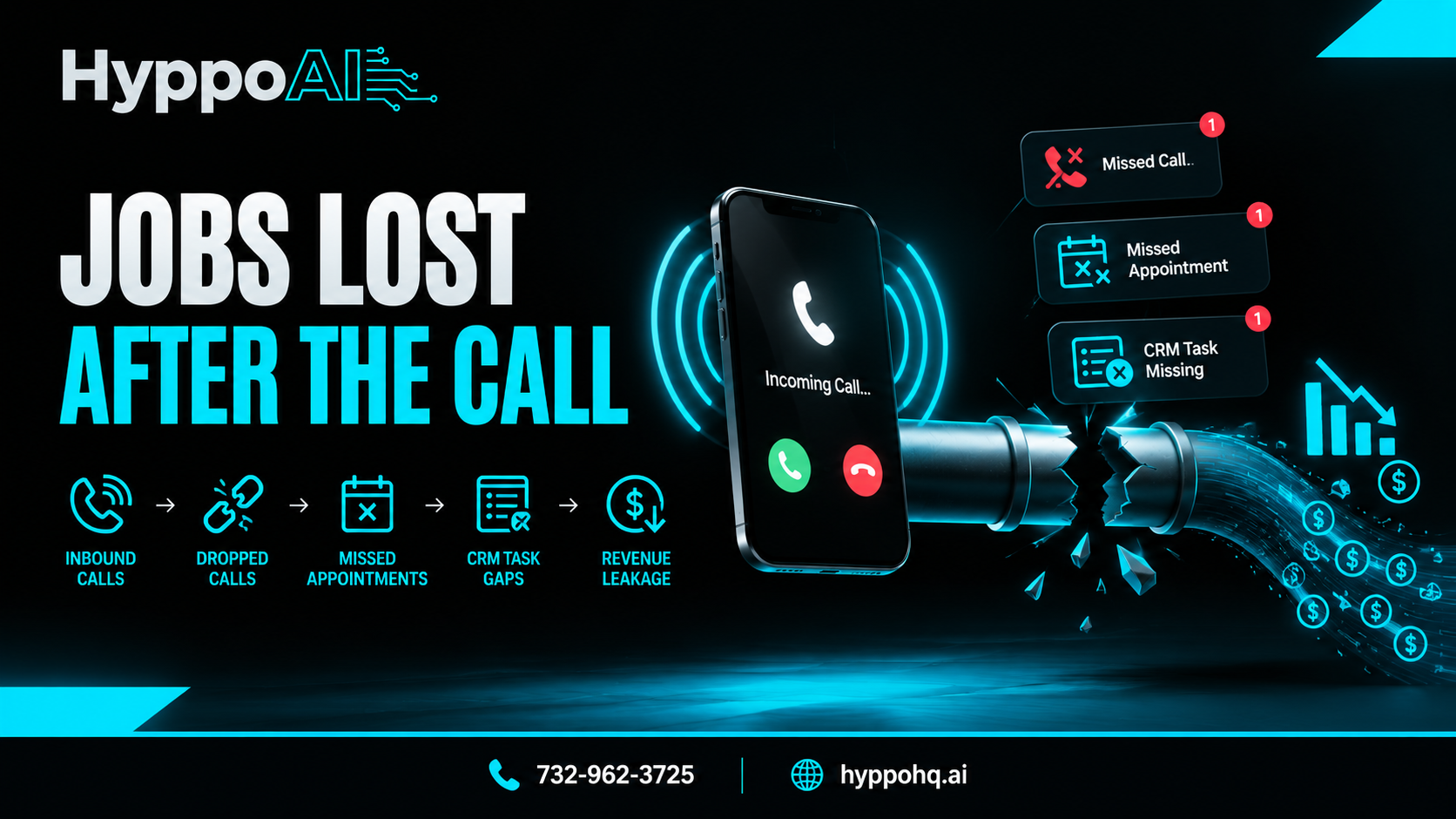
Why service businesses lose jobs after the phone rings
For many service businesses, the hardest part is getting the phone to ring.
You invest in ads, SEO, referrals, trucks, techs, and reputation. Then a lead finally calls.
But winning the job does not happen when the phone rings. It happens in the minutes, hours, and days after that first contact.
That is where many businesses quietly lose revenue.
If you are getting calls but not booking enough work, the problem is often not demand. It is what happens next: missed calls, slow response times, weak intake, inconsistent follow-up, and no system to keep the lead moving.
The real leak starts after first contact
Most owners assume a ringing phone means opportunity is handled.
It is not.
A call is just the start of the buying process. The customer is still deciding:
- Can this company help me?
- Can they respond fast?
- Do they sound organized?
- Will I trust them in my home or business?
- Is it easier to keep calling others?
If your process creates friction, the lead keeps shopping.
In service industries, speed and certainty matter. The company that responds clearly and consistently often wins, even if it is not the cheapest.
Why service businesses lose jobs after the phone rings
1. The call goes unanswered
This is the most obvious problem, and still one of the biggest.
Owners are in the field. Office staff are busy. Calls come in after hours, during lunch, or while someone is helping another customer.
When nobody answers, many leads do not leave a voicemail. They simply call the next company.
Even if you call back later, the moment may be gone.
2. Response time is too slow
A lead who needs HVAC, plumbing, electrical, roofing, cleaning, or restoration service is usually not in research mode for long.
They want a fast answer.
If your callback happens 30 minutes later, or worse, the next day, you are often already behind. The first business to respond with confidence has a major advantage.
3. The person answering is not trained to convert
Answering the phone is not the same as handling the lead well.
Common issues include:
- Sounding rushed or distracted
- Failing to ask the right qualifying questions
- Not collecting complete contact details
- Giving vague answers
- Forgetting to offer the next step
- Ending the call without booking or confirming follow-up
A weak first conversation creates doubt. Doubt costs jobs.
4. No one follows up consistently
A lot of jobs are not lost on the first call. They are lost in the silence after it.
Maybe the customer asked for an estimate. Maybe they wanted to check with a spouse. Maybe they were comparing options.
Without structured follow-up, those leads go cold fast.
Most service businesses rely on memory, sticky notes, or whoever has time. That is not a system. That is a gamble.
5. The handoff between office and field breaks down
This is a common operational problem.
The office takes the call, but the tech never gets the full details. The estimator is late to respond. The customer has to repeat everything. Nobody knows who owns the lead.
Every bad handoff lowers trust.
Customers notice when your internal process feels messy.
6. After-hours leads get ignored
A surprising number of high-intent leads come in after normal business hours.
That makes sense. People call when they get home, when they notice the issue, or when the emergency happens.
If your business stops responding at 5 p.m., you are likely leaving revenue on the table.
7. There is no visibility into what is being lost
You cannot fix what you do not measure.
Many businesses do not know:
- How many calls were missed
- How long callbacks take
- How many leads were never contacted again
- Which sources bring the best calls
- Where in the process jobs are being lost
Without that visibility, owners assume the problem is marketing when the real issue is follow-up.
The hidden cost of poor phone handling
Losing one job hurts.
Losing jobs repeatedly because of broken intake and follow-up hurts growth.
The costs show up as:
- Lower booking rates
- Higher marketing cost per customer
- Wasted ad spend
- Inconsistent revenue
- Frustrated staff
- Negative reviews from poor communication
- Fewer repeat and referral opportunities
This is why phone performance is not just an admin issue. It is a revenue system.
What better lead handling looks like
Service businesses that win more jobs usually make the process simple, fast, and consistent.
That means:
Fast response
Leads hear back quickly, even if the team is busy.
Consistent intake
Every caller is asked the right questions and entered correctly.
Clear next steps
The customer knows exactly what happens next.
Reliable follow-up
No estimate, voicemail, or inquiry gets forgotten.
Better coverage after hours
The business can still capture and respond to leads outside normal office times.
Where AI can help service businesses
For SMB service companies, this is one of the clearest use cases for AI.
AI is not just about content or chatbots. It can support the front line of revenue by helping businesses respond faster and follow up more consistently.
Depending on the workflow, AI can help with:
- Answering or routing inbound calls
- Capturing lead details accurately
- Responding after hours
- Triggering follow-up sequences
- Logging conversations into systems
- Reducing delays between inquiry and response
- Giving owners better visibility into missed opportunities
The goal is not to remove the human element. It is to remove the gaps that cause leads to disappear.
For service businesses, speed plus consistency is a serious competitive edge.
Simple questions every owner should ask
If you want to know whether your business is losing jobs after the phone rings, start here:
- How many calls do we miss each week?
- How fast do we call back missed leads?
- Do we have a standard intake process?
- Are after-hours calls handled in any structured way?
- Who owns follow-up on estimates and open leads?
- How many leads never get a second touch?
- Do we have reporting on call outcomes?
If the answers are unclear, the leak is probably bigger than it looks.
Fix the system, not just the symptom
A lot of owners respond by telling staff to "answer faster" or "follow up better."
That rarely solves the root issue.
The better move is to build a system that makes good response behavior automatic.
That may include:
- Better call coverage
- Tighter intake workflows
- Automated reminders
- AI reception and voice automation
- Lead tracking and reporting
- Defined ownership for follow-up
When the system improves, conversion improves.
Final thought
Service businesses do not just lose jobs because the phone did not ring enough.
They lose jobs because the process after the ring is slow, inconsistent, or invisible.
If your business is already generating calls, there may be more revenue in fixing response and follow-up than in buying more traffic.
HyppoAI helps SMB service businesses close the gap between inbound leads and booked jobs with smarter AI systems and automation. Visit https://hyppohq.ai or call +17329623725 to see how your business can respond faster, follow up better, and stop losing work after the first call.
