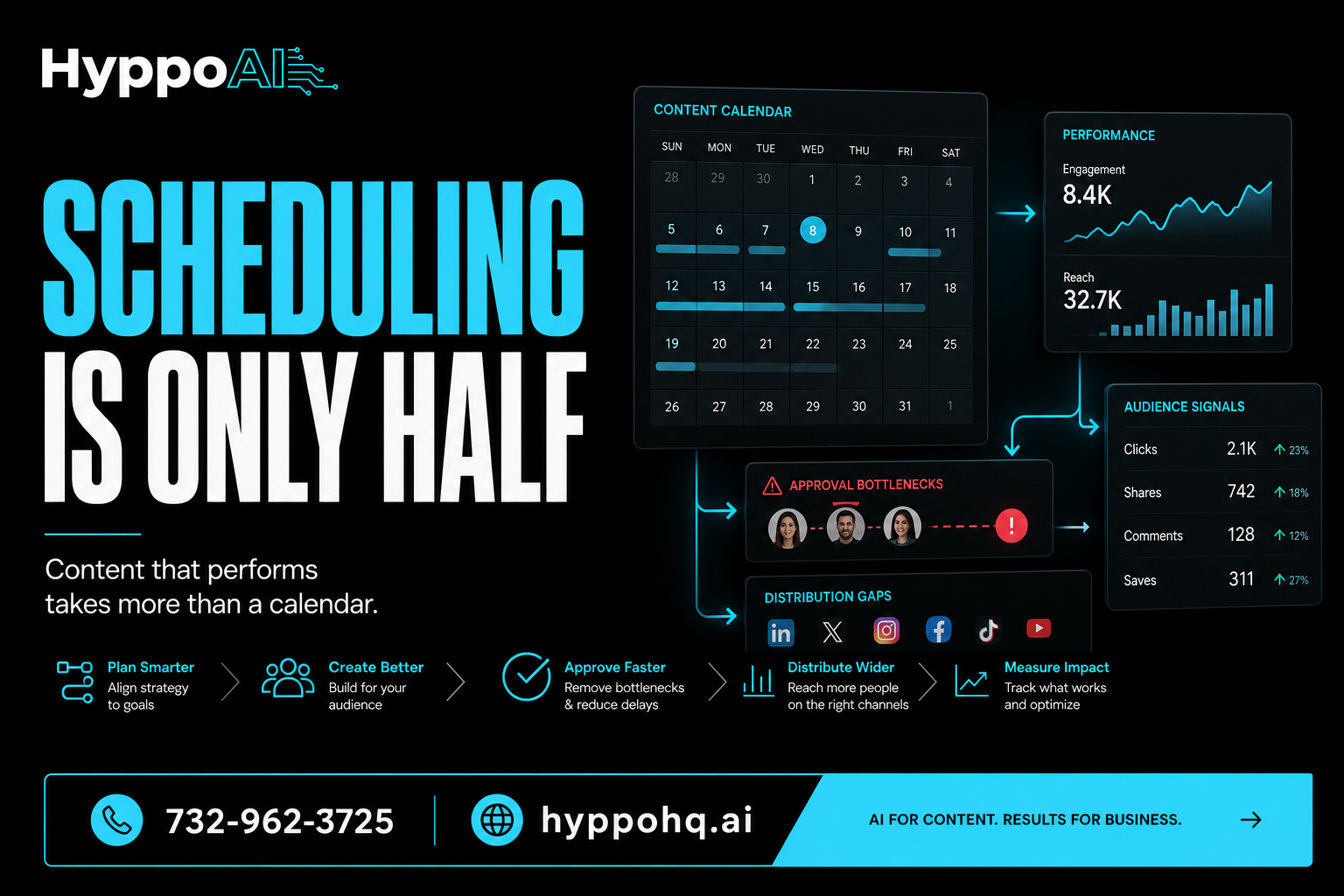
Why scheduling content is only half the problem
Most businesses think content marketing gets easier once the calendar is full.
Posts are drafted. Captions are approved. Everything is scheduled two weeks ahead. On paper, that feels like control.
But scheduling content is only half the problem.
The harder half is making sure that content actually does something for the business. If your posts are going out consistently but you are not seeing stronger engagement, better conversations, or more qualified leads, the issue is not usually the scheduler. The issue is the system behind the content.
For SMBs, this matters even more. Time is limited. Teams are lean. Every post should support awareness, trust, and pipeline growth. Publishing for the sake of consistency is not a strategy. It is just activity.
Why scheduled content often underperforms
Scheduling solves one operational challenge: getting content published on time.
That is useful, but it does not solve the strategic questions that actually drive outcomes:
- Who is this content for?
- What stage of the buyer journey does it support?
- What problem is it helping solve?
- What action should the audience take next?
- How will the business measure whether it worked?
A full content calendar can create the illusion of progress. The brand looks active, but the audience may not be moving any closer to trust or purchase.
This is where many SMBs get stuck. They confuse consistency with effectiveness.
The real job of content
Good content is not just there to fill a feed.
It should help your business do at least one of these things:
- Educate potential buyers
- Build authority in your niche
- Remove friction from the buying decision
- Answer common objections
- Create repeatable top-of-funnel visibility
- Start conversations that can turn into sales opportunities
If your content is not tied to one of those outcomes, scheduling more of it will not fix the problem.
Volume without direction usually creates noise.
Content needs a conversion path
One of the biggest gaps in most content strategies is the lack of a clear next step.
A post may be well written and visually polished, but if there is no logical path forward, the audience consumes it and moves on.
That path could be:
- Replying to a question
- Sending a direct message
- Booking a call
- Visiting a service page
- Downloading a resource
- Joining an email list
Without a conversion path, content becomes disconnected from revenue.
For SMBs, that is expensive. You are already investing time, tools, and team attention. The content should not end at publication.
Scheduling without strategy creates bottlenecks
A lot of teams use scheduling tools to create efficiency. That part makes sense.
But efficiency applied to weak content strategy just helps weak content go out faster.
Common bottlenecks include:
- Messaging that is too broad to resonate
- Captions that do not reflect buyer intent
- No differentiation from competitors
- Inconsistent brand voice
- No follow-up system for comments or inbound interest
- No analysis of what topics actually drive action
In other words, the calendar is organized, but the engine behind it is underdeveloped.
That is why content operations and content strategy have to work together.
What businesses should fix beyond scheduling
If you want content to produce business results, start by improving the system around it.
1. Clarify the audience
Content performs better when it speaks to a specific buyer with a specific problem.
Instead of posting for “everyone,” define:
- Your ideal customer type
- Their most urgent pain points
- The language they already use
- The objections that slow down decisions
- The outcomes they care about most
This gives your content relevance. Relevance is what earns attention.
2. Build content around business goals
Each piece of content should support a goal, not just a publishing slot.
Examples include:
- Brand awareness
- Lead generation
- Appointment booking
- Trust building
- Customer retention
- Sales enablement
When the goal is clear, the message becomes sharper and the call to action becomes easier to write.
3. Create repeatable content themes
Many SMBs struggle because they reinvent the wheel every week.
A better approach is to define a few repeatable themes that map to your expertise and your audience needs.
For example:
- Educational how-to posts
- Myth-busting industry takes
- Customer problem breakdowns
- Process explainers
- Behind-the-scenes operational insights
- FAQ-based content
This makes scheduling easier, but more importantly, it makes your content more coherent.
4. Improve follow-up, not just publishing
A post is not finished when it goes live.
Someone has to monitor comments, respond to questions, route leads, and track signals of interest. If that handoff does not exist, opportunities get lost.
This is where AI and automation can help SMBs significantly. Smart systems can support faster responses, better lead capture, and more consistent follow-up without forcing a small team to manually manage every interaction.
5. Measure what matters
Vanity metrics can be misleading.
Reach and likes are useful signals, but they are not the whole picture. Businesses should also track:
- Saves and shares
- Profile visits
- Direct messages
- Click-throughs
- Form fills
- Booked calls
- Lead quality
- Conversion rates by content type
When you measure downstream impact, you can identify what content actually supports growth.
Where AI fits into the picture
AI does not replace strategy, but it can strengthen execution.
For SMBs, that is a major advantage.
The right AI workflow can help teams:
- Generate content ideas based on real customer questions
- Draft captions faster while keeping brand voice consistent
- Repurpose strong-performing content into multiple formats
- Analyze engagement patterns
- Route inbound leads more efficiently
- Support timely follow-up after content triggers interest
This is the difference between using AI as a shortcut and using AI as infrastructure.
If your only goal is to schedule faster, you are underusing the technology. The bigger opportunity is building a smarter content system that connects publishing, engagement, and follow-up.
A better way to think about content operations
Instead of asking, “How do we schedule more posts?” ask better questions:
- What content consistently moves buyers toward action?
- Where are leads dropping off after engaging with content?
- Which topics create trust fastest?
- How quickly are we responding when people show interest?
- What parts of the workflow can be automated without losing quality?
Those questions lead to operational improvements, not just calendar maintenance.
Consistency still matters, but it is not enough
To be clear, scheduling is still important.
Consistency builds familiarity. It keeps your brand visible. It reduces last-minute scrambling.
But consistency without message-market fit, distribution logic, and follow-up discipline will only take you so far.
That is why scheduling content is only half the problem.
The other half is building a system that turns content into business momentum.
Final takeaway
If your business is posting regularly but not seeing meaningful results, do not assume you need more content. You may need a better content operation.
Start with strategy. Tighten the message. Define the next step. Improve follow-up. Then use AI to make the whole process more efficient and scalable.
That is how SMBs move from “we are posting” to “our content is working.”
If you want to build smarter AI-powered systems for content, follow-up, and growth, visit HyppoAI at https://hyppohq.ai or call +17329623725 to learn more.
