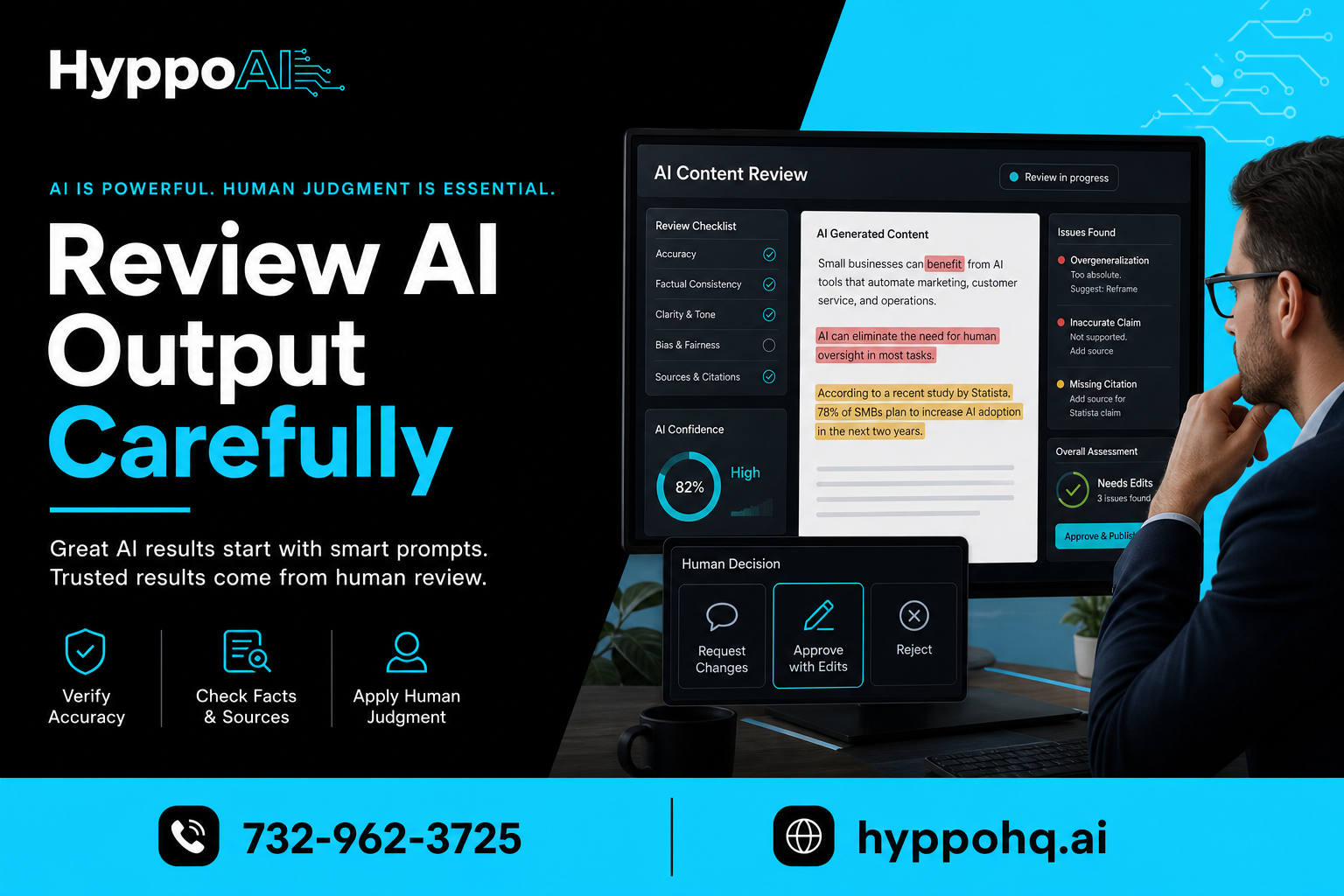
Why reviewing ChatGPT output is still important for SMBs
ChatGPT can help small and midsize businesses move faster.
It can draft emails, summarize meetings, write SOPs, brainstorm campaigns, and speed up customer communication. That kind of leverage matters when your team is trying to do more with less.
But there is a mistake many businesses make early: they treat AI output like finished work.
That is where problems start.
Reviewing ChatGPT output is still important because AI is a strong assistant, not a final decision-maker. It can produce useful first drafts, but it can also miss context, flatten nuance, introduce errors, or sound confident while being wrong.
If you want better results from AI, the goal is not to avoid using it. The goal is to use it with oversight.
ChatGPT is fast, but speed is not the same as accuracy
One reason ChatGPT feels so powerful is that it responds instantly. For busy SMB owners and operators, that speed is attractive.
But fast output can create a false sense of reliability.
A polished answer is not always a correct answer. AI can:
- Misstate facts
- Overgeneralize from limited context
- Invent details that were never provided
- Miss brand-specific language
- Suggest actions that do not fit your workflow
This matters more in business settings than many people realize. A small mistake in a social post may be manageable. A small mistake in a customer email, internal process, proposal, or policy can create confusion, lost trust, or wasted time.
That is why review is not optional. It is part of responsible AI use.
Human review protects brand trust
Your business does not just communicate information. It communicates judgment.
Customers, leads, and team members are not only evaluating what you say. They are evaluating whether your business sounds credible, clear, and consistent.
ChatGPT can help generate language, but it does not fully understand your brand the way your team does. Even with strong prompting, output can still feel:
- Too generic
- Too wordy
- Too casual or too formal
- Slightly off-brand
- Misaligned with your customer's real concerns
For SMBs, trust is a competitive advantage. If your content starts sounding inconsistent or inaccurate, people notice.
Reviewing AI output helps make sure your messaging still reflects your standards, voice, and positioning.
Context is where AI often breaks down
ChatGPT works by predicting likely language patterns. It is powerful, but it does not automatically know the full reality of your business.
It may not understand:
- Your exact service model
- Your local market dynamics
- Internal policies and constraints
- Customer history
- Sensitive legal or operational details
- The difference between what sounds good and what is actually true
That gap matters.
For example, an AI-generated response might recommend a process that looks efficient on paper but would create friction for your actual team. It may draft a message that sounds persuasive but misses what your customers really care about. It may summarize a meeting but leave out the one detail that changes the decision.
Review is how you close the context gap.
AI is strongest as a first draft engine
A practical way to think about ChatGPT is this: it is often best at getting you to version one faster.
That is valuable.
Starting from a blank page is slow. Starting from a decent draft is faster. But a draft still needs review before it becomes something you publish, send, or operationalize.
This is especially true for:
Customer-facing content
Anything a customer sees should be checked for:
- Accuracy
- Tone
- Clarity
- Brand fit
- Specificity
Internal documentation
SOPs, summaries, and training materials should be reviewed for:
- Correct process steps
- Missing exceptions
- Team-specific language
- Actionability
Strategic recommendations
If ChatGPT is helping with planning, analysis, or decision support, someone still needs to validate:
- Assumptions
- Relevance
- Risks
- Feasibility
The more important the output, the more important the review.
Reviewing output does not slow you down when done correctly
Some teams worry that reviewing AI output cancels out the time savings.
Usually, that only happens when the workflow is weak.
A better approach is to build a simple review system based on risk.
Use a low, medium, high review model
Low-risk content might include early brainstorming, rough outlines, or internal idea generation. Review can be quick.
Medium-risk content might include marketing copy, social captions, or internal summaries. These need a more careful pass.
High-risk content might include customer commitments, pricing language, legal-adjacent content, process instructions, or anything tied to compliance or reputation. These require strong human review.
This framework helps your team move fast without treating every output the same.
What to review before using ChatGPT output
If your team uses ChatGPT regularly, create a simple checklist.
Review for these five areas:
1. Accuracy
Are the facts correct? Were any assumptions added? Does the output include claims you cannot verify?
2. Relevance
Does the response actually solve the problem you asked about, or is it just plausible-sounding filler?
3. Context fit
Does it align with your business model, customer expectations, and internal reality?
4. Brand voice
Does it sound like your company, or does it sound like generic AI copy?
5. Actionability
Can someone use this immediately, or does it still need clarification?
A short checklist like this can dramatically improve AI output quality across your business.
The risk is not that AI makes mistakes
AI making mistakes is normal.
The real risk is when people stop noticing them.
As teams get more comfortable with AI, they can become less critical of the output. That is when weak information starts slipping into real workflows.
Over time, that can lead to:
- Sloppy communication
- Inconsistent customer experience
- Poor internal documentation
- Bad decisions based on unchecked assumptions
The solution is not fear. It is discipline.
Businesses that get the most value from AI are not the ones that trust it blindly. They are the ones that combine automation with review, judgment, and clear systems.
Better prompts help, but they do not replace oversight
Yes, better prompting improves output.
If you give ChatGPT stronger context, examples, constraints, and goals, you will usually get better drafts. That is worth doing.
But even excellent prompts do not eliminate the need for review.
Why? Because business communication is not just about generating text. It is about making sure the final output is useful, accurate, and aligned with the real-world situation.
Prompting improves efficiency.
Review protects quality.
You need both.
The smartest AI workflow is human-in-the-loop
For SMBs, the best approach is not full manual work and not full autopilot.
It is a human-in-the-loop system.
That means:
- Use AI to speed up drafting and idea generation
- Use people to verify, refine, and approve
- Create repeatable standards for what gets reviewed
- Improve prompts over time based on common errors
This approach keeps the time savings while reducing the downside.
It also helps your team build confidence in AI the right way: through structured use, not blind trust.
Final takeaway
Reviewing ChatGPT output is still important because AI is a productivity tool, not a substitute for judgment.
If you want better business results, do not ask whether AI can produce content quickly. Ask whether your team has a process to make that content accurate, relevant, and usable.
That is where the real advantage is.
If you want help building practical AI workflows for your business, HyppoAI helps SMBs use AI in ways that are efficient, reliable, and grounded in real operations. Visit https://hyppohq.ai or call +17329623725 to learn more.
