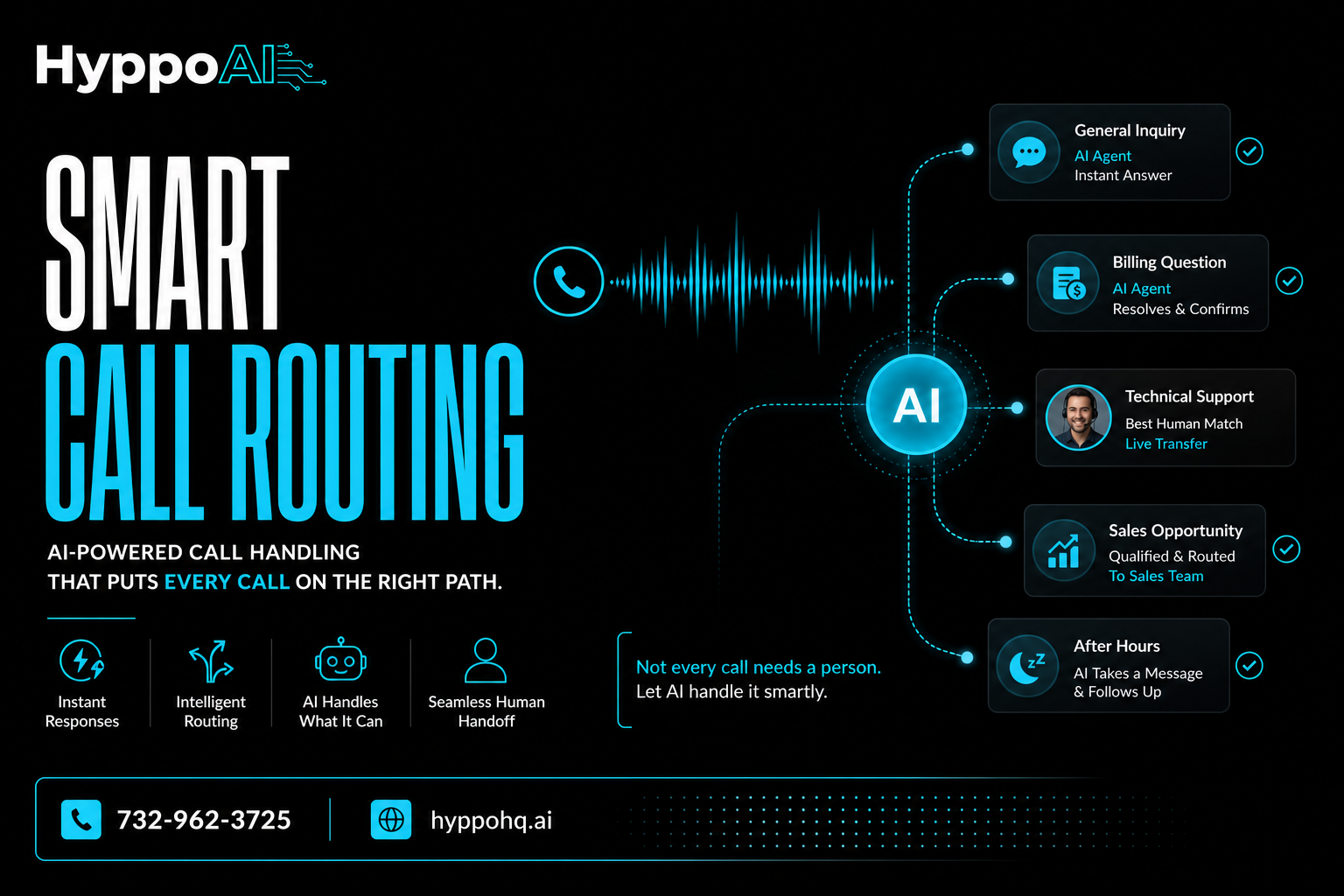
Why not every call needs a human right away
Every business wants to deliver fast, helpful service. But that does not mean every inbound call needs a person to jump in immediately.
For small and mid-sized businesses, that assumption creates a costly bottleneck. Staff get interrupted, simple questions eat up valuable time, and high-value calls can get buried under routine requests. The result is slower response times, more missed opportunities, and a team that feels stretched.
The better approach is simple: let humans handle the calls that truly require human judgment, and let automation handle the rest.
That is where AI voice systems and AI receptionists create leverage.
The problem with sending every call to a person
When every call goes straight to a human, the process sounds customer-friendly in theory. In practice, it often creates friction.
A live team member may be pulled away from:
- Sales conversations
- In-person customers
- Scheduling and operations
- Complex support issues
- Revenue-generating work
At the same time, many incoming calls are repetitive. People may want business hours, service area details, pricing basics, appointment availability, or status updates. These calls matter, but they do not always require a human right away.
If your best people are constantly answering the same questions, you are using expensive talent on low-complexity tasks.
What AI should handle first
AI is not about replacing people. It is about filtering, organizing, and accelerating communication so your team can work smarter.
An AI receptionist can often handle the first step of a call by:
- Answering common questions instantly
- Capturing caller information
- Qualifying leads
- Routing urgent calls to the right person
- Scheduling appointments
- Taking messages after hours
- Creating a consistent first response every time
This gives callers immediate attention without forcing your staff to stop everything.
Routine questions do not need a live handoff
Many callers simply need information. If someone wants to know your hours, service offerings, or whether you serve their area, AI can answer in seconds.
That speed improves the customer experience while reducing internal interruptions.
Lead qualification should happen before the handoff
Not every inbound call is sales-ready. Some people are researching. Some are outside your target market. Some need a different service than what you offer.
AI can ask a few smart questions before passing the call along. That means your team spends more time talking to qualified opportunities and less time sorting through noise.
Urgent issues can still reach a human fast
This is the key point many businesses miss. Using AI first does not mean hiding from customers. It means creating a smarter path.
If a caller has an urgent issue, AI can identify that and escalate immediately. The right calls reach the right people faster because the system is not clogged with routine requests.
When a human should step in immediately
Of course, some calls do need a person right away.
Examples include:
- High-intent sales inquiries
- Escalated customer complaints
- Sensitive billing or account issues
- Emergency service needs
- Complex cases requiring judgment or negotiation
The goal is not to remove the human element. The goal is to reserve it for the moments where it has the highest value.
That is a better experience for both the customer and your team.
Why this matters for SMBs
Large companies can throw headcount at communication problems. Most SMBs cannot.
Small and mid-sized businesses need systems that help them:
- Respond faster
- Miss fewer leads
- Protect staff time
- Stay consistent after hours
- Scale without adding unnecessary overhead
If your phones ring all day, every interruption has a cost. It affects focus, scheduling, customer service, and follow-up.
An AI-first call flow helps you create structure without sacrificing responsiveness.
The business case for AI-first call handling
There is a direct operational upside to not routing every call to a human immediately.
Lower interruption cost
Every unscheduled interruption breaks concentration. For busy teams, that creates hidden inefficiency throughout the day.
AI can absorb the repetitive front-end conversations so staff can stay focused on meaningful work.
Better speed to response
Customers do not like waiting. They want acknowledgment now, not later.
AI can answer instantly, 24/7. Even when a human follow-up is needed, the caller has already been engaged and their information has already been collected.
Improved lead capture
Missed calls often mean missed revenue. If no one answers, the prospect may move on to the next option.
AI helps ensure every call gets a response, every time. That consistency can improve conversion opportunities, especially outside normal business hours.
Smarter use of your team
Your employees should spend time where they create the most value. That usually means closing deals, solving complex problems, and building relationships, not repeating the same basic answers all day.
Common concern: will it feel impersonal?
This is a fair question. Poor automation feels robotic and frustrating. Good automation feels fast, clear, and useful.
The difference comes down to design.
A well-built AI voice experience should:
- Sound natural and professional
- Be easy to understand
- Get to the point quickly
- Offer a clear path to a human when needed
- Reflect your business processes accurately
Customers usually care less about whether the first response is human and more about whether it is helpful.
If they get answers quickly and are routed correctly, the experience often feels better, not worse.
How to decide which calls should go to AI first
A simple way to start is to review your most common inbound call types.
Ask:
- Which calls are repetitive?
- Which calls require judgment?
- Which calls are urgent?
- Which calls should be scheduled?
- Which calls need qualification before transfer?
Once you map those patterns, it becomes easier to build a call flow that protects your team while improving response time.
A practical rule of thumb
Use AI first for predictable, repeatable, high-volume interactions.
Use humans for nuanced, emotional, urgent, or high-value conversations.
That balance is where the real efficiency comes from.
AI is not a wall, it is a filter
Businesses sometimes worry that automation creates distance. In reality, the right system does the opposite.
It removes friction.
Instead of making every caller wait for a person, AI gives each caller an immediate response, gathers the right context, and moves them to the next best step. That may be a direct answer, a scheduled appointment, a message capture, or a live transfer.
In other words, AI should not block communication. It should improve the path.
The bottom line
Not every call needs a human right away because not every call requires human judgment right away.
When businesses treat every inbound call the same, they waste time, create internal chaos, and increase the odds of missed leads. When they use AI to answer, qualify, and route intelligently, they create a faster and more scalable system.
That means your team can focus on the conversations that actually need them.
If you want to build a smarter call flow for your business, HyppoAI can help. Visit https://hyppohq.ai or call +17329623725 to learn how AI voice automation can support your team without slowing down your customer experience.
