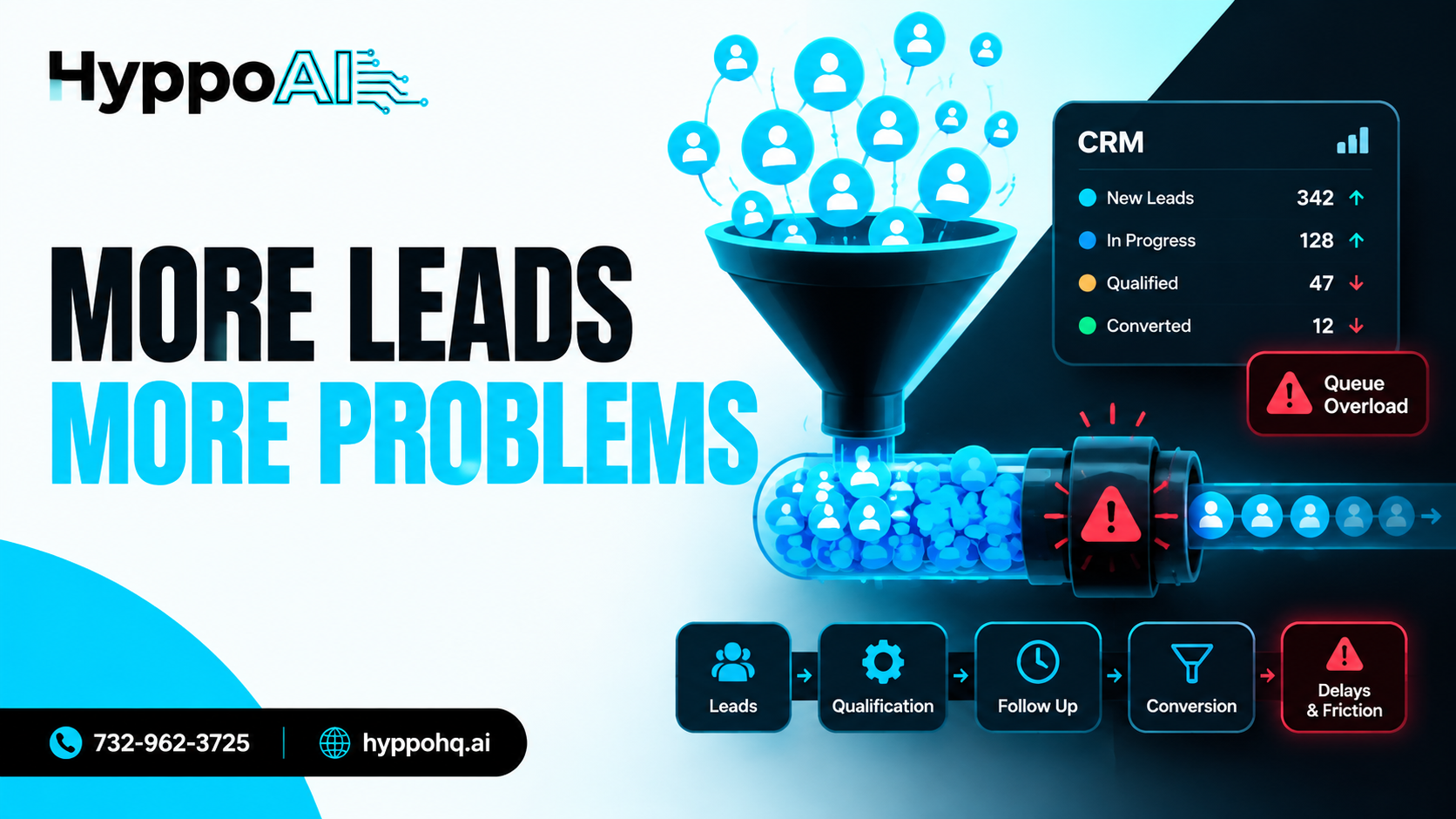
Why more leads can actually create more problems
More leads should be a good thing.
But for many small and midsize businesses, a spike in demand does not create growth. It creates friction.
The inbox gets flooded. Calls get missed. Follow-ups slow down. The team gets reactive. And the business owner starts wondering why marketing is working while operations feel worse.
That is the hidden problem with chasing volume before building capacity.
If your business is generating more inquiries but closing less efficiently, the issue is not always lead quality. Often, the real problem is what happens after the lead comes in.
More leads amplify broken systems
Leads do not fix operational gaps. They expose them.
When your process is manual, inconsistent, or dependent on one overloaded person, every new inquiry adds pressure. What looked like momentum quickly turns into missed opportunities.
Common symptoms include:
- Slower response times
- Missed calls during busy hours
- Leads falling through the cracks
- Double entry between tools
- Inconsistent follow-up
- Sales conversations happening too late
- Team burnout from constant interruptions
A business can be “busy” and still leak revenue every day.
That is why more top-of-funnel activity is not automatically better. If your backend cannot handle the load, increased lead flow can actually lower conversion rates.
The cost of unmanaged lead volume
Most businesses measure lead generation.
Fewer measure lead handling.
That is where problems start.
A new lead is time-sensitive. If nobody responds quickly, the prospect moves on, loses interest, or contacts a competitor. Even strong demand can underperform when speed and consistency are missing.
The costs show up in several ways:
Revenue loss
Every missed call or delayed follow-up reduces the chance of booking the job, consultation, or sale.
Lower marketing ROI
You pay to generate attention, then lose value because the handoff process is weak.
Team overload
More leads often mean more interruptions, more context switching, and more admin work for staff who should be focused on higher-value tasks.
Poor customer experience
Prospects expect fast, clear communication. If the first interaction feels disorganized, trust drops early.
Bad decision-making
When systems are messy, leaders often assume they need more leads when what they really need is better lead management.
Why this happens in SMBs
For SMBs, growth rarely breaks because of effort. It breaks because of process.
Many teams build their lead flow in stages:
- A website form gets added
- Calls go to a shared phone
- Someone checks messages manually
- Follow-up lives in a spreadsheet or inbox
- Reminders depend on memory
This works at low volume.
Then marketing improves. Referrals increase. Ads start performing. Suddenly the same process that felt manageable becomes the bottleneck.
The issue is not that more leads are bad. The issue is that unmanaged complexity scales faster than most businesses expect.
More leads require faster systems, not just more effort
When lead volume rises, many businesses respond by asking people to work harder.
That usually fails.
You cannot reliably scale speed, consistency, and follow-up with memory alone. You need systems that reduce delay and remove manual friction.
That includes:
- Immediate response workflows
- Clear routing for calls and messages
- Automated follow-up sequences
- Centralized lead tracking
- Visibility into response times and outcomes
This is where AI and automation become practical, not theoretical.
Used correctly, they help SMBs handle more demand without sacrificing responsiveness.
Where AI can solve the real problem
AI is not just for generating content or answering novelty questions. In a lead-driven business, it can improve the exact areas where growth tends to create problems.
1. Instant first response
When a lead comes in, speed matters.
AI-powered systems can acknowledge inquiries immediately, capture key details, and keep the conversation moving while your team handles higher-value work.
2. Missed call coverage
A missed call is often a missed sale.
AI receptionists and voice automation can answer after-hours or overflow calls, gather intent, and ensure leads do not disappear just because your staff is unavailable.
3. Consistent follow-up
Most lost leads are not lost because they said no. They are lost because nobody followed up properly.
Automation can trigger reminders, texts, emails, and next steps so prospects stay engaged.
4. Better qualification
Not every lead needs the same path.
AI workflows can help sort, prioritize, and route inquiries based on urgency, fit, or service type, reducing wasted time.
5. Operational visibility
When your lead process is systemized, you can finally see where delays happen and where conversions drop.
That makes better decisions possible.
What to fix before you chase more leads
If your pipeline feels chaotic, do not start by increasing ad spend.
Start by auditing your lead handling process.
Ask these questions:
- How fast do we respond to new leads?
- What happens when we miss a call?
- Who owns follow-up, and is it consistent?
- Are leads tracked in one place?
- Where do prospects get stuck or go cold?
- How much of this process depends on memory?
If the answers are unclear, that is the opportunity.
Focus on these priorities first
- Reduce response time
- Eliminate missed handoffs
- Standardize follow-up
- Centralize lead data
- Automate repetitive communication
The goal is not to remove the human element.
The goal is to make your team faster, more reliable, and less buried in repetitive tasks.
Growth should feel controlled, not chaotic
Healthy growth is not just about generating attention.
It is about building a business that can absorb demand without breaking the customer experience.
More leads only help when your systems can convert them.
Otherwise, volume creates noise:
- More inquiries to manage
- More pressure on staff
- More delays
- More missed revenue
- More frustration for everyone involved
The smarter path is simple: fix the funnel after the click, call, or form submission.
That is where real scale happens.
The takeaway
More leads can absolutely create more problems.
Not because demand is bad, but because weak systems get exposed under pressure.
For SMBs, the answer is not just “get more leads.” It is “build a better response engine.”
When you combine strong operations with AI-powered automation, growth becomes easier to manage, easier to measure, and far more profitable.
If your business is generating interest but struggling to keep up, HyppoAI helps SMBs build smarter systems for lead handling, follow-up, and automation. Visit https://hyppohq.ai or call +17329623725 to learn how to turn more leads into better outcomes.
