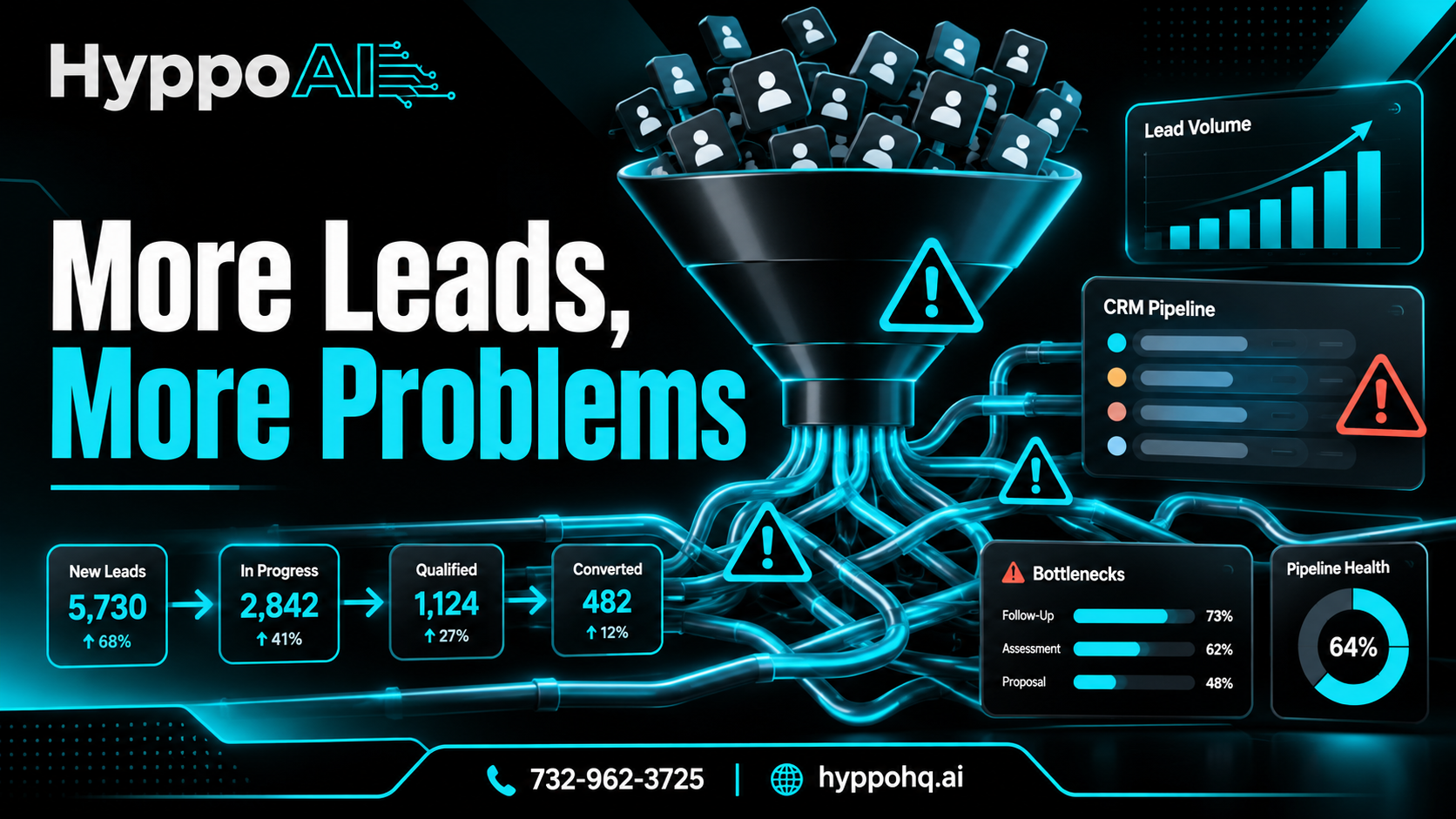
Why more leads can actually create more problems
More leads usually sound like the answer.
More traffic. More calls. More form fills. More opportunities.
But for many small and midsize businesses, more leads do not solve problems. They expose them.
If your team is already stretched, your follow-up is inconsistent, or your process depends on people remembering what to do next, adding more leads can create more chaos instead of more revenue.
That is the part many businesses miss.
Growth is not just about generating demand. It is about building the operational capacity to handle demand well.
At HyppoAI, we see this pattern often with SMBs. The issue is rarely a lack of interest. The issue is what happens after that interest shows up.
More leads amplify weak systems
Leads do not fix broken workflows. They put pressure on them.
When your business gets busier, every gap becomes more expensive:
- Missed calls turn into lost revenue
- Slow replies reduce conversion rates
- Manual admin work piles up
- Team members forget follow-ups
- Hot prospects go cold while staff handles existing customers
- Reporting gets messy, so decision-making gets worse
A business can look like it is growing on the surface while profitability and customer experience quietly decline underneath.
That is why more leads can create more problems. Volume without systems creates friction.
The hidden costs of lead overload
A lot of owners assume the main risk of poor lead handling is a missed sale.
That is only part of the picture.
Lead overload also creates secondary problems that affect the entire business.
Slower response times
When inquiries increase, response times usually slip first.
A prospect who would have converted with a fast reply may move on if they wait too long. In competitive service markets, speed matters. If your team cannot respond quickly and consistently, more leads simply mean more missed windows.
Lower lead quality perception
Sometimes owners think lead quality has dropped when the real issue is process failure.
If follow-up is delayed, inconsistent, or incomplete, even good leads start to look bad. The problem is not always the marketing. It is often the handoff.
Team burnout
More inbound demand can overwhelm staff fast.
When employees are constantly reacting to calls, messages, scheduling, and follow-up tasks, they have less time for focused work. That creates stress, errors, and turnover risk.
Poor customer experience
Leads are forming an opinion of your business from the first interaction.
If they reach voicemail, wait too long, repeat themselves, or get inconsistent communication, trust drops early. More leads can damage your reputation if the front-end experience is not built to scale.
Bad forecasting and decision-making
Without clear systems, businesses lose visibility.
You may not know:
- Which leads were contacted
- Which source produced the best customers
- How many opportunities were lost to slow follow-up
- Where prospects dropped off
- Whether your team is actually at capacity
That makes it harder to invest confidently in marketing, hiring, or automation.
Why this happens so often in SMBs
Small and midsize businesses often grow faster than their internal systems.
In the early stage, that makes sense. A lean team can handle a manageable number of leads through manual effort, shared inboxes, sticky notes, and memory.
But once volume increases, informal processes break.
What worked at 10 leads a week does not work at 100.
That is where many businesses get stuck. They keep trying to solve an operations problem with more marketing.
The result is predictable:
- More spend
- More inbound activity
- More pressure on staff
- More missed opportunities
- More frustration for owners
The real bottleneck is not always lead generation. It is lead management.
What to fix before adding more leads
If your business wants growth that is sustainable, the goal is not just more leads. The goal is better lead handling.
Here are the core areas to tighten first.
1. Speed to lead
The first few minutes matter.
Create a process that ensures every lead gets an immediate response or acknowledgment. That could include:
- Automated text confirmation
- Instant email reply
- AI-assisted intake
- Smart call routing
- Appointment request workflows
Fast response builds trust and keeps prospects engaged.
2. Consistent follow-up
Most leads do not convert on the first touch.
If follow-up depends on someone remembering to call back later, opportunities will slip through. Build a repeatable sequence for every inquiry so no lead gets ignored.
Consistency beats good intentions.
3. Centralized lead tracking
If lead data lives across phones, inboxes, DMs, and spreadsheets, visibility disappears.
Use one system to track:
- Lead source
- Contact status
- Next action
- Appointment outcome
- Conversion result
When everything is visible, management improves.
4. Capacity planning
More leads only help if your business can serve them well.
Before increasing volume, ask:
- Can the team respond fast enough?
- Can operations handle more booked work?
- Are there enough appointment slots?
- Is onboarding smooth?
- Will service quality hold up?
If the answer is no, the next step is not more ads. It is better infrastructure.
5. Automation where it makes sense
Automation is not about removing the human element. It is about removing avoidable friction.
For SMBs, that often means automating repetitive front-end tasks such as:
- Answering common questions
- Capturing lead details
- Routing inquiries
- Sending reminders
- Nudging follow-ups
- Logging conversations
That frees your team to focus on high-value conversations instead of repetitive admin.
The smarter growth model
Healthy growth comes from alignment between marketing, follow-up, and operations.
That means your business should be able to:
- Capture every opportunity
- Respond quickly
- Follow up consistently
- Track outcomes clearly
- Scale without overwhelming the team
When those pieces are in place, more leads become an asset.
Without them, more leads become noise.
This is why businesses sometimes feel disappointed after a successful campaign. The campaign worked. The system behind it did not.
More leads are only valuable if your business can convert them
Lead generation gets attention because it is visible.
But conversion infrastructure is what determines whether growth is profitable.
If your business is dealing with missed calls, delayed replies, inconsistent intake, or overloaded staff, the answer may not be to push harder on top-of-funnel marketing.
The better move is to strengthen the systems that turn interest into revenue.
That is where AI can make a real difference for SMBs. Used correctly, it helps businesses respond faster, reduce manual workload, and create a more reliable lead journey without adding unnecessary complexity.
More leads are not automatically better.
Better systems are.
If you want to build a lead handling process that scales without creating more chaos, HyppoAI can help. Visit https://hyppohq.ai or call +17329623725 to learn how smarter AI systems can support growth for your business.
