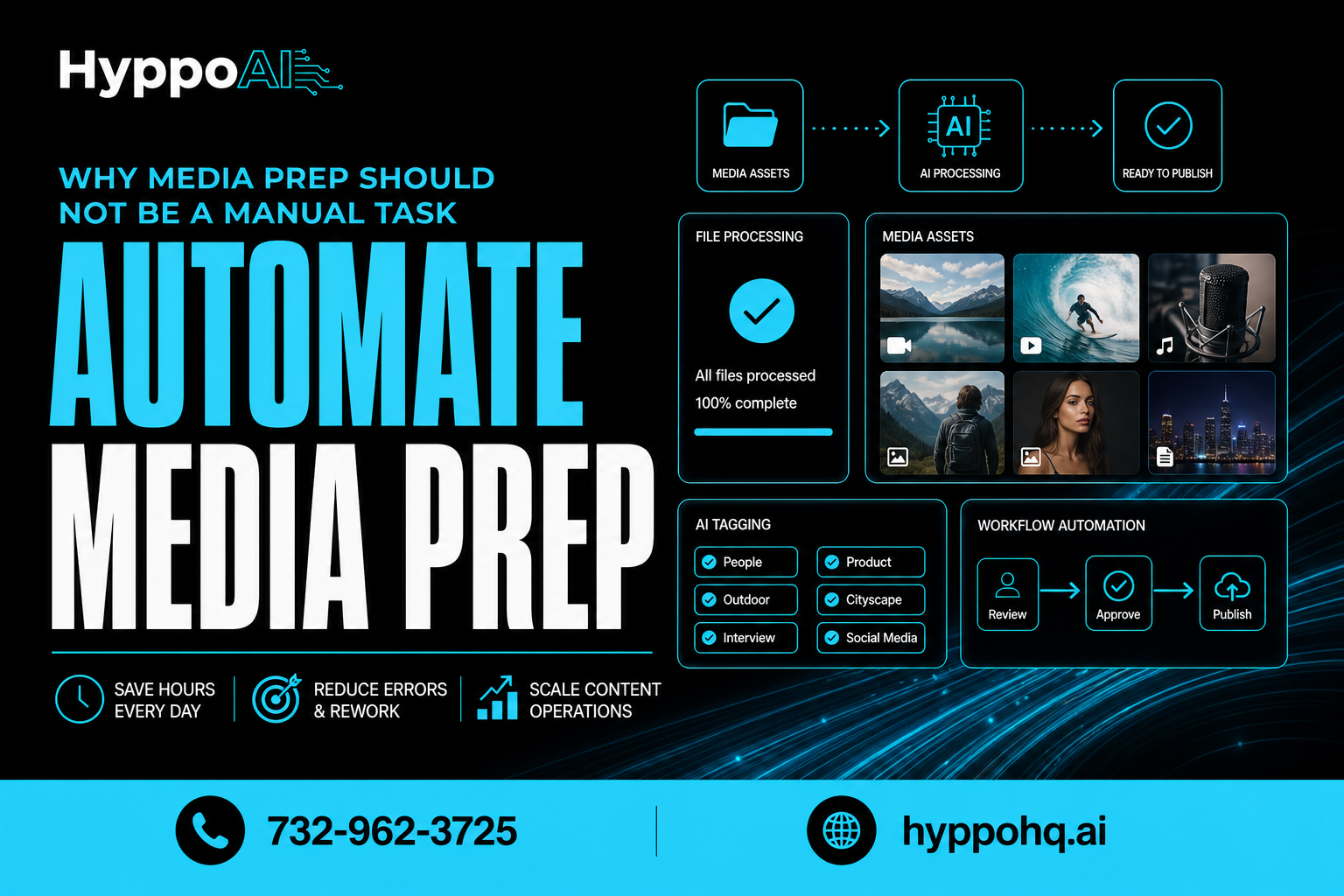
Why media prep should not be a manual task
Manual media prep looks manageable at first. Rename a few files, resize a few assets, organize a few folders, and move content from one system to another. But as volume grows, that simple process turns into a bottleneck.
For small and mid-sized businesses, time is too valuable to spend on repetitive production tasks. When media prep depends on people doing the same steps over and over, errors increase, turnaround slows, and scaling becomes harder than it should be.
At HyppoAI, we see a simple truth: if a process is repetitive, rules-based, and critical to delivery, it should not stay manual.
What media prep actually includes
Media prep is more than uploading files. It often includes a chain of small but important tasks that must happen before content is ready for publishing, distribution, storage, or analysis.
Typical media prep work can include:
- Renaming files to match naming conventions
- Converting formats for different platforms
- Resizing images or compressing video
- Tagging assets with metadata
- Organizing files into folders or libraries
- Checking quality and completeness
- Routing assets to the right team or system
Each task may seem minor on its own. Together, they create a process that can consume hours every week.
The problem with manual media prep
Manual work introduces friction into workflows that should be fast and predictable. The more content your business handles, the more expensive that friction becomes.
Human error is inevitable
Even strong teams make mistakes when they are asked to repeat the same actions all day. A file gets mislabeled. A version gets uploaded to the wrong folder. A required format is missed. Metadata is incomplete.
These are not signs of a bad team. They are signs of a fragile process.
When your workflow depends on memory, attention, and repeated clicking, inconsistency is built in.
It does not scale well
A manual process may work with 10 files. It starts breaking at 100. At 1,000, it becomes a serious operational issue.
Growth exposes weak systems. If your team needs to add more people just to keep up with media prep, the process is not scaling. Labor is being used to patch a workflow problem instead of driving value.
It slows down delivery
Every manual step adds delay. If someone has to review, rename, sort, convert, and move assets before the next stage can begin, your pipeline is only as fast as that person’s availability.
That delay affects:
- Campaign launches
- Social publishing schedules
- Internal approvals
- Client delivery timelines
- Reporting and analysis
Speed matters, especially for SMBs competing against larger organizations with more resources.
It pulls talent away from higher-value work
Your team should be focused on strategy, creative quality, customer communication, and growth. Manual media prep forces skilled people to spend time on repetitive operational work instead.
That is not an efficient use of talent. It is a hidden cost that often goes unnoticed because the work simply becomes part of the routine.
Why automation is the better approach
Automation does not just make media prep faster. It makes the process more reliable, more consistent, and easier to manage.
Standardization becomes automatic
When workflows are automated, rules are applied the same way every time. Files can be renamed consistently. Formats can be converted based on predefined logic. Assets can be routed to the correct destination without guesswork.
That consistency improves downstream performance across teams and systems.
Teams save time immediately
One of the clearest benefits of automation is time recovery. Instead of spending hours on repetitive steps, teams can focus on work that requires judgment and creativity.
That can mean:
- Faster campaign execution
- Shorter production cycles
- Less back-and-forth between departments
- More capacity without adding headcount
For SMBs, that efficiency can create a real competitive advantage.
Quality control improves
Automated workflows can check for missing fields, incorrect formats, duplicate files, or incomplete uploads before assets move forward. That reduces rework and helps catch issues earlier.
A strong process does not rely on someone noticing a problem late. It is designed to prevent the problem from moving downstream in the first place.
Workflows become easier to measure
Manual processes are hard to track. It is difficult to know where delays happen, how much time is being spent, or which errors occur most often.
Automation creates visibility. Once a workflow is structured, businesses can measure throughput, identify bottlenecks, and improve performance over time.
That kind of operational clarity is hard to achieve when most of the work lives in inboxes, spreadsheets, and memory.
Signs your media prep process needs automation
If any of these sound familiar, manual media prep is likely costing your business more than you think:
- Your team spends hours each week organizing or converting assets
- Files are often hard to find or inconsistently named
- Publishing or delivery is delayed by repetitive prep work
- Errors show up because steps are skipped or handled differently
- Volume is increasing, but the process has not changed
- Team members are doing operational tasks instead of strategic work
These are not minor annoyances. They are signals that the workflow needs redesign.
Automation is not just for large enterprises
Many SMBs assume workflow automation is too complex, too expensive, or only useful at enterprise scale. That assumption keeps inefficient processes in place longer than necessary.
The reality is simpler. If your business handles recurring media tasks, automation can provide value now, not later.
You do not need to automate everything at once. Start with the highest-friction tasks:
- File intake and sorting
- Format conversion
- Naming conventions
- Metadata tagging
- Approval routing
Small improvements in these areas can create major gains in speed and consistency.
The strategic case for AI in media workflows
AI takes automation further by helping businesses handle more complexity without adding manual overhead. Instead of just following static rules, AI-powered systems can support smarter classification, tagging, prioritization, and workflow decisions.
For SMBs, that matters because growth usually creates complexity before it creates budget. AI can help teams manage increasing content volume without needing to expand operations at the same pace.
The goal is not to remove people from the process entirely. The goal is to remove unnecessary manual effort so people can focus where they add the most value.
Better systems create better outcomes
When media prep is manual, the process depends on effort. When it is automated, the process depends on design.
That shift matters.
Well-designed workflows reduce mistakes, improve speed, and give your team room to work on what actually moves the business forward. Instead of reacting to operational drag, you build a system that supports growth.
For companies creating and managing more content every month, manual media prep is not just inefficient. It is a limit on scale.
If your team is still spending too much time preparing assets by hand, it may be time to rethink the workflow. Visit https://hyppohq.ai or call +17329623725 to learn how HyppoAI helps SMBs use AI to streamline repetitive processes and operate more efficiently.
