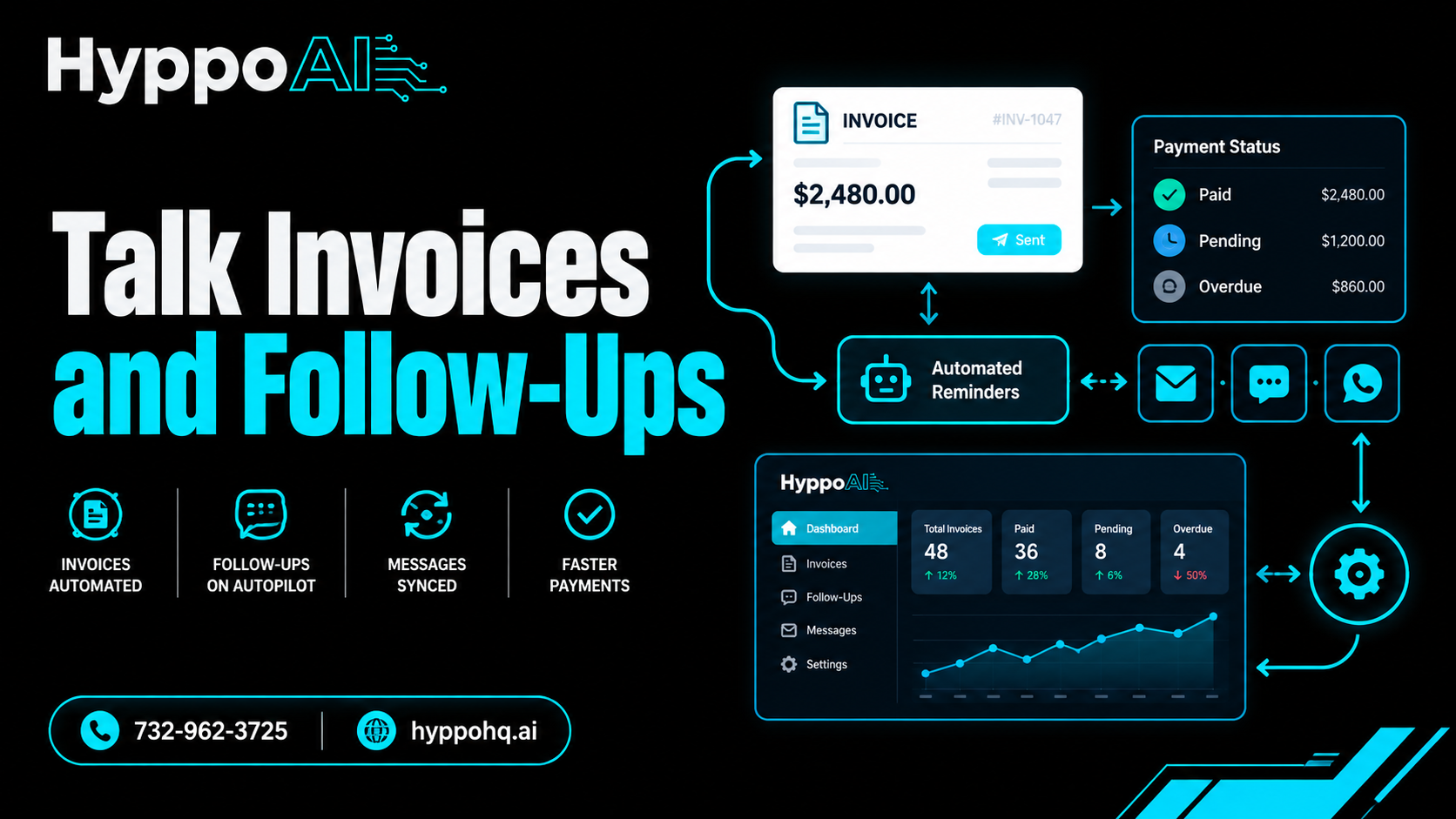
Why invoice payments and follow-ups should talk together
Most small businesses do not have a payment problem. They have a communication problem.
Invoices go out from one tool. Payment reminders happen in another. Follow-ups live in someone’s inbox, CRM, or task list. The result is predictable: late payments, missed touchpoints, confused customers, and a team wasting time chasing information.
If invoice payments and follow-ups are not connected, your process is working against you.
For SMBs trying to scale, these workflows should talk to each other in real time. When they do, you collect faster, reduce manual work, and create a smoother customer experience.
What it means for invoice payments and follow-ups to “talk”
This does not have to mean a complex enterprise system.
It simply means your tools share the right signals at the right time, such as:
- an invoice was sent
- a customer opened it
- a payment is due in three days
- a payment failed
- a partial payment was made
- the invoice is now overdue
- a follow-up message was sent
- a team member needs to step in
When these events trigger the next action automatically, the business runs with less friction.
Instead of relying on memory, sticky notes, or manual check-ins, the system moves the process forward.
Why disconnected systems create avoidable delays
When billing and follow-up live in silos, three things usually happen.
1. Customers get inconsistent communication
A customer may receive an invoice but no reminder. Or they may pay, then still get a past-due message because the payment status did not sync quickly enough.
That creates confusion and weakens trust.
2. Teams waste time checking multiple tools
Someone has to verify whether the invoice was sent, whether it was viewed, whether payment came in, and whether anyone already followed up.
That context switching adds up fast.
3. Cash flow slows down
Late payments are often not about refusal. They are about missed timing, weak reminders, or unclear next steps.
When no automated follow-up exists, invoices age longer than they should.
The operational case for connecting the workflow
If you want cleaner operations, your invoicing process should behave more like a system and less like a series of isolated tasks.
A connected workflow helps you:
- reduce days sales outstanding
- improve visibility into receivables
- cut manual admin time
- create more consistent customer communication
- trigger escalation only when needed
- give staff clear next actions
This is where automation becomes practical, not theoretical.
You are not replacing human judgment. You are removing the repetitive gaps between steps.
What a connected invoice follow-up process can look like
A simple example:
Before the due date
- Invoice is sent automatically
- Customer receives a confirmation message
- Reminder goes out a few days before due date
On the due date
- System checks payment status
- If unpaid, a follow-up message is triggered
- Internal task is created only if certain criteria are met
After the due date
- Escalation cadence begins automatically
- Messaging changes based on age of invoice
- Team is alerted for high-value or high-risk accounts
After payment
- Follow-ups stop immediately
- Receipt or confirmation is sent
- Status updates across tools
That last point matters more than most businesses realize.
The moment payment is received, every part of the workflow should know. Otherwise, your business risks sending the wrong message at the wrong time.
Why this matters for customer experience too
Businesses often think about invoicing as back-office administration. Customers do not.
To them, it is part of the experience of doing business with you.
A clean, timely, logical payment process signals professionalism. A messy one signals disorganization.
Customers notice when:
- reminders are clear and well timed
- payment options are easy to use
- receipts arrive quickly
- no one asks them to pay twice
- support can answer billing questions fast
In other words, connected systems do not just improve collections. They protect trust.
Where AI and automation fit in
For SMBs, this is where AI can create immediate operational value.
AI does not need to replace your accounting platform. It can sit across your workflow and help coordinate it.
Examples include:
- identifying which overdue accounts need a human follow-up first
- personalizing reminder timing based on customer behavior
- routing billing questions to the right place faster
- summarizing account status for your team instantly
- triggering next steps based on payment events
The goal is not more software for the sake of software.
The goal is fewer delays, fewer missed handoffs, and better decisions.
Signs your current process is too disconnected
If any of these sound familiar, your invoice payments and follow-ups likely are not talking enough:
- your team manually checks payment status before sending reminders
- customers say they already paid after receiving follow-ups
- overdue invoices depend on someone remembering to act
- billing communication is inconsistent across customers
- reporting on receivables takes too long
- no one has a clear view of what happens after an invoice is sent
These are not just admin issues. They are process design issues.
How to start fixing it without overcomplicating things
You do not need a full rebuild to improve this.
Start with the handoffs.
Map the current sequence
List what happens from invoice creation to payment received.
Include:
- tools used
- people involved
- messages sent
- decision points
- common delays
Identify missed signals
Ask where information stops moving.
For example:
- Does the follow-up tool know when payment happens?
- Does the team know when an invoice becomes overdue?
- Does the customer get the right message at each stage?
Automate the obvious next steps
Focus first on repetitive actions with clear triggers, like:
- due date reminders
- overdue notices
- payment confirmations
- internal alerts for exceptions
Add intelligence where prioritization matters
Once the basics are connected, you can layer in AI to help your team focus on the right accounts and actions.
The bigger picture: operations that actually scale
As a business grows, small disconnects become expensive.
One unpaid invoice is manageable. Fifty overdue invoices across disconnected tools becomes an operational drag.
The companies that scale well are not always the ones with the most people. They are often the ones with the cleanest systems.
When invoice payments and follow-ups talk to each other, you create:
- faster collections
- better internal visibility
- fewer customer errors
- more predictable operations
That is not just finance hygiene. That is business infrastructure.
If your invoicing, payments, and follow-up process still depends on manual checking and fragmented tools, it may be time to redesign the workflow. HyppoAI helps SMBs build smarter operational systems with AI and automation. Visit https://hyppohq.ai or call +17329623725 to see how a connected process can reduce friction and improve cash flow.
