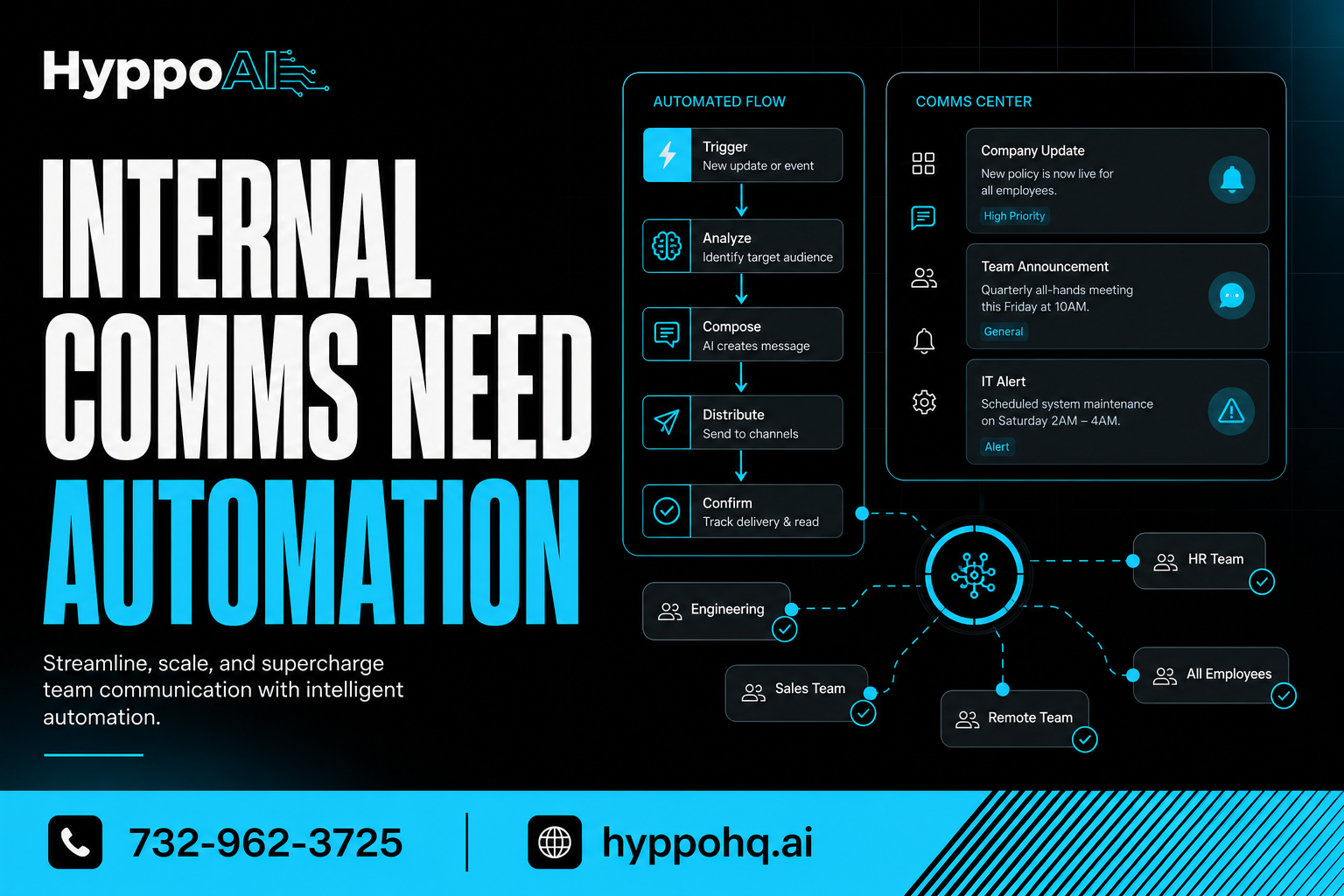
Why internal communication needs automation too
Internal communication is usually treated like a people problem.
It is not.
Most of the time, it is a systems problem.
When teams miss updates, repeat the same questions, forget handoffs, or lose context between departments, the issue is rarely effort. The issue is that communication depends too much on memory, manual follow-up, and scattered tools.
That is exactly why internal communication needs automation too.
A lot of small and midsize businesses invest in automation for sales, lead capture, customer support, and scheduling. That makes sense. Those functions are visible and tied directly to revenue.
But internal communication drives all of them.
If your team cannot move information clearly and consistently, automation on the front end will only expose more back-end friction.
Why internal communication breaks down
In most SMBs, communication lives in too many places at once:
- email threads
- chat apps
- text messages
- project boards
- meeting notes
- verbal updates
- individual memory
That creates a predictable set of problems:
- people do not know where to look for the latest update
- tasks get delayed because no one knows who owns the next step
- managers spend time chasing status instead of making decisions
- employees repeat work because context was never shared
- important details get buried in long threads or side conversations
None of this means your team is weak.
It means your operating system is manual.
Manual communication works for a very small team, for a very short period of time. Once the business grows, the volume of messages grows faster than the team’s ability to track them.
That is when automation becomes necessary.
What communication automation actually means
Communication automation does not mean replacing human interaction.
It means removing the repetitive, low-value parts of communication so people can focus on the parts that require judgment, collaboration, and leadership.
In practice, that can look like:
- automatic task notifications when a job changes status
- instant summaries after meetings or calls
- triggered updates to the right department when a customer action happens
- reminders for approvals, deadlines, or incomplete handoffs
- centralized reporting that pulls updates from multiple systems
- AI-generated recaps that reduce the need for long status meetings
The goal is simple: the right information reaches the right person at the right time without someone having to remember to send it.
The hidden cost of manual internal communication
Most businesses underestimate how much manual communication costs them because it does not always show up as a line item.
Instead, it shows up as:
- slower execution
- more interruptions
- inconsistent customer experiences
- avoidable mistakes
- decision bottlenecks
- manager burnout
Think about how much time your team spends doing things like:
- asking for updates
- forwarding messages
- clarifying what someone meant
- checking whether something was completed
- searching for notes, files, or previous conversations
That is operational drag.
And operational drag compounds.
A five-minute delay in one handoff can become a one-day delay across a workflow. A missed internal update can lead to a frustrated customer, a missed deadline, or a team member doing work based on outdated information.
Automation helps reduce that drag by turning communication into a repeatable process instead of an improvised habit.
Where automation helps most inside a business
Not every internal message needs automation. But many routine communication points do.
Handoffs between departments
This is one of the biggest failure points in growing businesses.
Sales closes a deal, but onboarding lacks context. Operations finishes a task, but billing is not informed. Support identifies a recurring issue, but leadership never sees the pattern.
Automation can trigger the next communication step automatically so handoffs are not dependent on someone remembering to send an update.
Status updates and visibility
Teams lose speed when leaders have to ask for updates manually.
Automated dashboards, summaries, and notifications give everyone visibility without creating more meetings or more chat noise.
That means:
- fewer status-check messages
- faster decisions
- clearer accountability
Approvals and escalations
Approvals often stall because they sit in inboxes or private messages.
Automation can route requests to the correct person, send reminders, and escalate when deadlines are missed. That keeps work moving without constant follow-up.
Recurring internal questions
If your team repeatedly asks the same operational questions, that is a signal.
It usually means the information is either hard to find or not delivered at the right moment.
Automation and AI can surface answers, documentation, or process steps when people need them, reducing interruptions and inconsistency.
Internal automation improves external results
This is the part many businesses miss.
Better internal communication is not just an internal efficiency win. It improves the customer experience too.
When internal systems communicate well:
- customers get faster responses
- fewer details fall through the cracks
- teams sound more coordinated
- service delivery becomes more consistent
- leadership can spot problems earlier
In other words, internal communication automation supports revenue, retention, and reputation.
If your customer-facing systems are modern but your internal communication is still manual, you are building speed on top of friction.
That does not scale well.
Signs your business needs communication automation
If any of these sound familiar, your business is likely ready for it:
- your team asks for updates that should already be visible
- important information lives in one person’s head
- projects slow down during handoffs
- meetings are used mainly to share status
- managers spend too much time following up
- employees use multiple channels for the same workflow
- mistakes happen because someone missed a message
These are not random annoyances.
They are system signals.
And system problems need system solutions.
How SMBs should approach it
The best way to automate internal communication is not to automate everything at once.
Start with the highest-friction points.
Ask:
- where do delays happen most often?
- which updates are repeated every day?
- what information is most often missed?
- where are people relying on memory instead of process?
Then build from there.
A smart rollout usually follows this order:
- map the workflow
- identify communication bottlenecks
- automate routine alerts, summaries, or handoffs
- centralize visibility
- refine based on team feedback
The goal is not more messages.
The goal is better timing, better clarity, and less manual effort.
Automation gives teams room to think
The best internal communication systems do not flood teams with notifications.
They reduce noise.
That matters because communication overload is just as damaging as communication gaps. If everything is urgent, nothing is clear.
Good automation creates structure. It filters what matters, routes information correctly, and makes it easier for people to act without chasing context.
That gives your team more room for actual work:
- solving problems
- serving customers
- making decisions
- improving processes
That is the real value.
Automation is not just about doing more with less. It is about helping the business operate with more precision.
Final thought
If your business already uses automation for leads, scheduling, or customer communication, internal communication is the next logical step.
Because growth does not only create more customers.
It creates more complexity inside the business.
And if that complexity is managed manually, it will eventually slow everything down.
Internal communication needs automation too because clarity should not depend on memory, speed should not depend on constant follow-up, and scale should not depend on chaos.
If you want to build smarter internal systems for your business, visit https://hyppohq.ai or call +17329623725 to see how HyppoAI can help.
