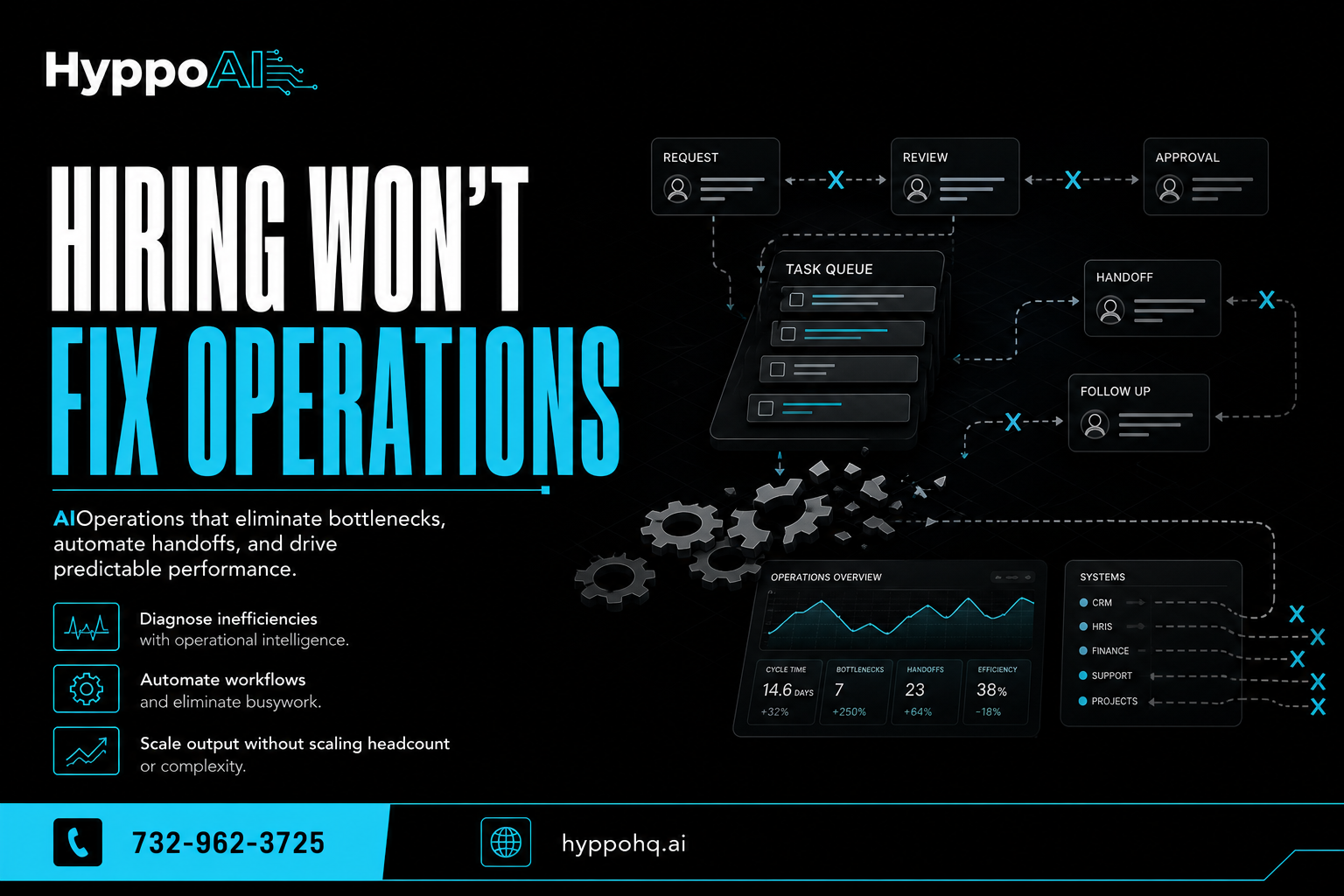
Why hiring alone doesn’t fix operational problems
Most business owners hit the same wall at some point: things feel busy, growth starts to stall, and the default answer becomes, “We need to hire.”
Sometimes that is true. But often, hiring alone does not fix the real operational problem.
If your workflows are inconsistent, your communication is fragmented, or your team is constantly reacting instead of executing, adding more people can actually make the problem worse. More headcount layered onto broken systems usually creates more complexity, more handoffs, and more room for mistakes.
For SMBs, this matters even more. Every hire is a real investment in payroll, training, management time, and risk. If the underlying issue is operational, the smarter move is to fix the machine before adding more operators.
The real problem is often operational, not staffing
When a business feels overloaded, it is easy to assume there simply are not enough hands. But overload can come from several deeper issues:
- Tasks are being done manually when they could be standardized
- Team members are unclear on ownership
- Leads are coming in, but follow-up is inconsistent
- Information lives in too many places
- Customers are waiting because processes are slow
- Leadership is answering the same questions repeatedly
None of those problems disappear just because you hire another person.
In fact, if the business lacks clear systems, a new hire often inherits confusion instead of clarity. That means longer ramp-up time, inconsistent output, and more management overhead for the owner.
Why hiring can amplify broken systems
Hiring is often treated like a growth solution. In reality, it can become a multiplier. If your operation is strong, hiring can multiply output. If your operation is weak, hiring can multiply inefficiency.
More people create more handoffs
Every new employee adds communication paths, dependencies, and potential bottlenecks. Without documented processes, tasks start bouncing between people.
That leads to:
- Delays in execution
- Duplicate work
- Missed details
- Confusion around accountability
A business with poor operational structure does not become smoother with more people. It becomes noisier.
New hires need systems to succeed
Even great employees struggle in businesses without clear workflows. They need:
- Defined responsibilities
- Repeatable processes
- Access to the right information
- Clear expectations for speed and quality
Without those basics, performance becomes inconsistent and managers spend more time putting out fires.
Labor costs rise before results do
Hiring increases expenses immediately. Results usually come later, if they come at all. If the hire enters a broken environment, the return on that investment gets delayed even further.
For SMBs trying to scale responsibly, that is a dangerous pattern.
Signs your business has a systems problem, not a people problem
Before you open another role, step back and look for these signals:
Work depends too much on specific people
If key tasks only get done when one person is available, you do not have a scalable system. You have operational dependency.
The same mistakes keep happening
Recurring errors usually point to process gaps, not just employee performance issues.
Follow-up is inconsistent
If leads, customers, or internal requests slip through the cracks, the issue is often workflow design. This is one of the clearest signs that automation or better process mapping is needed.
Reporting is unclear
If leadership cannot quickly answer questions like “Where are leads getting stuck?” or “Why are jobs delayed?” then the business likely lacks operational visibility.
Owners are still the central hub
If everything routes back to the owner for decisions, approvals, or answers, hiring alone will not solve the bottleneck. The bottleneck is structural.
What to fix before you hire
Hiring works best after core operations are stable. That does not mean your business has to be perfect. It means the basics should be clear, repeatable, and measurable.
Standardize repeatable tasks
Look for tasks your team does over and over:
- Lead intake
- Appointment scheduling
- Follow-up messages
- Status updates
- FAQs
- Internal handoffs
If these are handled differently every time, start there. Standardization reduces confusion and makes future hiring easier.
Clarify ownership
Every critical task should have a clear owner. Not a group. Not “whoever sees it.” One owner.
Clear ownership improves speed and accountability while reducing internal friction.
Map the customer journey
Many operational issues show up where the customer experience breaks:
- Slow response times
- Missed calls
- Delayed estimates
- Poor handoff from sales to service
- No follow-up after inquiry
Mapping the journey helps identify where systems are failing before you assume the answer is more staff.
Automate where it makes sense
Not every problem needs another employee. Some need automation.
For SMBs, automation can help with:
- Capturing inbound leads
- Responding after hours
- Routing inquiries
- Sending reminders
- Logging conversations
- Triggering follow-up sequences
The goal is not to replace people for the sake of it. The goal is to remove repetitive operational drag so your team can focus on higher-value work.
Where AI can help solve operational bottlenecks
This is where many businesses start seeing real leverage. AI is not just a marketing tool. For SMBs, it can be an operational tool.
Used correctly, AI can support the parts of the business that are slowing growth:
Faster response and intake
If your team misses calls, delays replies, or struggles to keep up with lead volume, AI-supported systems can help maintain responsiveness without adding immediate headcount.
Better consistency
AI-driven workflows can help standardize communication, qualification, and routing so fewer things get handled ad hoc.
Less admin load
When repetitive tasks are reduced, your team has more time for problem-solving, customer relationships, and revenue-generating work.
More scalable operations
A business with better systems can absorb more demand before needing to hire. That improves margins and makes future hiring more strategic.
When hiring does make sense
This does not mean hiring is bad. It means hiring should follow operational clarity, not substitute for it.
Hiring makes sense when:
- Workflows are documented
- Ownership is clear
- Demand is consistently exceeding capacity
- Performance can be measured
- New team members can plug into an existing system
At that point, adding people can increase throughput without increasing chaos.
A smarter question to ask
Instead of asking, “Who do we need to hire?” ask:
- What is actually breaking in the operation?
- Where are delays happening?
- What work is repetitive and systemizable?
- What depends too much on manual effort?
- What would make the current team more effective first?
That shift in thinking often saves businesses from expensive decisions that do not solve the real issue.
The bottom line
Hiring alone does not fix operational problems. If the business runs on unclear processes, inconsistent follow-up, and owner-dependent decisions, more staff will not create efficiency. It will usually create more complexity.
The better move is to strengthen the system first. Standardize what can be standardized. Clarify ownership. Improve visibility. Automate repetitive tasks. Then hire into a structure that supports success.
That is how SMBs scale with less friction and better results.
If your business is growing but operations feel messy, HyppoAI can help you identify where automation and AI fit into your workflow. Visit https://hyppohq.ai or call +17329623725 to explore smarter systems for scaling.
