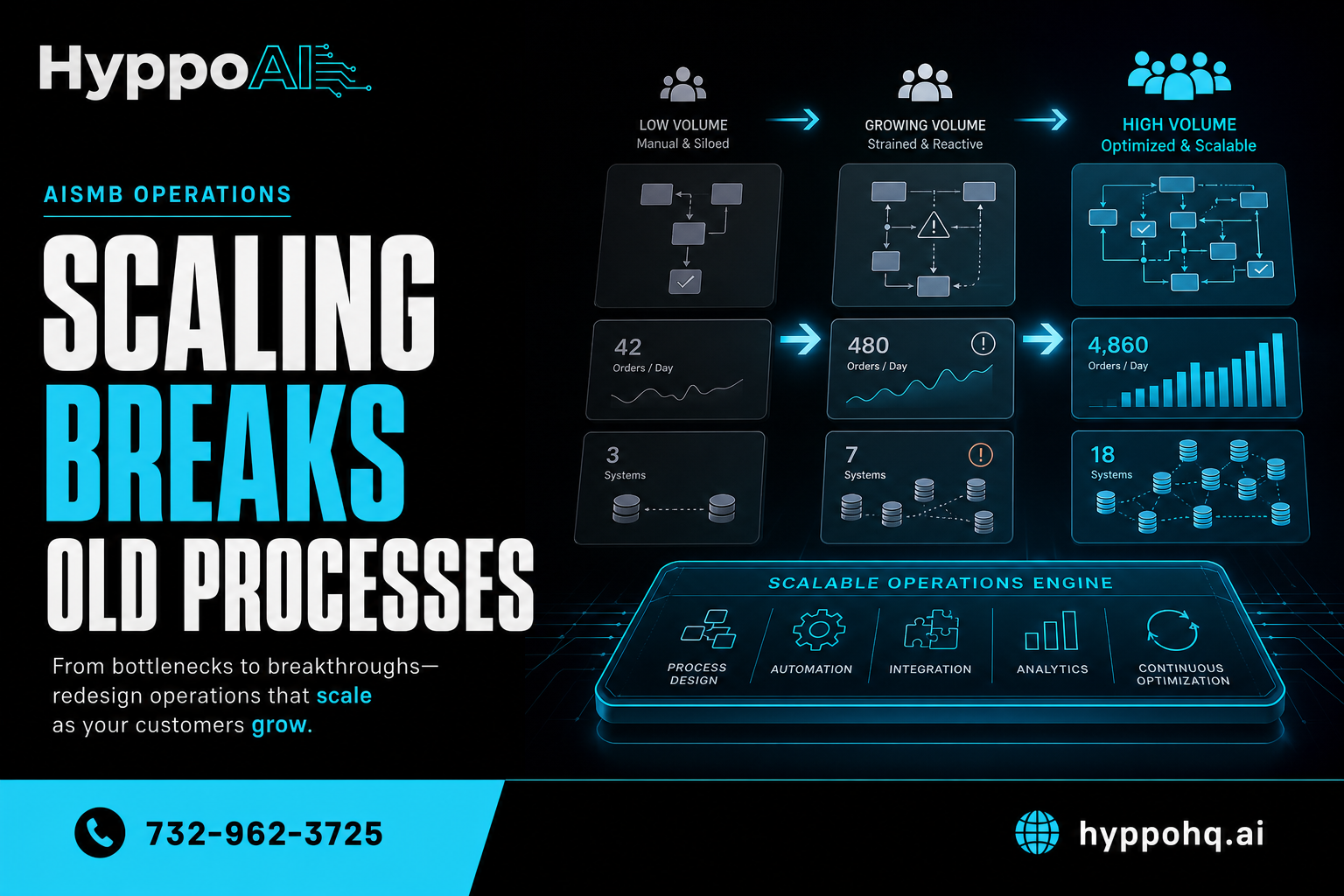
Why growth breaks existing processes as your business scales
Growth is exciting, but it also creates pressure in places most businesses do not expect.
A process that feels efficient in the early stage can become a bottleneck once the business adds more customers, more requests, and more moving parts. That is not a sign the team failed. It is usually a sign the business has reached a new level that demands a different operating model.
At HyppoAI, we see this often with SMBs adopting AI and automation. Leaders want to scale output, but the systems underneath the business were built for a smaller version of the company. Growth does not just test capacity. It tests whether your workflows, communication, and decision-making can still hold up under more volume.
Why growth changes the rules
In the beginning, businesses often run on speed, flexibility, and direct communication. A founder can approve decisions quickly. Team members can solve issues informally. Customer needs are easier to track because there are fewer of them.
That works for a while.
But as demand increases, the same habits that once helped the business move fast can start slowing it down. More customers mean more edge cases. More employees mean more handoffs. More products or services mean more complexity.
What worked when the business was smaller often stops working once the volume increases.
This is the core reason growth breaks existing processes: those processes were designed for a different level of complexity.
Common reasons existing processes fail during growth
1. Informal communication stops being reliable
Small teams can get away with quick conversations, memory-based updates, and verbal approvals. Once the company grows, that creates confusion.
People start asking questions like:
- Who owns this task?
- Was this approved?
- Which version is correct?
- Did anyone follow up with the customer?
When communication lives in scattered messages or in one person’s head, growth exposes the gaps fast.
2. Manual work does not scale well
Many businesses grow using manual processes because they are easy to start. Spreadsheets, repeated copy-paste tasks, and one-off customer handling can work at low volume.
Then volume rises.
Now the team spends more time managing the process than delivering the actual value. Errors increase. Response times slow down. Employees get frustrated.
This is where automation and AI can make a major difference, but only if the business first understands where the friction really is.
3. Decision-making becomes a bottleneck
Early-stage businesses often rely on one or two people to make every important call. That can feel efficient when the business is small.
As the company grows, centralized decision-making creates delays. Teams wait for approvals. Customers wait for answers. Opportunities sit idle.
A process that depends too heavily on a single person is fragile. Growth makes that fragility impossible to ignore.
4. Customer expectations increase with scale
As a business grows, customers do not become more patient. They usually expect more consistency, faster service, and clearer communication.
If internal processes are inconsistent, the customer experience becomes inconsistent too. That is where growth can start hurting reputation instead of helping revenue.
5. Exceptions become the norm
A process may look fine until the business starts seeing more unusual requests, special cases, or operational variations. At higher volume, those exceptions pile up.
What once felt like a rare issue becomes a daily disruption.
That is often the moment leaders realize the process was never truly scalable. It was just manageable at a smaller size.
Signs your processes are breaking under growth
Not every issue is obvious right away. Sometimes the warning signs show up gradually.
Look for patterns like:
- Teams repeating the same questions
- Delays between departments
- Increased customer complaints or follow-ups
- More rework and fewer first-time-right outcomes
- Heavy dependence on specific employees
- Reporting that takes too long to assemble
- Tools that no longer connect cleanly
If growth is creating more firefighting than forward progress, your processes may need redesign, not just more effort.
Why adding more people is not always the answer
A common reaction to growth is to hire more people. Hiring can help, but it does not fix a broken system.
If the process itself is unclear, adding headcount can actually multiply inefficiency. More people means more training, more coordination, and more room for inconsistency.
That is why process improvement matters before expansion gets too far ahead. Strong systems let people do better work. Weak systems force good people to spend time overcoming avoidable friction.
How SMBs can respond smarter
Audit where work actually slows down
Do not guess. Map the workflow.
Look at where requests start, where they pause, where approvals happen, and where errors occur. The goal is not to document everything for the sake of documentation. The goal is to identify where growth is putting the most pressure on the business.
Standardize what should be repeatable
Not every task needs a rigid script, but repeatable work should have repeatable steps.
This can include:
- Intake processes
- Customer follow-up sequences
- Internal approvals
- Data entry rules
- Reporting formats
Standardization reduces confusion and creates a stronger foundation for automation.
Automate high-friction, low-value tasks
If employees are spending too much time on repetitive administrative work, that is a strong signal.
AI and automation can help with:
- Routing requests
- Summarizing conversations
- Drafting responses
- Updating records
- Tracking workflow status
- Generating recurring reports
The point is not to automate everything. The point is to remove unnecessary drag so the team can focus on higher-value decisions.
Build processes for visibility, not just completion
A process is not truly effective if work gets done but nobody can see what is happening.
Leaders need visibility into:
- Current workload
- Process delays
- Ownership
- Customer status
- Performance trends
Visibility helps teams solve problems earlier instead of reacting after issues spread.
Revisit processes regularly
A process should not be treated as permanent just because it worked once.
As the business changes, systems should evolve too. Growth stages are different. Customer needs shift. Technology improves. What made sense six months ago may already be outdated.
The best operators review processes consistently and improve them before breakdown becomes expensive.
The role of AI in scaling operations
For SMBs, AI is most useful when it supports operational clarity.
That means using AI to reduce manual effort, improve speed, and create better consistency across the business. It does not mean layering new tools on top of broken workflows and hoping the problem disappears.
When applied well, AI can help businesses scale without overwhelming the team. It can strengthen response times, reduce repetitive work, and make process performance easier to track.
But the real advantage comes from combining smart technology with smart process design.
Growth should trigger redesign, not panic
If your existing processes are starting to fail, that does not mean growth is the problem. It means the business is entering a new phase.
That phase requires stronger systems, clearer ownership, and better use of automation. Businesses that recognize this early are in a much better position to scale with confidence.
Growth will always expose what is fragile. The opportunity is to use that pressure as a signal to build better.
If your SMB is growing and your workflows are starting to strain, HyppoAI can help you identify where AI and automation can create real operational leverage. Visit https://hyppohq.ai or call +17329623725 to start the conversation.
