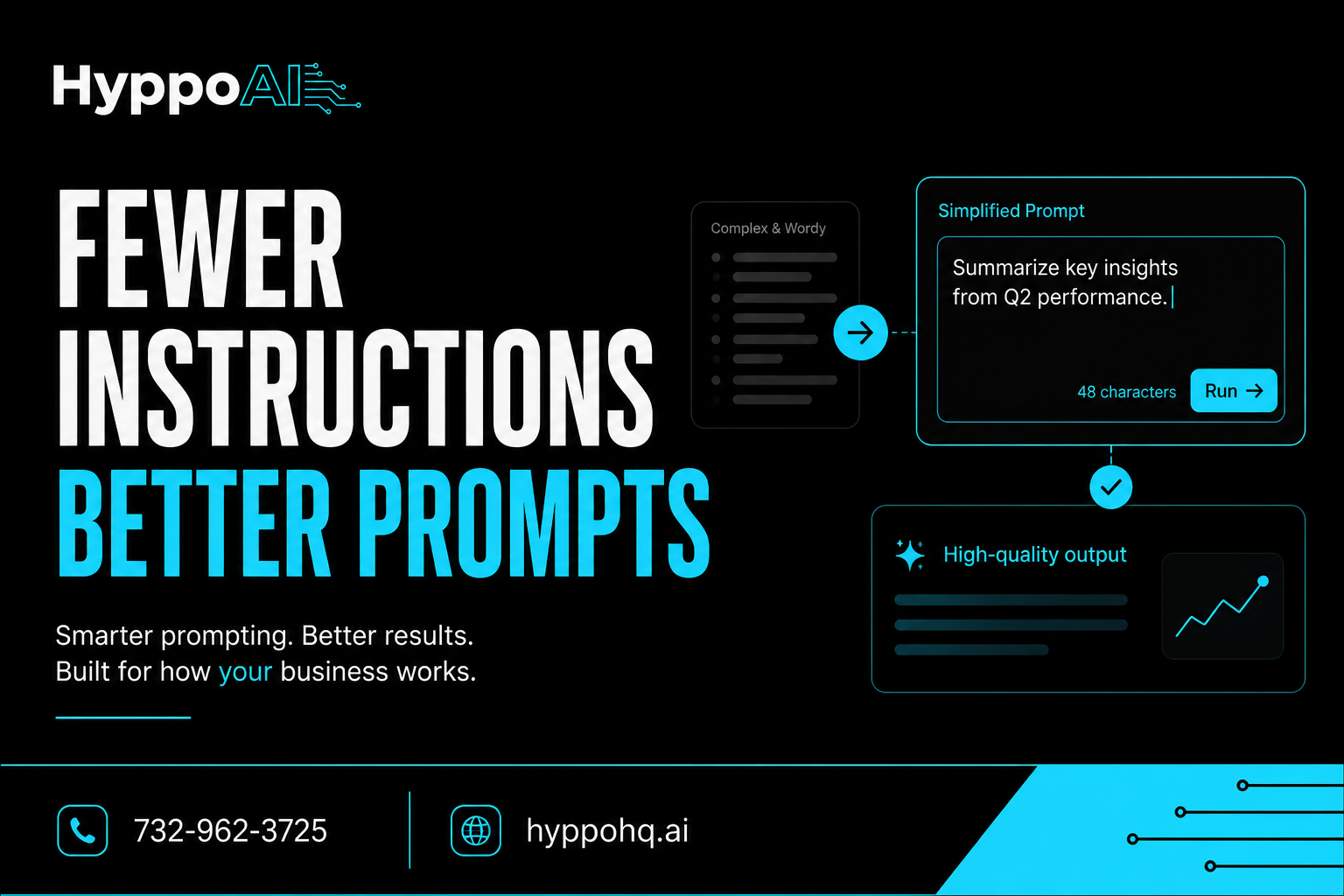
Why fewer instructions often work better in AI prompts
When people start using AI at work, the first instinct is usually the same: add more instructions.
More context. More rules. More edge cases. More examples. More warnings.
It feels logical. If you tell the model everything, it should perform better.
In practice, that is not always what happens.
Very often, fewer instructions lead to better outputs. The response is cleaner, the model follows the core task more closely, and the result is easier to use. For small and midsize businesses, that matters. You do not need prompts that look like policy manuals. You need prompts that produce useful work.
Why more instructions can reduce quality
AI models are good at pattern recognition, summarization, drafting, and transformation. They are not humans reading a contract line by line with perfect priority handling.
When you overload a prompt, a few things can go wrong:
- The main objective gets buried
- Instructions conflict with each other
- The model over-focuses on formatting instead of substance
- Important context mixes with low-value detail
- Outputs become stiff, generic, or inconsistent
A long prompt can create noise.
If the model has to balance too many directives at once, it may miss the real job. Instead of answering the question well, it starts trying to satisfy every rule equally. That usually weakens the result.
For example, if you ask AI to write a sales email and include 15 style rules, 8 compliance notes, 4 audience reminders, and 6 formatting constraints, you may get something technically compliant but practically flat.
The model did not fail because it had too little information.
It failed because the signal-to-noise ratio got worse.
The real goal is clarity, not volume
Better prompting is not about saying more. It is about making the task clearer.
That means separating what matters from what does not.
A strong prompt usually has just a few essential parts:
- The task
- The audience
- The desired output format
- Any critical constraints
That is enough in many cases.
Here is a simple example.
Overloaded prompt
Write a professional but friendly follow-up email to a roofing lead. Keep it concise but detailed. Sound confident but not aggressive. Mention our family values, our fast response times, our quality materials, our years of experience, and our financing options. Use short paragraphs. Include a call to action. Do not sound robotic. Make it persuasive but not salesy. Mention the weather if relevant. Avoid exclamation points. Keep it under 120 words. Use a sixth-grade reading level. Make it feel local.
Cleaner prompt
Write a 100-word follow-up email to a roofing lead in Palm Bay, Florida. Tone: confident, local, professional. Goal: book an estimate. Mention fast response times and financing options. End with a simple call to action.
The second version is easier to follow because it gives the model a clear job with a few high-priority constraints.
Why simpler prompts often perform better
There are a few practical reasons this works.
1. Clear priorities improve output
AI performs better when the task is obvious.
If you want a summary, ask for a summary. If you want a caption, ask for a caption. If you want objections rewritten into FAQ answers, say exactly that.
The more directly you define the job, the more likely the output will match your intent.
2. Less conflict means less drift
Many prompt problems come from hidden contradictions.
Common examples include:
- Be detailed, but keep it very short
- Sound casual, but also highly formal
- Be creative, but follow this exact structure
- Cover every point, but make it skimmable in one sentence
Humans can see the tension in those instructions. AI will still try to satisfy all of them. The result is often uneven.
Fewer instructions reduce that conflict.
3. Iteration beats overengineering
A lot of teams try to build the perfect prompt on the first try.
That is usually the wrong approach.
A better workflow is:
- Start with a simple prompt
- Review the output
- Add one useful constraint if needed
- Test again
This process is faster and more reliable than stuffing every possible instruction into version one.
4. Simplicity is easier to scale
For SMB teams, prompts often get reused across sales, support, operations, and marketing.
If your prompt is too long, too fragile, or too dependent on one person’s writing style, it becomes hard to maintain. Simpler prompts are easier to teach, document, and improve.
That matters when you want AI to support real business workflows instead of one-off experiments.
When more instructions do help
This does not mean short prompts are always better.
Sometimes more detail is useful, especially when:
- The task requires strict formatting
- You need the model to follow a specific brand voice
- The output must comply with internal policy
- The context is highly specialized
- You are building a repeatable production workflow
The key is not to add more for the sake of more.
Add only what materially improves the result.
Think in layers:
- Core task first
- Critical constraints second
- Nice-to-have preferences last
If a detail does not change the quality of the output in a meaningful way, it probably does not belong in the prompt.
A practical framework for better prompts
If you want more consistent AI results, use this simple framework.
Step 1: Define the outcome
Ask yourself: what exactly should the AI produce?
Examples:
- A 5-bullet summary
- A customer follow-up text
- A job description draft
- A call script for missed leads
Be concrete.
Step 2: Define the audience
Who is this for?
Examples:
- First-time customers
- Internal staff
- Business owners
- Prospects who did not answer the phone
Audience clarity improves tone and relevance.
Step 3: Add only essential constraints
Limit constraints to the ones that truly matter.
Examples:
- Keep it under 120 words
- Use a direct tone
- Output as bullet points
- Include one CTA
That is usually enough.
Step 4: Test and refine
Do not guess what the perfect prompt should be.
Run it. Review it. Tighten one variable at a time.
This is where most prompt quality comes from.
What this means for SMBs using AI
For small businesses, speed and consistency matter more than prompt complexity.
If your team is using AI for lead follow-up, social captions, customer service drafts, internal SOPs, or sales support, simpler prompts usually create better adoption.
Why?
- Staff can learn them faster
- Results are easier to troubleshoot
- Workflows are easier to document
- Outputs are more consistent across users
The goal is not to impress people with a giant prompt.
The goal is to get usable output with less friction.
That is where AI starts creating real operational value.
The bottom line
Fewer instructions often work better because they force clarity.
They reduce noise, limit conflicts, and keep the model focused on the real task. In many business use cases, that leads to better outputs than long, overloaded prompts.
If your AI results have been inconsistent, do not assume you need a more complicated system.
You may just need a cleaner prompt.
At HyppoAI, we help SMBs use AI in ways that are practical, scalable, and tied to real business outcomes. Visit https://hyppohq.ai or call +17329623725 to learn how we can help your team build smarter AI workflows.
