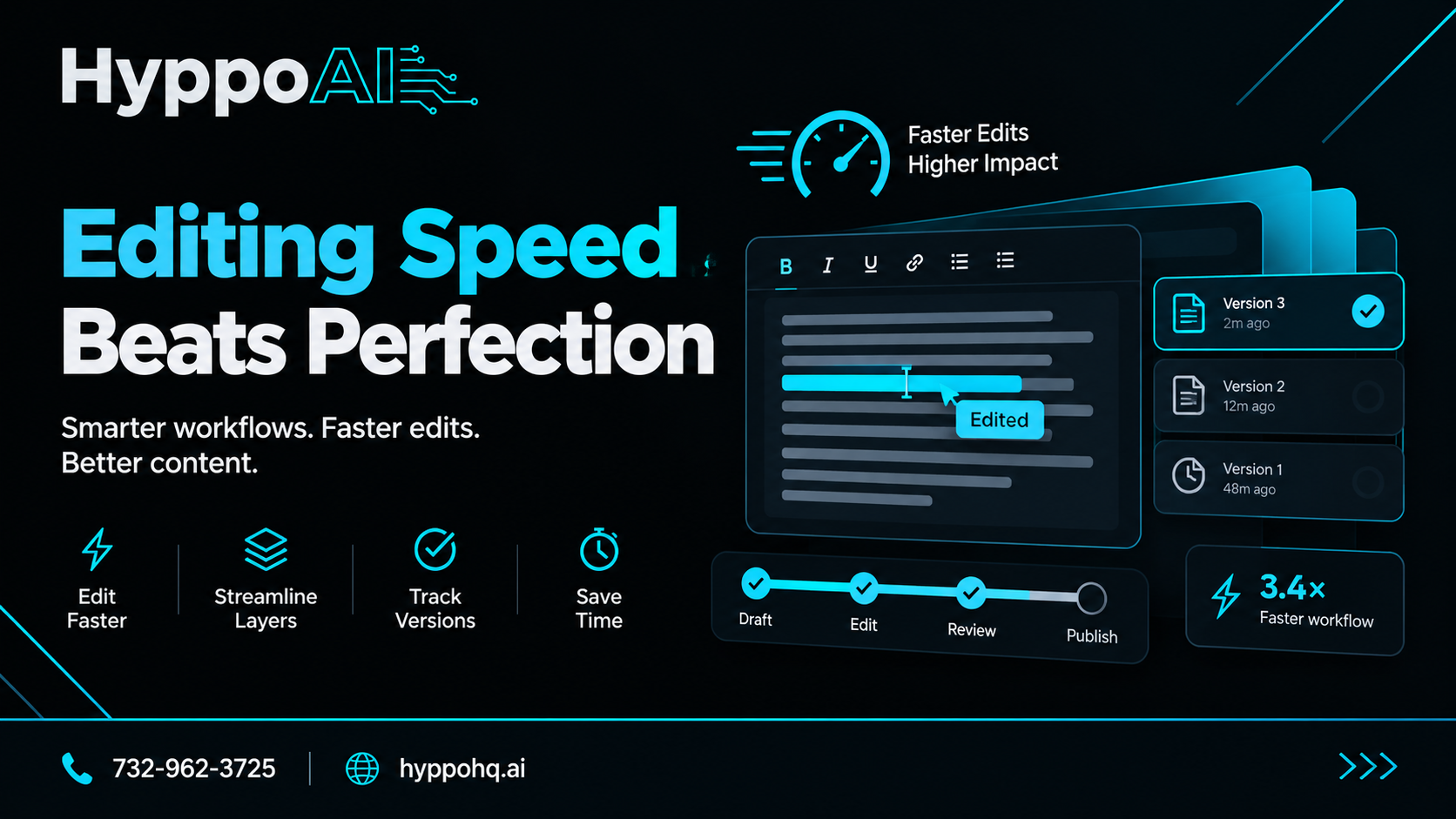
Why editing speed matters more than perfection in content
Perfection is attractive because it feels responsible. If you polish every sentence, review every detail, and delay publishing until everything looks flawless, you can tell yourself the work is high quality.
But in practice, perfection often becomes expensive hesitation.
For growing businesses, especially SMBs, editing speed usually matters more than perfect output. Fast edits create momentum. Momentum creates feedback. Feedback creates better decisions. And better decisions compound much faster than a tiny improvement in wording that took three extra hours to achieve.
At HyppoAI, we see this principle show up across content, marketing systems, internal workflows, and AI adoption. The businesses that move fastest are rarely the ones chasing perfect drafts. They are the ones building a repeatable process to review, refine, and improve quickly.
Perfection slows the learning loop
The biggest problem with perfection is not quality control. It is delayed learning.
When you spend too long trying to make one piece of content flawless, you postpone the moment when real people react to it. That means you wait longer to learn:
- What messaging actually resonates
- Which offers attract attention
- What questions prospects still have
- Where your audience loses interest
- Which channels deserve more effort
Speed shortens the distance between creation and insight.
A post published today with 90% polish teaches you more than a perfect post published next week. In most business contexts, feedback from the market is more valuable than internal debate over minor edits.
Fast editing improves decision-making
Editing speed is not about being careless. It is about making decisions efficiently.
Every edit is a decision:
- Keep this sentence or cut it
- Lead with the problem or the solution
- Use a stronger CTA or a softer one
- Simplify the language or add more detail
Teams that edit quickly tend to develop better judgment over time because they make more editorial decisions in a shorter period. They see patterns faster. They recognize what works. They stop wasting time on choices that do not materially affect results.
That is a real competitive advantage.
Good content wins through clarity, not endless polishing
Most audiences do not reward microscopic perfection. They reward clarity, relevance, and usefulness.
If your content is:
- Easy to understand
- Focused on a real problem
- Structured for quick reading
- Matched to the audience's intent
- Published consistently
then it is already ahead of a large percentage of what gets posted online.
What hurts performance more often is not an imperfect phrase. It is delay, inconsistency, and overthinking.
A business that publishes useful content three times a week will usually outperform a business that publishes one highly polished piece every few weeks. Frequency creates more surface area for discovery, more opportunities for engagement, and more data for optimization.
The hidden cost of slow editing
Slow editing does not just affect one article or one post. It creates operational drag.
That drag often looks like:
- Missed publishing deadlines
- Bottlenecks in approvals
- Team frustration
- Lower campaign velocity
- Reduced testing volume
- Less responsiveness to trends or customer questions
For SMBs, this matters even more because resources are limited. If your team spends too much time perfecting low-impact details, you lose time that could have been used to improve offers, respond to leads, or build better systems.
Speed creates consistency
Consistency is one of the most underrated growth levers in content and operations.
A fast editing process makes consistency possible because it removes friction. Instead of treating every draft like a major production, you turn editing into a practical step inside a reliable workflow.
That matters because consistency builds:
- Audience trust
- Brand recognition
- Search visibility
- Team confidence
- Better internal documentation
The goal is not rushed work. The goal is sustainable output.
When your editing process is efficient, your business can keep showing up without burning out the team.
What fast editing actually looks like
Fast editing is not random. It is structured.
A strong process usually includes a few simple priorities:
1. Edit for purpose first
Ask what the piece needs to accomplish.
Is it supposed to:
- Educate
- Convert
- Start a conversation
- Answer a common objection
- Support SEO visibility
When the purpose is clear, editing gets easier because you know what matters and what does not.
2. Fix big problems before small ones
Start with the issues that affect performance most:
- Weak structure
- Unclear positioning
- Poor flow
- Missing CTA
- Confusing wording
Do not waste time tweaking punctuation if the main argument is still unclear.
3. Use templates and frameworks
Templates reduce decision fatigue.
Whether you are writing captions, blog posts, follow-up emails, or landing page copy, a repeatable structure helps your team edit faster and more consistently.
4. Set time limits
Without boundaries, editing expands to fill the available time.
A reasonable review window forces prioritization. That often leads to better business outcomes than endless revision cycles.
5. Publish, measure, improve
Treat publishing as part of the editing process, not the end of it.
The market gives the final review. Use performance data to improve the next version instead of trying to predict everything in advance.
AI makes editing speed even more valuable
AI changes the economics of content creation.
When drafting becomes faster, editing becomes the real bottleneck. That means businesses need to get better at reviewing and refining output efficiently.
This is where many teams get stuck. They use AI to generate more content, but they still rely on slow manual review habits built for a different pace of work.
To benefit from AI, businesses need editing systems that can keep up.
That may include:
- Brand voice guidelines
- Approval checklists
- Prompt frameworks
- Content scoring rules
- Shared templates
- Clear ownership across the workflow
The point is simple: if AI speeds up production, your editing process must speed up too.
Speed does not mean lower standards
This is where people get confused.
Choosing speed over perfection does not mean accepting weak work. It means distinguishing between high standards and unnecessary delay.
High standards say:
- Be accurate
- Be clear
- Be useful
- Be on-brand
- Be aligned with the goal
Perfectionism says:
- Rework it again because it might be slightly better
- Hold it another day because someone may have one more opinion
- Keep adjusting details that the audience may never notice
Those are not the same thing.
One improves quality. The other often reduces output and slows growth.
What SMBs should focus on instead
If you run a small or mid-sized business, the better question is not, “Is this perfect?”
It is:
- Is this clear enough to publish?
- Does it solve a real problem?
- Does it reflect our brand accurately?
- Can we learn something by putting it in front of people now?
- Do we have a process to improve the next version faster?
That mindset creates progress.
And progress beats perfection because progress compounds.
Every fast, thoughtful edit strengthens your systems. Every published piece teaches you something. Every cycle makes your team sharper.
Over time, that speed becomes an operational advantage, not just a writing habit.
Final takeaway
Editing speed matters more than perfection because business growth depends on momentum, learning, and consistency. Perfect content that arrives too late often loses to good content that ships on time and improves through real-world feedback.
If your team wants to move faster without sacrificing quality, the answer is not more polishing. It is a better process.
HyppoAI helps SMBs build smarter AI-powered workflows for content, operations, and growth. Visit https://hyppohq.ai or call +17329623725 to see how we can help your business create, edit, and scale more efficiently.
