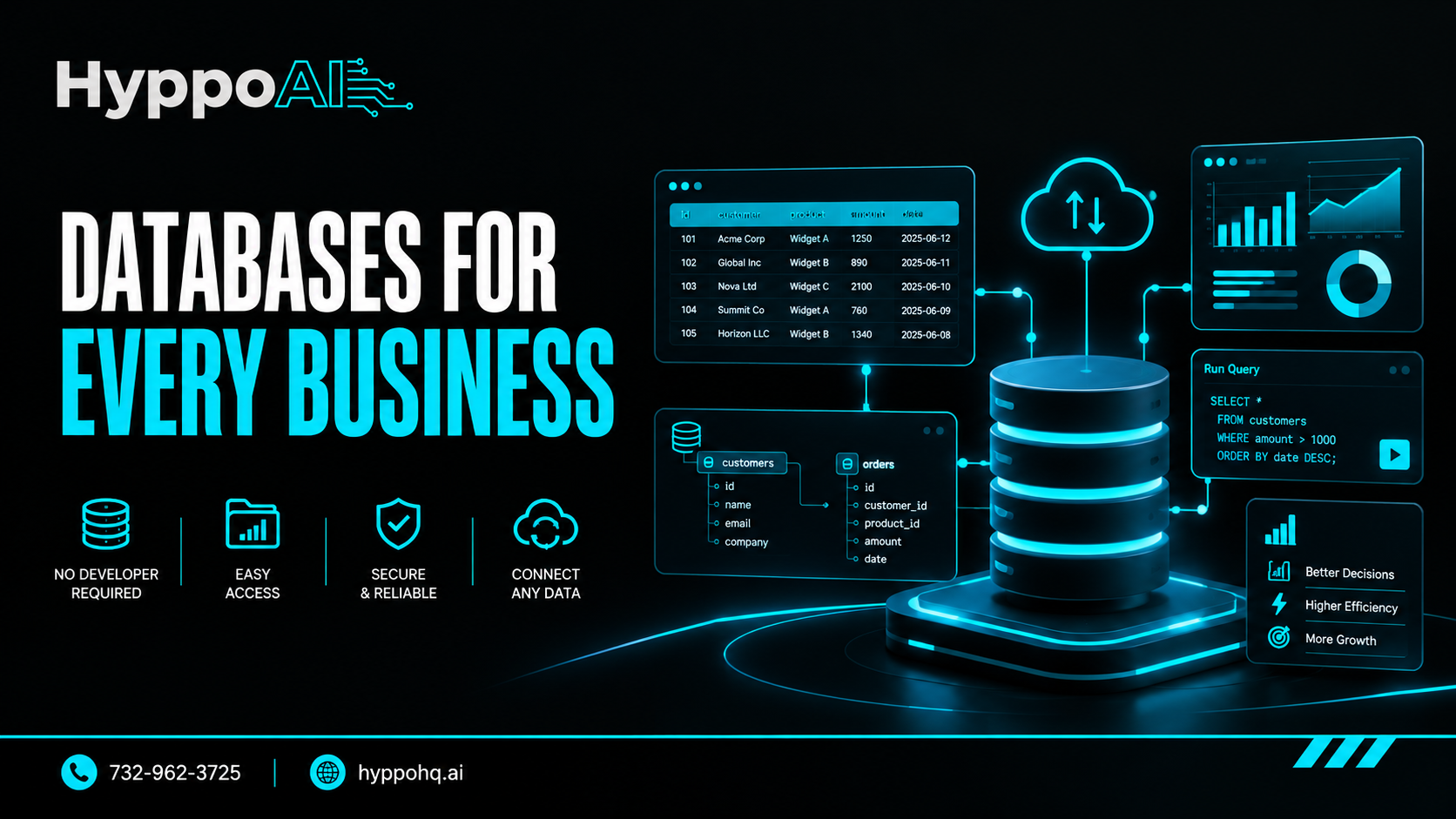
Why databases are not just for developers anymore
For a long time, databases were treated like a technical tool that only developers needed to touch. If you were not writing code, building apps, or managing servers, databases felt far removed from your day-to-day work.
That idea is outdated.
Today, databases are becoming a practical business tool for owners, operators, marketers, sales teams, and customer service staff. If your business runs on customer information, appointments, invoices, inventory, conversations, or internal processes, then your business already depends on data. A database is simply the system that keeps that data organized and usable.
For small and midsize businesses, this matters more than ever. As companies adopt automation and AI, the quality of the underlying data becomes the difference between smooth growth and constant friction.
What a database actually does
At the simplest level, a database stores information in a structured way so it can be searched, updated, filtered, and connected.
That may sound technical, but the business value is easy to understand.
A database helps you:
- Keep customer records in one place
- Track leads and follow-ups
- Store service history and notes
- Organize orders, inventory, or appointments
- Connect data across tools and teams
- Power reports, dashboards, and automations
Think of it as the system behind the systems you already use. Your CRM, booking software, invoicing platform, help desk, and AI tools all rely on some form of database.
Why non-developers should care
You do not need to build a database from scratch to benefit from one. You just need to understand what it enables.
For non-developers, databases are useful because they turn scattered information into something operational.
Instead of asking:
- Where is that customer note?
- Which leads have not been contacted?
- Who missed an appointment?
- What services are most profitable?
- Which tasks are slowing the team down?
You can get clear answers quickly.
That means fewer bottlenecks, less manual work, and better decisions.
Databases support better decisions
Most businesses have more data than they realize, but not enough structure to use it well.
When information lives across spreadsheets, inboxes, sticky notes, and disconnected apps, reporting becomes slow and unreliable. A database creates consistency. It gives leaders a clearer picture of what is happening in the business.
That can help with decisions like:
- Which lead sources produce the best customers
- Which services create repeat business
- Where deals are getting stuck in the pipeline
- Which customers need follow-up now
- How team performance changes over time
Better data does not just help large enterprises. It helps SMBs move faster with fewer mistakes.
Databases make automation possible
Automation is one of the biggest reasons databases matter outside development.
If you want software or AI to take action automatically, it needs structured information to work with. A database provides that structure.
For example, a business can use database-driven automation to:
- Send reminders before appointments
- Trigger follow-up messages after missed calls
- Route new leads to the right person
- Update customer records after a conversation
- Flag inactive customers for re-engagement
- Generate internal alerts when tasks are overdue
Without organized data, automation becomes inconsistent. With organized data, automation becomes reliable and scalable.
Databases are the foundation for useful AI
AI gets a lot of attention, but AI is only as useful as the information it can access.
If your business wants to use AI for lead handling, customer support, internal search, reporting, or workflow automation, databases matter because they provide the source of truth.
An AI assistant cannot be very helpful if customer records are incomplete, service data is inconsistent, or key business information is scattered across tools.
When your data is centralized and structured, AI can do more valuable work, such as:
- Answering questions based on real business data
- Drafting follow-ups using customer context
- Summarizing account history for your team
- Identifying trends across operations
- Supporting faster and more accurate responses
This is why databases are no longer just a developer concern. They are a business readiness concern.
Common database use cases for SMBs
You may already be using databases without calling them that. Many everyday business tools are database-powered.
Here are a few practical use cases where databases help non-technical teams.
Sales and lead management
A database can track:
- New leads
- Contact details
- Follow-up status
- Notes from calls or meetings
- Source attribution
- Closed-won and closed-lost outcomes
This helps sales teams stay organized and helps owners see where revenue opportunities are being lost.
Customer service and support
A database can store:
- Past interactions
- Issue history
- Resolution notes
- Preferences
- Escalation status
That gives your team context, which improves response quality and consistency.
Operations and scheduling
A database can organize:
- Appointments
- Staff assignments
- Job status
- Service history
- Completion times
This reduces confusion and helps teams coordinate more effectively.
Marketing and retention
A database can help segment customers based on:
- Purchase history
- Service frequency
- Geography
- Engagement level
- Last contact date
That makes campaigns more targeted and follow-up more timely.
You do not need to be technical to use data well
One of the biggest misconceptions is that databases require deep technical knowledge. In reality, many modern platforms make database-backed workflows accessible through dashboards, forms, filters, and no-code automations.
What matters most is not whether you can write SQL or build an app.
What matters is whether your business can:
- Capture the right information
- Keep it consistent
- Make it easy to access
- Use it to trigger action
- Learn from it over time
That is a business process challenge, not just a software challenge.
Signs your business needs a better data system
If any of these sound familiar, your business may be ready for a stronger database-driven setup:
- Your team re-enters the same information in multiple places
- Important customer details get lost in messages or spreadsheets
- Follow-ups depend too much on memory
- Reporting takes too long or feels inaccurate
- Automation breaks because data is inconsistent
- AI tools are hard to trust because the inputs are messy
These are not just productivity issues. They are growth issues.
The shift from storage to strategy
The real value of a database is not just storing information. It is creating a system your business can actually run on.
For developers, that might mean building applications.
For business owners and operators, it means something more practical:
- Cleaner workflows
- Faster answers
- Better visibility
- More dependable automation
- Smarter use of AI
That is why databases are no longer a niche technical topic. They are part of how modern businesses scale.
Final takeaway
Databases are not just for developers because business data is not just a developer problem. Every growing company needs a reliable way to organize information, reduce manual work, and support better decisions.
If your business wants to automate more, respond faster, and get more value from AI, the conversation should not start with tools alone. It should start with your data foundation.
HyppoAI helps SMBs build smarter systems around automation, AI, and operations. Visit https://hyppohq.ai or call +17329623725 to learn how better data systems can support growth.
