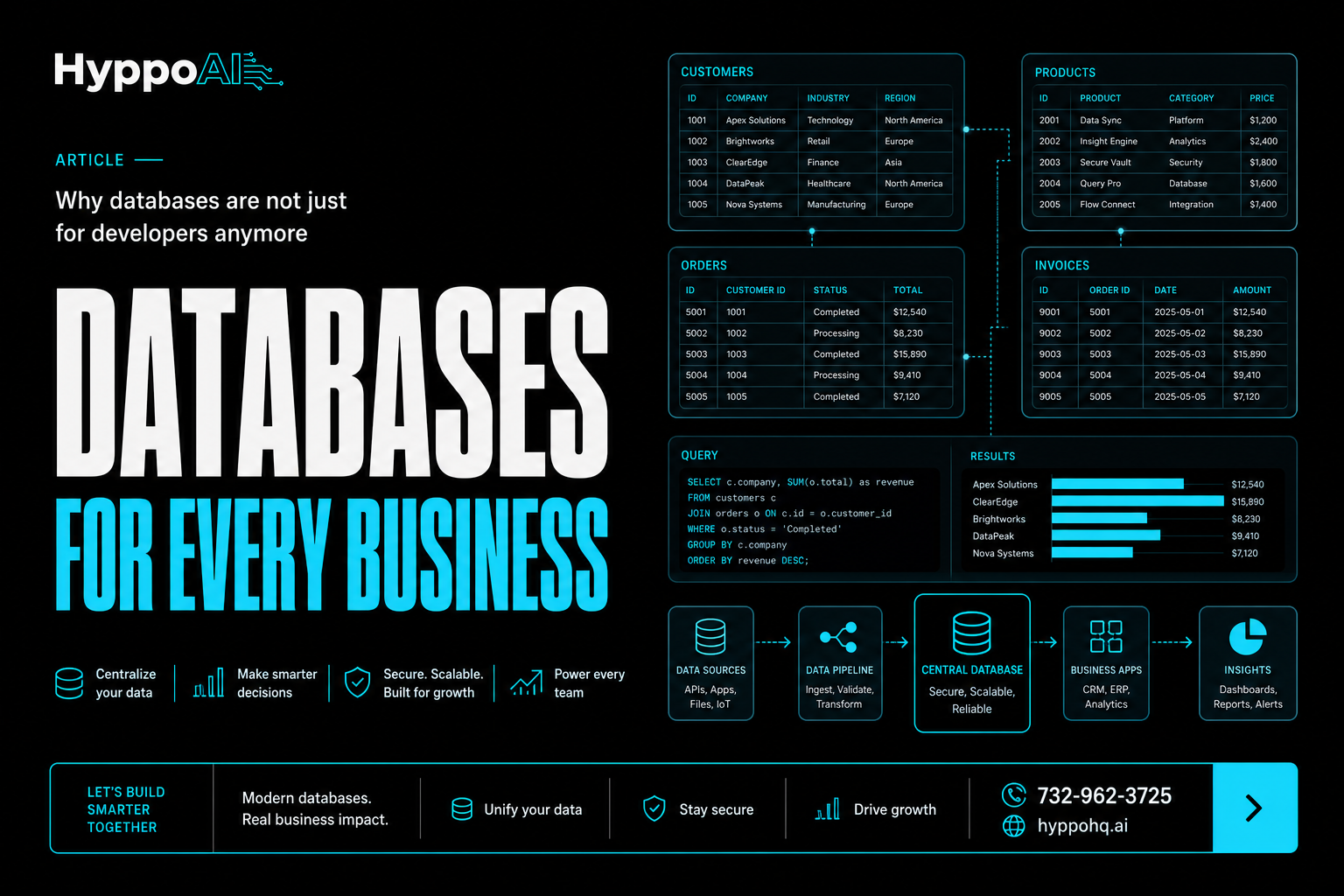
Why databases are not just for developers anymore
Most business owners hear the word "database" and think of developers, IT teams, or complex enterprise software.
That idea is outdated.
Today, databases sit behind many of the tools small and mid-sized businesses already use every day. Your CRM, scheduling platform, invoicing tool, marketing automation system, and AI workflows all rely on structured data. In plain terms, a database is just an organized way to store, update, and use information.
If you run a business, databases matter to you because your operations run on information.
What a database actually is
A database is a system for storing information in a way that makes it easy to find, update, and use.
Think about the core records in a business:
- customer names and contact details
- lead sources
- appointments
- estimates and invoices
- service history
- support requests
- follow-up tasks
- team activity
When that information is scattered across spreadsheets, inboxes, sticky notes, and disconnected apps, things break. Leads get missed. Follow-up slows down. Reporting becomes unreliable. Team members waste time hunting for answers.
A database creates structure.
That structure is what makes automation, visibility, and scale possible.
Why this matters to non-developers
You do not need to write code to benefit from a database.
You just need to understand that every repeatable business process depends on clean, usable information. If your business wants to move faster, serve customers better, or use AI effectively, your data cannot stay messy.
For non-developers, databases help solve practical problems like:
- keeping customer records in one place
- tracking where leads came from
- triggering follow-up automatically
- reducing duplicate work
- seeing what is working in sales and operations
- giving AI tools the context they need to respond accurately
This is not a technical luxury. It is an operational advantage.
Databases power the tools you already use
Many business owners already rely on databases without realizing it.
Your CRM is built on a database. Your booking software uses one. Your email platform tracks contacts and behavior through one. Even a simple internal dashboard pulls from structured records somewhere in the background.
The shift is this: databases are no longer just infrastructure for software teams. They are now part of day-to-day business execution.
That means leaders in operations, sales, service, and marketing should care about how information is captured and organized.
Example: lead management
Imagine a service business receiving leads from:
- website forms
- phone calls
- social media
- paid ads
- referrals
Without a reliable database, those leads may land in different places and get handled inconsistently.
With a structured system, each lead can be:
- captured automatically
- tagged by source
- assigned to the right team member
- followed up with on schedule
- tracked through the pipeline
- measured for conversion and revenue
That is not a developer issue. That is a revenue issue.
Databases make automation possible
Automation sounds exciting, but automation without structure usually creates chaos faster.
A database is what gives automation rules something to act on.
For example, if a new lead enters your system, the database can store:
- name
- phone number
- service type
- zip code
- urgency level
- date submitted
From there, automation can do useful work:
- send a confirmation text
- notify your team
- create a task
- schedule a callback
- update pipeline status
- trigger reminder sequences
Without organized data, those actions become inconsistent or impossible.
This is one reason AI and automation projects fail. Businesses try to layer smart tools on top of disorganized information.
The tool is not the real problem. The underlying data is.
Better decisions start with better data
Most owners want clearer answers to simple questions:
- Which lead sources generate the best customers?
- How long does follow-up take?
- Where do deals stall?
- Which services are most profitable?
- How many inbound calls turn into booked jobs?
If your information lives in disconnected systems, those answers are hard to trust.
A database creates a single source of truth, or at least a more reliable operational record. That makes reporting more useful and decisions more logical.
Databases help teams move from guessing to knowing
When data is structured well, you can:
- spot bottlenecks faster
- identify missed revenue opportunities
- measure team performance fairly
- forecast demand more accurately
- improve customer experience with less friction
That is why databases matter far beyond engineering.
AI is only as useful as the data behind it
This is where the conversation becomes even more relevant for SMBs.
Businesses want AI to answer questions, qualify leads, summarize conversations, automate follow-up, and support customer service. But AI needs context.
That context comes from your business data.
If customer records are incomplete, inconsistent, or scattered, AI outputs become weaker. If your data is structured and accessible, AI becomes far more practical.
For example, an AI system can perform better when it can reference:
- customer history
- appointment status
- prior conversations
- product or service details
- internal process rules
In other words, databases are not separate from AI strategy. They are part of the foundation.
Common myths that hold businesses back
“We are too small to need a database”
If you have customers, leads, jobs, or recurring tasks, you already have data. The question is whether it is organized well enough to support growth.
“Our spreadsheet is enough”
Spreadsheets can work for simple tracking, but they often break down when multiple people need access, updates happen constantly, and automation is required.
“This is only for technical teams”
The technical side matters, but the business value comes from operations, visibility, and execution. Owners and managers should absolutely be involved.
“We can fix data later”
Later usually means after missed leads, poor reporting, and failed automation attempts. Clean structure early saves time and money.
What SMBs should focus on first
You do not need a massive transformation to benefit from better database thinking.
Start with the basics:
1. Identify your core business records
What information drives your day-to-day operations?
Usually this includes:
- leads
- customers
- jobs or appointments
- invoices
- follow-up tasks
- communications
2. Reduce duplicate entry
If your team enters the same information in multiple places, errors multiply. Look for ways to centralize records.
3. Standardize key fields
Names, phone numbers, statuses, service types, and lead sources should be captured consistently.
4. Connect your systems
Your CRM, forms, phone system, scheduling, and automation tools should not operate in isolation if they are all part of the same customer journey.
5. Build around action, not storage
A good database is not just a digital filing cabinet. It should support follow-up, reporting, accountability, and automation.
The real takeaway
Databases are not just for developers because business performance is not just about code.
It is about how information flows through your company.
When your data is structured well, your team moves faster, your automations work better, your reporting becomes more useful, and your AI tools become more effective.
That is why databases matter to owners, operators, marketers, sales teams, and service managers, not just technical staff.
If your business is serious about scaling with AI and automation, start by treating your data like an asset instead of an afterthought.
Want help turning messy business data into systems that actually support growth? Visit HyppoAI at https://hyppohq.ai or call +17329623725 to see how smarter data structure, automation, and AI can help your business run better.
