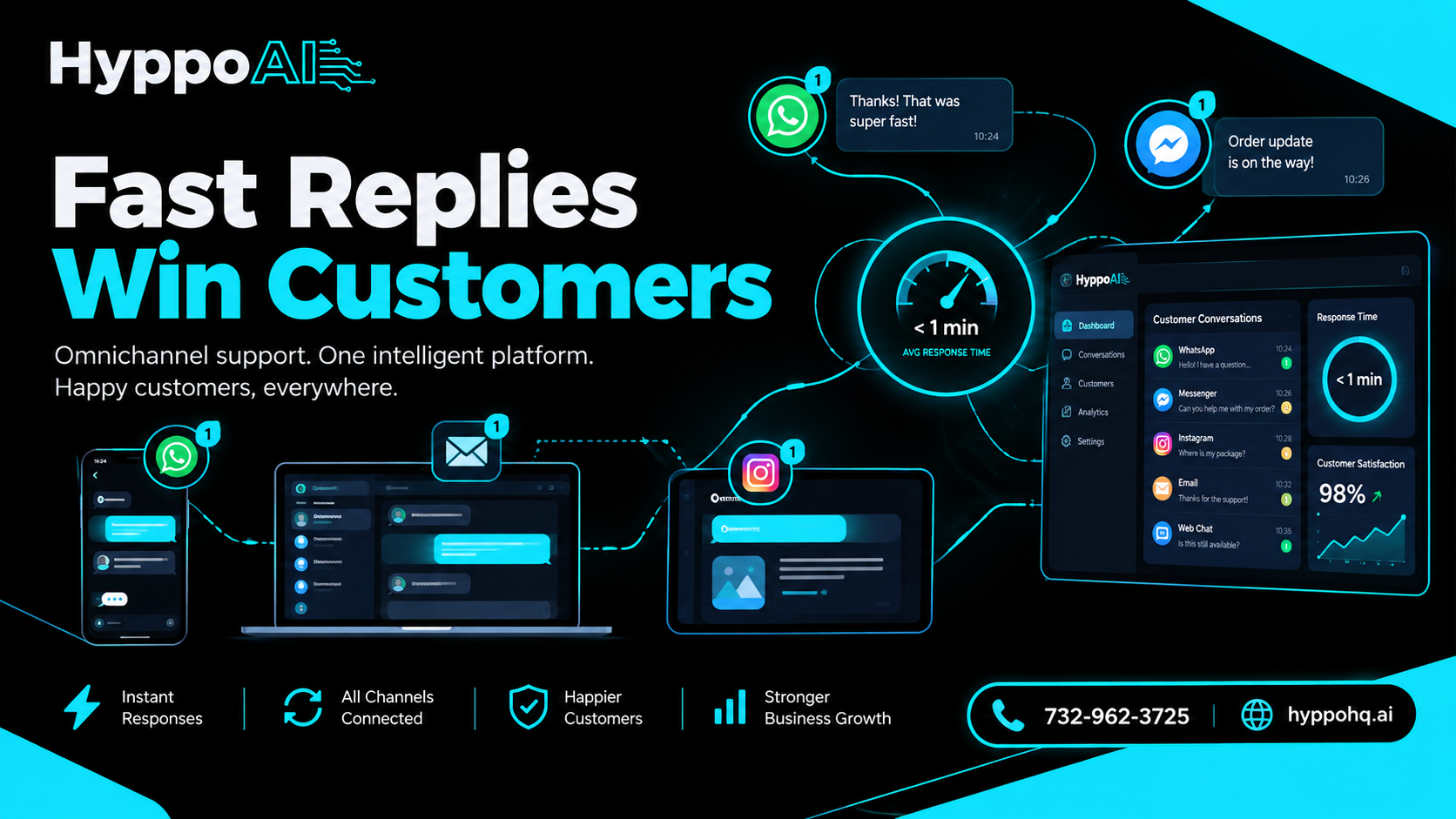
Why customers expect fast replies on every platform
Customers do not separate your business by channel.
They do not think, “Instagram is for browsing, email is for tomorrow, and website chat is for next week.” They just see your brand. And when they ask a question, they expect a fast reply no matter where they reached out.
That expectation is not a trend. It is the new baseline.
For small and mid-sized businesses, this creates both pressure and opportunity. The pressure comes from needing to respond across multiple platforms. The opportunity comes from the fact that speed now shapes trust, conversions, and customer loyalty.
Fast replies are now part of the customer experience
A fast response used to feel like great service. Now it feels normal.
Customers are used to instant access in almost every part of their digital lives. They can order food, book appointments, track packages, and message brands in seconds. That constant convenience changes what they expect from every business they interact with.
When someone sends a DM, fills out a website form, replies to a text, or emails your team, they are usually looking for one of three things:
- A quick answer
- A next step
- Confirmation that someone is paying attention
If they do not get that quickly, they often move on.
For SMBs, that means response time is no longer just a support metric. It is part of marketing, sales, and retention.
Every platform feels like the front door
Your website is not your only first impression anymore.
Customers may discover your business through:
- Google Business Profile
- Facebook Messenger
- Instagram DMs
- Website chat
- Contact forms
- SMS
- Review platforms
To the customer, each of these is a valid place to start a conversation. They assume your business is present and responsive wherever you appear.
That is why every platform now acts like a front door.
If one door is open and another is ignored, the customer does not think about internal staffing limitations. They simply feel friction.
Channel convenience drives behavior
People choose the platform that feels easiest in the moment.
A customer on mobile might send a quick Instagram message instead of filling out a form. Someone at work may prefer email. A returning customer may text because it is faster than calling.
The point is simple: customers do not adapt to your preferred workflow. They choose theirs.
Businesses that win make it easy to start and continue the conversation anywhere.
Speed signals competence and trust
Fast replies do more than answer questions. They send a message.
They tell customers:
- This business is organized
- This team is active
- Someone will follow through
- I can trust them with my time
Slow replies often send the opposite signal, even when the business does great work.
In many cases, customers are not comparing you only on price or product. They are comparing how easy you are to reach and how quickly you respond.
That matters even more in competitive local markets, where several businesses may offer similar services.
Slow responses create invisible losses
Not every lost lead tells you they left because of delay.
They just stop replying. They book elsewhere. They buy from a competitor. Or they decide not to move forward at all.
These are invisible losses, and they add up.
A missed message on one platform can mean:
- A lost sale
- A missed appointment
- A weaker first impression
- A negative review later
- Lower trust before the conversation even starts
For SMBs, this is where operational gaps become revenue gaps.
Social platforms trained customers to expect immediacy
Social media changed more than marketing. It changed communication speed.
People are used to real-time interaction. They see who is active, who has read messages, and which brands respond publicly. That visibility raises expectations across all channels, not just social.
If a business posts regularly but takes days to answer simple questions, customers notice the mismatch.
They assume that if you have time to publish, you should have time to respond.
This is one reason fast replies matter so much. Responsiveness now feels like proof that the business is real, current, and engaged.
Customers expect continuity across channels
Today’s customer journey is rarely linear.
Someone might:
- Find you on Google
- Check Instagram for credibility
- Visit your website
- Send a chat message
- Follow up by email
From their perspective, this is one conversation.
From the business side, it often becomes multiple disconnected threads.
That disconnect creates delays, repeated questions, and dropped follow-up.
Customers do not want to re-explain themselves every time they switch platforms. They expect continuity. They want your business to remember the context and keep moving.
SMBs feel the pressure most
Large companies may have bigger teams, but SMBs often need to deliver the same speed with fewer people.
That is the real challenge.
A small team may be juggling:
- Incoming calls
- Social messages
- Email inquiries
- Appointment scheduling
- Follow-up tasks
- Day-to-day operations
Without a clear system, response times slip fast.
And once replies become inconsistent, customer trust drops.
This is why the issue is not just about working harder. It is about building smarter communication systems.
What fast replies look like in practice
Fast replies do not always mean solving everything instantly.
Often, customers simply want acknowledgment and direction.
A strong fast-response experience usually includes:
- Immediate confirmation that the message was received
- A clear expectation for next steps
- Basic answers to common questions
- Routing to the right person when needed
- Consistent tone across platforms
That kind of responsiveness reduces friction without overwhelming your team.
Consistency matters as much as speed
A five-minute reply on one platform and a two-day delay on another creates confusion.
Customers notice inconsistency quickly.
The goal is not just to be fast in one place. It is to create a reliable response experience across the channels your customers actually use.
That often means documenting workflows, standardizing replies, and using automation where it makes sense.
How AI can help SMBs meet modern expectations
This is where AI becomes practical, not theoretical.
For SMBs, AI can help close the gap between customer expectations and team capacity. It can support faster first responses, better lead capture, and smoother follow-up across platforms.
Used well, AI can help businesses:
- Respond instantly to common inquiries
- Capture leads after hours
- Route conversations to the right next step
- Reduce missed messages
- Maintain consistency in communication
- Support staff instead of replacing them
The key is using AI to remove bottlenecks, not add complexity.
At HyppoAI, the focus is on helping SMBs use AI in ways that improve operations and customer communication. When response speed improves, businesses often see better conversion, stronger trust, and fewer missed opportunities.
The real takeaway
Customers expect fast replies on every platform because digital behavior trained them to.
They have more choices, less patience, and higher expectations for convenience. Every message channel now feels like a direct line to your business, and every delay creates risk.
For SMBs, the answer is not trying to be everywhere manually at all times. The answer is building systems that make responsiveness scalable.
Fast replies are no longer a nice extra. They are part of the product, part of the brand, and part of the buying decision.
If your business wants to keep up with modern customer expectations, HyppoAI can help you build smarter response systems with AI. Visit https://hyppohq.ai or call +17329623725 to learn how to respond faster, capture more leads, and create a better customer experience across every platform.
