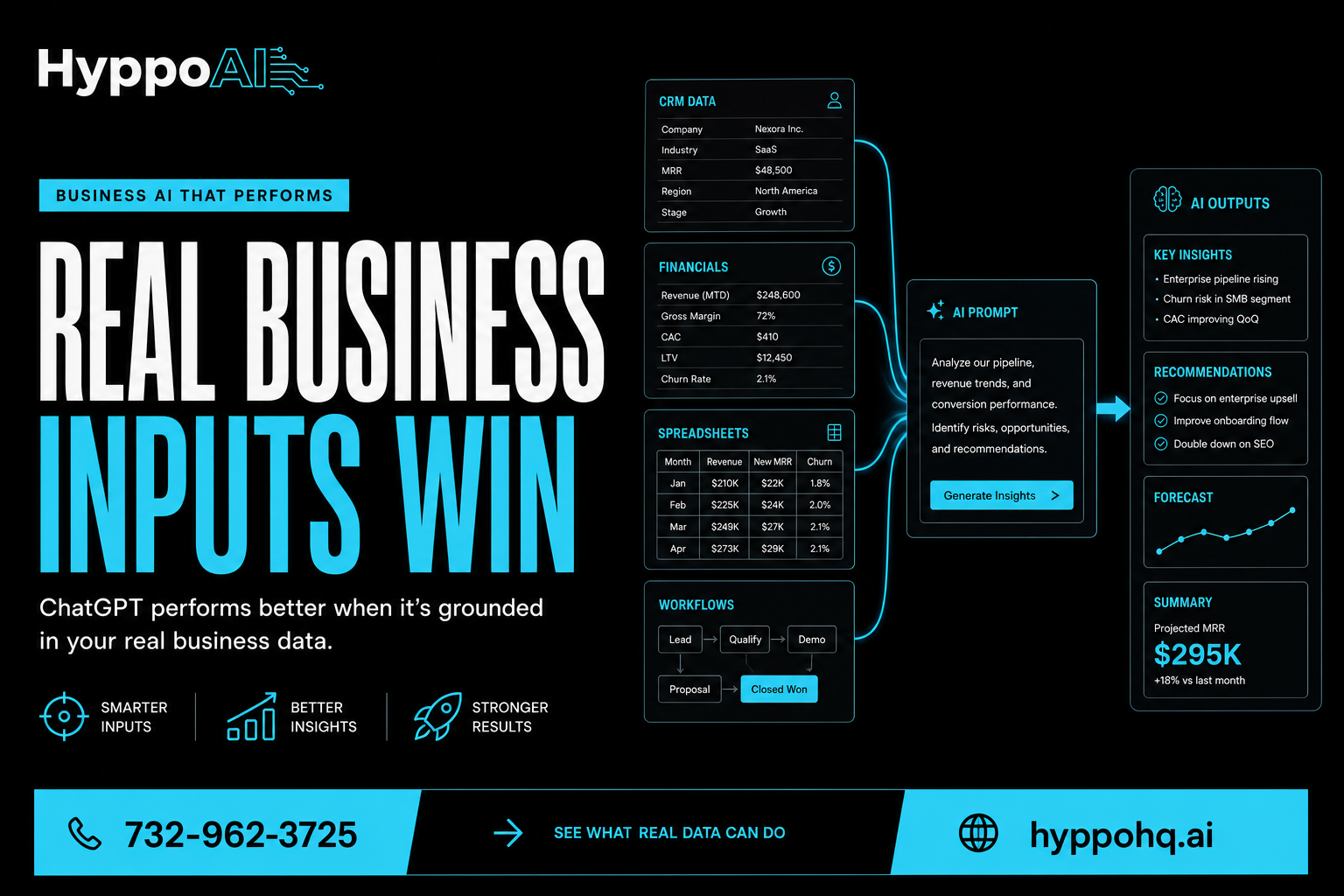
Why ChatGPT works best with real business inputs
ChatGPT is powerful, but it is not magic.
If you want useful output, you need useful input. That is the difference between getting a generic answer and getting something that actually helps your business move faster.
For small and midsize businesses, this matters even more. Time is limited. Teams are lean. Every workflow, follow-up, and customer interaction needs to produce value. When ChatGPT is fed real business inputs, it can help create content, streamline operations, support sales, and improve customer communication in a way that feels practical instead of theoretical.
What “real business inputs” actually means
Real business inputs are the details that reflect how your company actually operates.
That includes things like:
- Your services and pricing structure
- Your target customer profile
- Your sales process
- Your FAQs and objections
- Your brand voice
- Your internal workflows
- Your customer support language
- Your past marketing performance
- Your location, service area, and business goals
Without this context, ChatGPT fills in the blanks with averages. It gives you the most likely answer based on broad patterns. That can be fine for brainstorming, but it is rarely enough for execution.
With real inputs, the model becomes much more useful. It starts producing responses that are aligned with your business, your customers, and your actual objectives.
Generic prompts lead to generic output
A lot of businesses try AI once, get a weak result, and assume the tool is overhyped.
Usually, the problem is not the model. The problem is the input.
If you ask ChatGPT to “write a follow-up email,” it can do that. But if you ask it to write a follow-up email for a Palm Bay service business targeting leads who requested a quote but never booked, using a direct and professional tone, with a clear call to action, the result gets much stronger.
The quality improves because the model has constraints. It knows who the audience is, what stage they are in, and what outcome matters.
Better context creates better decisions
ChatGPT does not understand your business automatically. It works by predicting the next best token based on the information you provide.
That means context is not optional. Context is the system.
When you provide real inputs, you help the model:
- Prioritize the right information
- Avoid vague recommendations
- Match your tone and positioning
- Reduce hallucinated assumptions
- Produce more usable first drafts
- Save time on revisions
For SMBs, this is where AI stops being a novelty and starts becoming an operational tool.
Why this matters for SMBs specifically
Large companies can afford inefficiency. Smaller businesses usually cannot.
If your team is using ChatGPT for marketing, admin work, customer communication, documentation, or lead follow-up, weak prompts create extra cleanup work. That defeats the purpose.
Real business inputs make AI practical because they reduce friction.
Instead of asking the model to guess, you give it the source material it needs to support the business.
Examples of high-value inputs
Here are a few examples of inputs that dramatically improve results:
Sales and lead management
Provide:
- Lead source information
- Common objections
- Offer details
- Follow-up timing
- Ideal customer profile
This helps ChatGPT generate better:
- Follow-up emails
- Text sequences
- Call scripts
- Quote reminders
- Re-engagement campaigns
Marketing and content
Provide:
- Brand voice guidelines
- Service descriptions
- Audience pain points
- Testimonials
- Existing website copy
This helps ChatGPT create better:
- Social captions
- Blog outlines
- Ad copy
- Email campaigns
- Landing page drafts
Operations and internal systems
Provide:
- SOPs
- Intake forms
- Team roles
- Workflow steps
- Repetitive admin tasks
This helps ChatGPT support:
- Process documentation
- Internal training materials
- Workflow summaries
- Task checklists
- Automation planning
Real inputs reduce wasted time
One of the biggest misconceptions about AI is that it saves time automatically.
It does not.
It saves time when the business gives it structure.
If your team keeps rewriting outputs, correcting assumptions, or stripping out fluff, then the process is still inefficient. The goal is not to generate more words. The goal is to generate useful work.
When ChatGPT has access to real business inputs, it can produce outputs that are closer to final. That means:
- Fewer edits
- Faster approvals
- More consistency across team members
- Better alignment with your actual process
That is where the ROI starts showing up.
The trust factor: accuracy matters
Businesses cannot afford to sound wrong.
If AI generates content that misrepresents your offer, confuses your process, or uses the wrong tone with customers, trust drops fast.
That is why real inputs matter beyond productivity. They also protect quality.
The more grounded the model is in your actual business data, the more likely it is to produce relevant and accurate output.
What to give ChatGPT before expecting strong results
If you want better performance, start by organizing the basics.
Give the model access to information such as:
- Your company overview
- Your service list
- Your pricing logic, if appropriate
- Your audience segments
- Your preferred tone of voice
- Your top customer questions
- Your sales and support scripts
- Your internal terminology
- Your business goals for the quarter
This does not need to be complicated. Even a simple internal reference document can make a big difference.
AI works best when it reflects your business reality
The strongest use of ChatGPT is not asking random questions. It is building a system where the model consistently works from your real operating context.
That is how businesses move from experimenting with AI to actually using it.
Instead of treating ChatGPT like a search box, treat it like a trained assistant that needs onboarding. The better the onboarding, the better the output.
This is especially important for SMBs trying to scale without adding unnecessary overhead. Real inputs help AI become more reliable, more specific, and more useful across departments.
A simple way to start
If you are not sure where to begin, start small.
Choose one business function and gather the real inputs behind it.
For example:
- A lead follow-up workflow
- A customer support response library
- A weekly content creation process
- A new client onboarding sequence
Then test ChatGPT using that material.
Measure the result based on speed, quality, and how much editing is still required. That gives you a practical baseline and shows where more context can improve performance.
Final takeaway
ChatGPT works best with real business inputs because context drives quality.
The model is only as useful as the information it receives. If you want outputs that sound sharper, convert better, and fit your operations, stop relying on generic prompts. Start feeding the system the real details behind how your business works.
If you want help turning your business knowledge into practical AI systems, HyppoAI can help. Visit https://hyppohq.ai or call +17329623725 to learn how AI can work more effectively inside your business.
