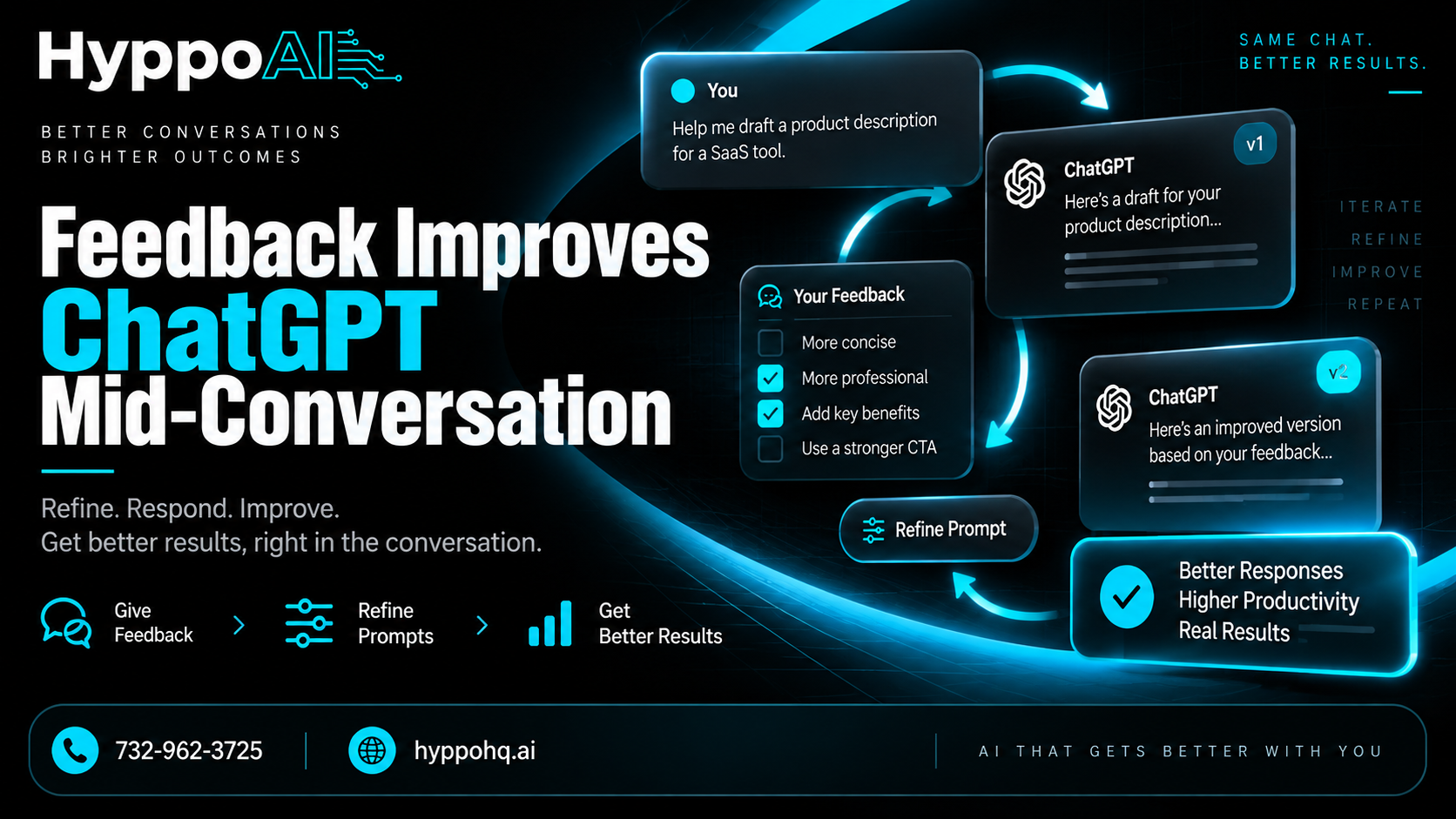
Why ChatGPT needs feedback to improve mid-conversation
ChatGPT can sound confident, polished, and fast. But one thing many users miss is this: it does not always improve on its own in the middle of a conversation.
If you want better answers, clearer structure, or more relevant output, your feedback matters. A lot.
For SMB teams using AI to save time, write content, support customers, or streamline operations, understanding this can make the difference between average results and genuinely useful work.
ChatGPT does not read your mind
Even when a model seems highly conversational, it still depends on the context you provide.
That means if a response is too vague, too long, off-brand, or technically incorrect, the model may keep heading in the wrong direction unless you redirect it.
It is not being stubborn. It is following patterns based on your prompt, your prior messages, and the likely next best response.
In other words, ChatGPT is responsive, not magically self-correcting.
Why feedback matters during a live conversation
Mid-conversation feedback helps the model update its working direction.
When you say things like:
- “Make this shorter”
- “Use a more professional tone”
- “That is not what I meant”
- “Focus on service businesses”
- “Give me three options instead of one”
You are narrowing the target.
That matters because AI performs best when the goal is specific. Without feedback, it may continue optimizing for the wrong style, audience, or format.
Feedback improves alignment
The biggest benefit of feedback is alignment.
You may know exactly what you want in your head, but the model only knows what has been said in the chat. If your expectations are not explicit, the output may drift.
Clear correction helps the model align with:
- Your tone
- Your intended audience
- Your formatting preferences
- Your business context
- Your definition of a good answer
Feedback reduces repetition
Sometimes ChatGPT repeats the same pattern in multiple replies. That usually happens when the original instruction was broad or when the model thinks it is being helpful by staying consistent.
A direct correction can break that loop.
For example, instead of saying “try again,” say:
- “Try again with less jargon”
- “Rewrite this for a small business owner”
- “Keep the same idea, but make it more concise”
Specific feedback creates better variation.
The model uses context, but context has limits
ChatGPT does use prior messages in a conversation. That is why it can feel like it remembers your goals.
But context is not the same as judgment.
The model does not independently decide, “This answer could be better, so I should revise my approach,” unless your input signals that change.
It predicts based on what is most likely useful from the conversation so far. If the conversation contains unclear or mixed instructions, the output may reflect that confusion.
Why “good enough” answers happen
Many users assume the first answer should be the final answer. In reality, the first response is often a draft.
That is not a flaw. It is part of how AI collaboration works.
Think of ChatGPT less like a mind reader and more like a fast-thinking assistant. A strong assistant improves quickly when you give direction.
What effective mid-conversation feedback looks like
The best feedback is short, concrete, and actionable.
Here are a few examples that work well:
Correct the format
If the output is structurally wrong, say so directly.
- “Turn this into bullet points”
- “Make this a 5-step list”
- “Write this as an email”
- “Use markdown headings”
Correct the tone
If the answer sounds off-brand or off-audience:
- “Make it more direct”
- “Use a no-nonsense tone”
- “Sound more confident and less academic”
- “Write for busy SMB owners”
Correct the scope
If the response is too broad or too narrow:
- “Focus only on lead follow-up”
- “Remove anything about enterprise teams”
- “Give examples for service businesses”
- “Keep this under 150 words”
Correct the assumptions
If the model misunderstood the task:
- “I am not asking for a definition”
- “This is for a blog post, not a social caption”
- “Assume the reader is non-technical”
- “Do not mention features we did not discuss”
Why this matters for SMBs using AI
Small and midsize businesses do not have time to waste on weak outputs.
If your team is using ChatGPT for marketing, customer communication, SOP drafting, idea generation, or internal operations, feedback is what turns AI from interesting to practical.
Without feedback, you may get:
- Generic content
- Unclear messaging
- Inconsistent brand voice
- Overly long responses
- Advice that does not fit your business
With feedback, you are much more likely to get useful, reusable work.
A better way to think about prompting
A lot of people treat prompting like a one-shot command. That is limiting.
A better approach is to treat prompting as iteration.
Start with a clear request. Then refine based on what you see.
That process usually looks like this:
- Ask for the first draft
- Identify what is off
- Give targeted feedback
- Request a revision
- Repeat until the output is usable
This is often faster than trying to write the perfect prompt from scratch.
Feedback is part of the workflow
Teams that get the best results from AI usually build feedback into the workflow.
They do not expect perfection on the first pass. They expect speed, then refinement.
That mindset helps teams:
- Produce better content faster
- Standardize outputs across staff
- Reduce editing time
- Improve AI adoption internally
Common mistake: vague feedback
Not all feedback improves results.
If you respond with “bad,” “wrong,” or “redo,” the model has very little to work with.
It may change something, but not necessarily the right thing.
Instead, explain what needs to change.
For example:
Bad: “This is not good”
Better: “This is too formal for our audience. Rewrite it in plain English.”
Bad: “Redo it”
Better: “Keep the core idea, but make it shorter and more persuasive.”
The more precise your correction, the better the next response tends to be.
Final takeaway
ChatGPT needs feedback to improve mid-conversation because it relies on your direction to refine its output. It can follow context, but it does not automatically know what you consider better unless you tell it.
For businesses, that is actually good news. It means stronger results are often just one or two clear corrections away.
If you want AI to produce sharper work, do not stop at the first answer. Guide it.
If your business is exploring practical AI systems for content, operations, and growth, HyppoAI can help. Visit https://hyppohq.ai or call +17329623725 to learn how smarter AI workflows can support your team.
