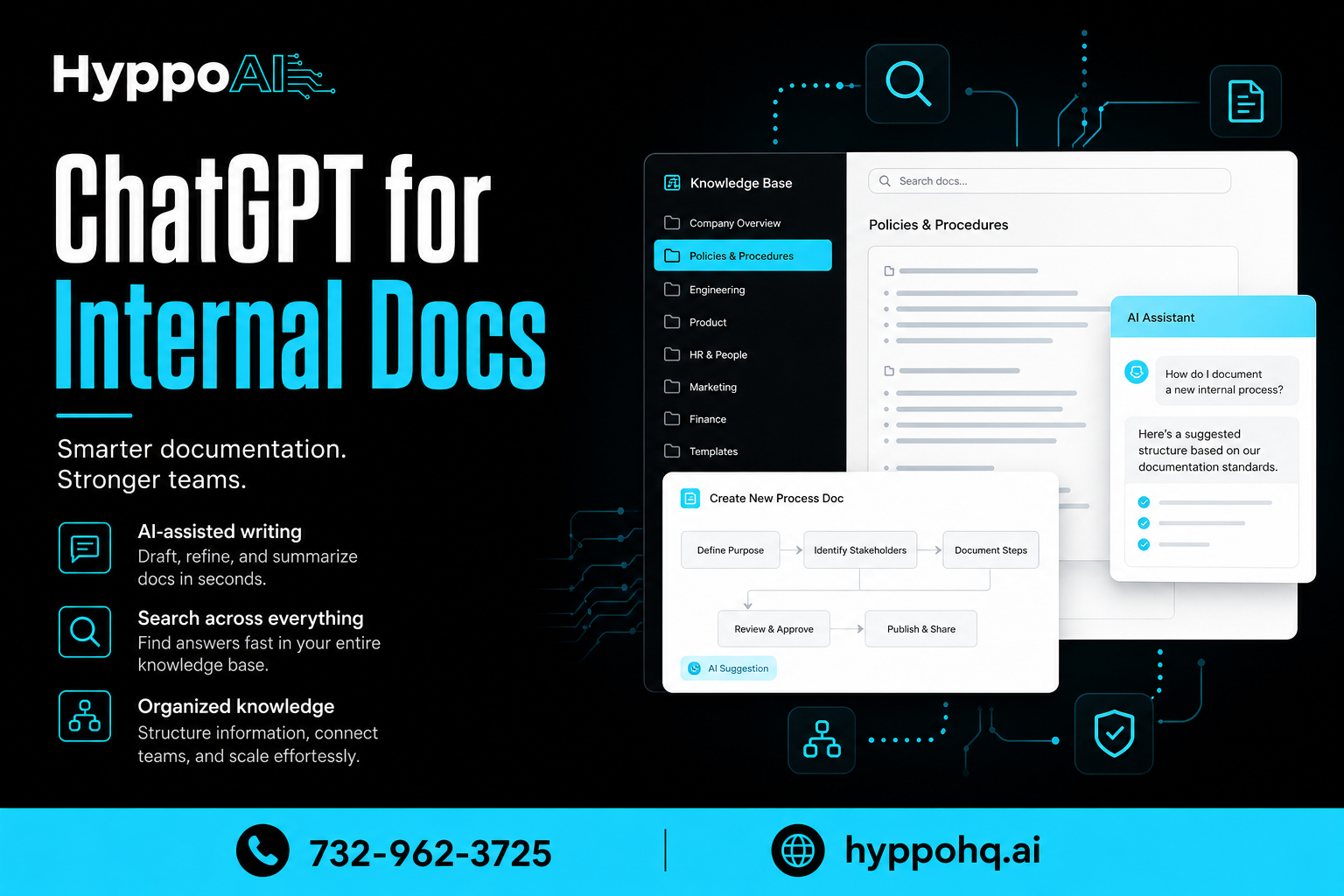
Why ChatGPT is useful for internal documentation
Internal documentation is one of those business systems that everyone knows matters, but few teams maintain consistently.
Processes change. Team members improvise. Knowledge lives in Slack threads, inboxes, and someone’s memory. Then when a new hire joins, a task gets handed off, or a mistake happens, the cost of weak documentation shows up fast.
That is why ChatGPT is useful for internal documentation.
It helps teams turn scattered knowledge into usable documents, reduce time spent writing from scratch, and keep operating procedures easier to update as the business grows. For SMBs especially, that matters. Most small teams do not have dedicated documentation specialists. They need practical tools that help them move faster without creating more overhead.
Why internal documentation breaks down
Most internal documentation does not fail because people do not care. It fails because the process is too slow.
Common problems include:
- SOPs that are outdated within weeks
- Repetitive explanations given in meetings or chat
- Inconsistent formatting across documents
- Knowledge trapped with one employee or department
- New hires depending on verbal training instead of written systems
- Teams avoiding documentation because writing takes too long
When documentation is hard to create, it gets postponed. When it is hard to update, it becomes unreliable. And when it is unreliable, people stop using it.
That creates operational drag.
How ChatGPT improves internal documentation
ChatGPT helps remove the friction that makes documentation difficult.
Instead of staring at a blank page, teams can use it to draft first versions quickly, summarize messy notes, standardize language, and rewrite technical ideas into clearer instructions.
This does not mean AI replaces human judgment. It means AI accelerates the parts of documentation work that usually slow teams down.
1. It speeds up first drafts
One of the biggest barriers to documentation is starting.
ChatGPT can turn rough bullet points, meeting notes, or process steps into a structured draft in seconds. That gives employees something to edit instead of asking them to write everything from zero.
For example, a team member can input:
- the purpose of a process
- the steps involved
- common mistakes
- tools required
- who owns the task
Then ChatGPT can format that into a cleaner SOP, checklist, or internal guide.
That time savings adds up quickly.
2. It makes documentation easier to standardize
Internal docs often become inconsistent when multiple people write them.
Some are too detailed. Some are too vague. Some use different terminology for the same task. That inconsistency makes documentation harder to trust and harder to search.
ChatGPT can help standardize:
- formatting
- tone
- section structure
- terminology
- level of detail
A business can create a simple documentation template and use ChatGPT to align future documents to that structure. The result is a cleaner internal knowledge base that feels more usable across teams.
3. It helps simplify complex information
Not every expert is a strong writer.
Often the person closest to a process knows exactly how it works but struggles to explain it clearly for someone else. ChatGPT is useful here because it can rewrite content for clarity without changing the core meaning.
That is especially valuable when documenting:
- technical workflows
- software procedures
- customer service escalation paths
- onboarding instructions
- internal policies
A subject matter expert can provide the raw information, and ChatGPT can help turn it into language that is easier for the rest of the team to follow.
4. It supports ongoing updates
Documentation is not a one-time project.
Processes evolve. Tools change. Responsibilities shift. If updating a document feels like a major task, teams delay it.
ChatGPT can make updates easier by helping users:
- revise old SOPs based on new steps
- condense long documents into quick-reference versions
- expand short notes into complete procedures
- compare two versions of a process and summarize changes
This makes documentation more maintainable over time, which is the real challenge for most businesses.
Practical use cases for SMB teams
For SMBs, ChatGPT is most useful when applied to real operational workflows.
Here are a few practical examples.
Onboarding documentation
New hires need consistent instructions. ChatGPT can help create:
- role-specific onboarding guides
- first-week checklists
- tool access instructions
- training summaries
- FAQ documents for common questions
This reduces dependence on verbal handoffs and helps new employees ramp faster.
Standard operating procedures
SOPs are essential for repeatable execution. ChatGPT can draft or improve procedures for:
- sales follow-up
- lead intake
- invoicing workflows
- appointment scheduling
- customer support processes
- internal approval systems
Clear SOPs reduce mistakes and make delegation easier.
Meeting and knowledge capture
A lot of useful information gets lost after internal meetings. ChatGPT can turn notes into:
- action summaries
- decision logs
- process updates
- internal memos
- next-step checklists
That helps preserve team knowledge instead of letting it disappear into chat history.
Cross-functional documentation
When multiple departments touch the same workflow, clarity matters.
ChatGPT can help document handoffs between:
- marketing and sales
- sales and operations
- support and account management
- leadership and department leads
This reduces confusion around ownership, timing, and expectations.
Best practices for using ChatGPT for documentation
ChatGPT is powerful, but results improve when teams use it intentionally.
Start with structured inputs
The better the input, the better the output.
Instead of asking for a vague document, provide:
- the goal of the process
- who the document is for
- step-by-step notes
- required tools or systems
- exceptions or edge cases
- desired format
That gives ChatGPT enough context to produce something useful.
Use human review
Internal documentation should always be reviewed by the person who owns the process.
AI can help draft, rewrite, and organize content, but the team still needs to verify accuracy. This is especially important for policy, compliance, finance, or customer-facing workflows.
Build templates
To get consistent results, create repeatable prompts and templates for common document types.
Examples include:
- SOP template
- onboarding guide template
- meeting summary template
- troubleshooting checklist template
- department handoff template
Once those are in place, ChatGPT becomes much more efficient as a documentation assistant.
Keep documents living, not static
The goal is not just to create documents. The goal is to create systems people actually use.
Review documentation regularly. Update it when processes change. Use ChatGPT to reduce the workload of maintaining that system.
What ChatGPT does not replace
It is important to be realistic.
ChatGPT does not replace operational leadership. It does not automatically know your business rules. It does not fix broken processes by itself.
If a workflow is unclear, undocumented, or inconsistent in real life, AI may help surface those gaps, but it cannot invent the right process for your team without direction.
The best results happen when businesses combine:
- clear ownership
- defined workflows
- strong review habits
- AI-assisted drafting and editing
That combination is where documentation becomes a true asset instead of an afterthought.
Why this matters for growing businesses
As a business grows, undocumented knowledge becomes expensive.
It slows onboarding, creates execution gaps, increases errors, and makes delegation harder than it should be. Strong documentation creates leverage. It helps teams operate with more consistency, train faster, and scale with less chaos.
That is why ChatGPT is useful for internal documentation. It lowers the effort required to create and maintain the systems that keep a business running.
For SMBs, that is not just a productivity win. It is an operational advantage.
If your team wants practical ways to use AI to improve documentation, workflows, and day-to-day operations, HyppoAI can help. Visit https://hyppohq.ai or call +17329623725 to learn more.
