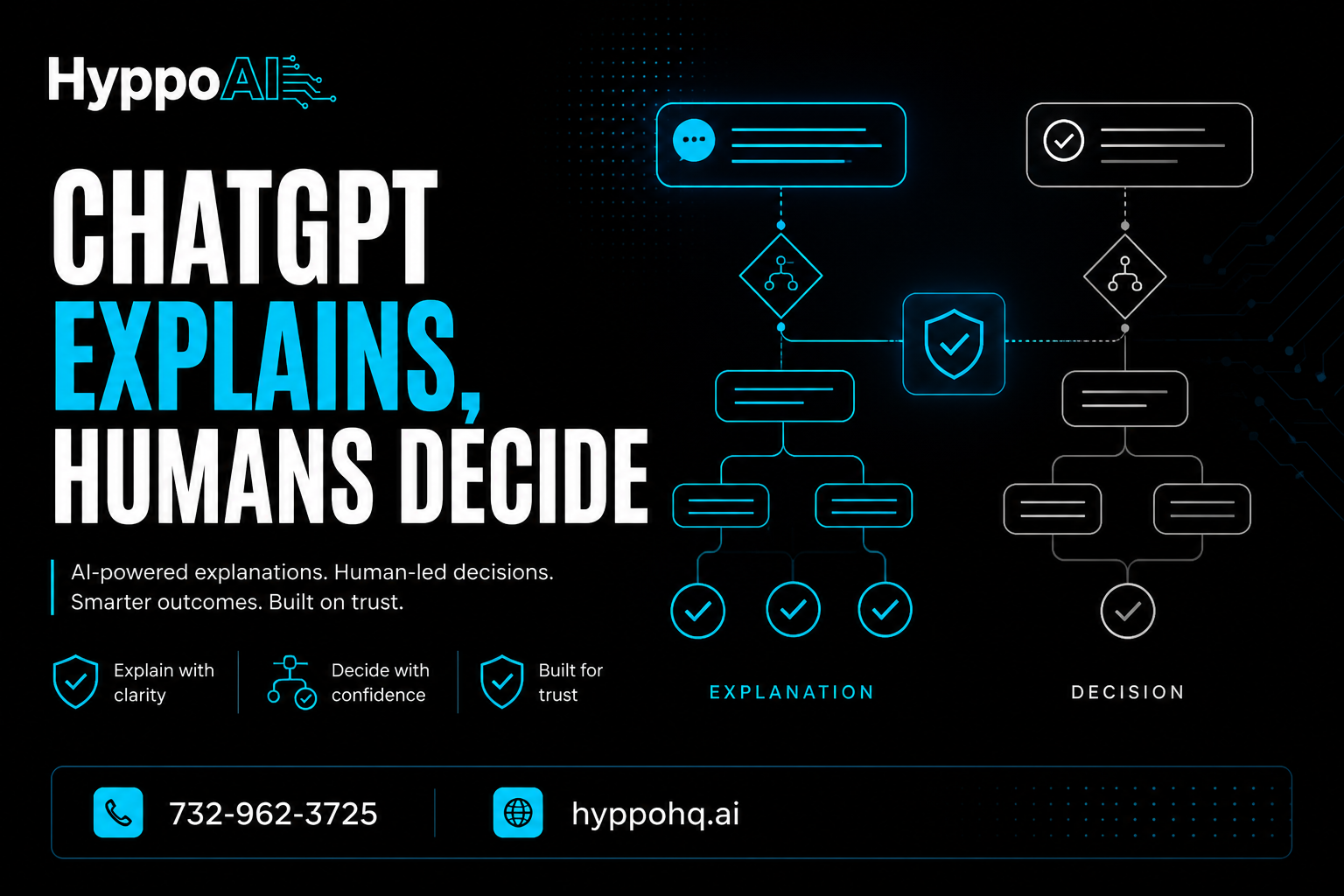
Why ChatGPT is better at explaining than deciding
ChatGPT is excellent at turning messy information into clear language. It can summarize options, compare tradeoffs, and explain complex topics in seconds.
What it should not do is make your final decision for you.
That distinction matters, especially for small and midsize businesses. When teams start treating AI like an authority instead of a tool, they risk faster confusion instead of faster progress.
At HyppoAI, we see the real value of AI in helping businesses think better, communicate faster, and operate more efficiently. But the smartest use of ChatGPT starts with understanding what it does well and where human judgment still matters most.
ChatGPT is built to predict language, not own outcomes
ChatGPT feels intelligent because it responds in polished, natural language. That can make its answers sound more certain than they really are.
Under the hood, it is not weighing responsibility, context, politics, risk tolerance, or long-term business consequences the way a leader does. It is generating the most likely useful response based on patterns in data and prompts.
That makes it strong at explanation.
It makes it weaker at decision-making.
Why explanation is its strength
ChatGPT is especially useful when you need to:
- simplify a technical concept
- summarize a meeting or report
- compare pros and cons
- reframe an idea for a different audience
- draft options for review
- organize scattered thinking into a usable structure
These tasks depend on clarity, speed, and language fluency. That is where the tool shines.
Why deciding is different
Good decisions are not just about information. They also involve:
- incomplete facts
- risk appetite
- timing
- accountability
- business goals
- internal politics
- customer impact
- legal or financial consequences
A model can help surface considerations, but it does not live with the result. Your team does.
Explanation reduces friction
One reason ChatGPT is so valuable in business is that explanation removes bottlenecks.
A lot of work slows down because people do not fully understand the issue in front of them. Teams talk past each other. Experts use jargon. Owners get buried in details. Managers struggle to turn ideas into clear next steps.
ChatGPT helps close that gap.
For example, it can:
- explain an operations problem in plain English
- turn raw notes into a client-ready summary
- break a strategy into step-by-step actions
- rewrite a technical answer for a non-technical stakeholder
- give staff a faster starting point for communication
That is not a small benefit. Better explanation improves execution.
Decision-making needs context that often stays unspoken
In many SMBs, the most important decision factors are not neatly documented.
They live in the owner's head, inside team dynamics, or in the realities of the market. Maybe a vendor looks best on paper, but you know they are unreliable. Maybe a process seems efficient, but your staff will never adopt it. Maybe a marketing plan sounds smart, but it does not fit your cash flow this quarter.
ChatGPT can miss those hidden constraints unless you explicitly provide them.
Even then, it is still responding to what is written, not what is felt, observed, or politically understood inside the business.
The confidence problem
One of the biggest risks is that ChatGPT often presents answers with smooth confidence.
That style is useful for explanation, but dangerous for decisions. A confident response can create the illusion that a recommendation has been fully validated when it has not.
For business owners, that means AI outputs should be treated as:
- drafts, not directives
- inputs, not approvals
- frameworks, not final calls
The best use case: decision support, not decision replacement
This is where many businesses get the most value.
Use ChatGPT to improve how decisions are prepared, not to outsource the decision itself.
That means asking it to:
- list the tradeoffs between options
- identify missing information
- stress-test your reasoning
- summarize stakeholder viewpoints
- outline risks you may have overlooked
- create a decision matrix for review
These are high-value uses because they sharpen human judgment instead of replacing it.
A better prompt mindset
Instead of asking:
- What should I do?
Ask:
- What are the strongest arguments for and against this option?
- What assumptions am I making?
- What risks should I evaluate before deciding?
- How would a CFO, operator, or customer view this?
- What information is missing from this decision?
That small shift changes AI from a fake authority into a practical thinking partner.
Why this matters for SMBs
Large enterprises may have layers of analysts, legal review, and formal decision systems. SMBs usually move faster with fewer buffers.
That creates opportunity, but it also raises the cost of poor judgment.
If a small business uses ChatGPT to explain pricing changes, train staff, document SOPs, or summarize customer feedback, the upside is immediate.
If that same business lets AI decide hiring priorities, vendor selection, customer policy, or strategic direction without human oversight, the downside can be expensive.
For SMBs, the smart path is simple:
Use AI for speed where clarity matters
Great examples include:
- internal documentation
- customer communication drafts
- onboarding materials
- process explanations
- marketing ideation
- meeting summaries
Keep humans in control where consequences matter
That includes:
- financial decisions
- hiring and firing
- legal-sensitive communication
- strategic planning
- customer exception handling
- brand positioning
ChatGPT can help you think, but it should not replace judgment
The strongest teams do not use AI to avoid thinking. They use it to think more clearly.
That is the real advantage.
ChatGPT can accelerate understanding. It can surface options faster. It can make complex topics easier to act on. But deciding still requires ownership, experience, and context.
In other words, explanation is scalable. Accountability is not.
A practical rule to remember
If the task is mainly about clarity, structure, or communication, ChatGPT is probably a strong fit.
If the task carries real business consequences and depends on nuance, values, or accountability, a human should make the final call.
That rule alone can help businesses avoid one of the most common AI mistakes: using a language tool as if it were a leader.
Final takeaway
ChatGPT is better at explaining than deciding because language prediction is not the same as judgment.
Used correctly, it becomes a powerful tool for faster understanding and better preparation. Used carelessly, it can create polished but shallow answers that sound more reliable than they are.
The goal is not to trust AI less. It is to use it more intelligently.
If you want to explore practical AI systems for your business, visit HyppoAI at https://hyppohq.ai or call +17329623725 to learn how smarter automation can support your team without replacing sound decision-making.
