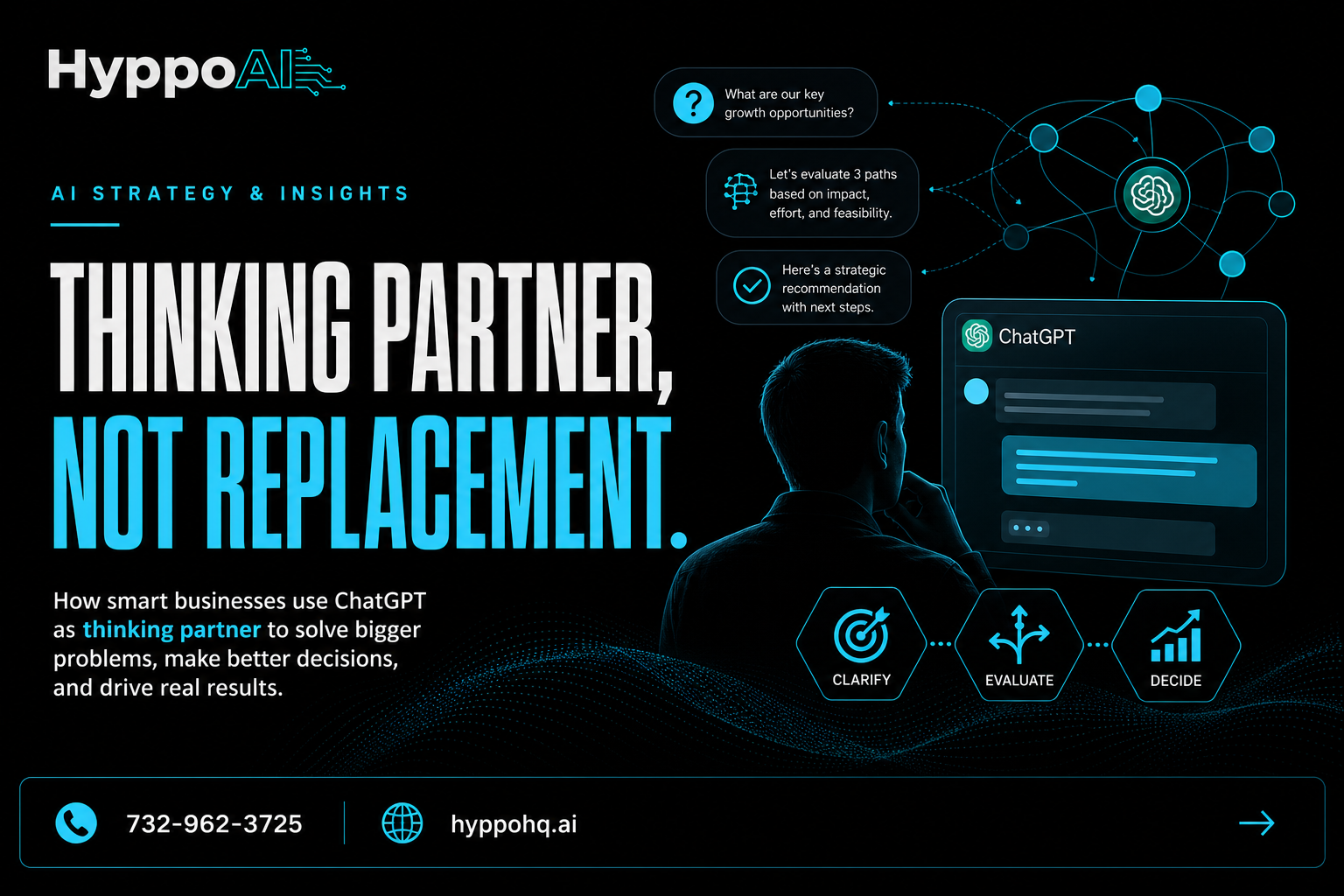
Why ChatGPT is best used as a thinking partner
ChatGPT is often framed as a tool that gives answers. That framing is incomplete.
The real advantage of ChatGPT is not that it can think for you. It is that it can think with you.
When you use ChatGPT as a thinking partner, you get better ideas, clearer decisions, and faster execution. When you use it as a replacement for judgment, strategy, or expertise, the quality drops fast.
For small and mid-sized businesses, this distinction matters. Teams do not need more generic output. They need faster clarity, stronger decision support, and a practical way to move from rough ideas to useful action.
What it means to use ChatGPT as a thinking partner
A thinking partner helps you:
- clarify what you are actually trying to solve
- explore options you may not have considered
- pressure-test assumptions
- structure messy thoughts into a usable plan
- improve communication before you send it out
That is where ChatGPT performs best.
Instead of asking it to deliver a perfect final answer from scratch, use it to improve your own reasoning. Give it context. Ask it to challenge your plan. Have it summarize tradeoffs. Let it turn a rough concept into a framework you can review and refine.
This creates a much better workflow than simply typing a vague prompt and hoping for brilliance.
Why this approach works better than “just write it for me”
Many people start with AI by asking for instant deliverables:
- write this email
- create this proposal
- build this strategy
- make this sales script
There is nothing wrong with that. But if the prompt is shallow, the result is usually shallow too.
ChatGPT is powerful, but it does not automatically know your business priorities, customer nuance, operational constraints, or risk tolerance. If you skip your own thinking, the output often sounds polished while missing what matters.
Using ChatGPT as a thinking partner solves that problem.
It improves the quality of your inputs
Better inputs produce better outputs. When ChatGPT helps you define the goal, audience, constraints, and success criteria first, the final result becomes more relevant.
It helps you see blind spots
Sometimes the most valuable response is not an answer. It is a question you forgot to ask.
For example, ChatGPT can help surface:
- hidden assumptions in a plan
- objections a customer may have
- operational risks in a new process
- simpler alternatives to a complex idea
It speeds up iteration
Business teams rarely need one perfect answer. They need to move through drafts quickly.
ChatGPT is excellent at iteration:
- version 1 for speed
- version 2 for clarity
- version 3 for tone
- version 4 for stakeholder concerns
That back-and-forth is where the value compounds.
Where SMBs get the most value
For SMB owners and operators, time is limited and decisions carry weight. ChatGPT works especially well as a thinking partner in areas where clarity matters more than raw content generation.
Strategy and planning
Use ChatGPT to:
- organize business goals into priorities
- compare multiple growth ideas
- map risks and dependencies
- turn broad plans into step-by-step actions
A useful prompt might be: “Here is my growth plan for the next quarter. Identify weak spots, missing assumptions, and the top three execution risks.”
Sales and marketing
Instead of asking only for copy, ask ChatGPT to help refine the message first.
You can use it to:
- identify the real customer pain point
- sharpen positioning
- create multiple angles for the same offer
- stress-test whether a message is clear or generic
This leads to stronger emails, ads, captions, landing pages, and follow-up sequences.
Operations and process improvement
Operations often live in messy documents, habits, and tribal knowledge. ChatGPT can help turn that into structure.
Ask it to:
- document a workflow
- simplify a handoff process
- identify bottlenecks
- create SOP outlines from rough notes
That does not replace operator judgment. It accelerates it.
Decision support
When a decision feels unclear, ChatGPT can help frame it.
For example:
- summarize pros and cons
- compare short-term and long-term effects
- identify what data is missing
- suggest criteria for making the decision
This is especially useful when you are too close to the problem and need a neutral structure for thinking.
What ChatGPT should not replace
Calling ChatGPT a thinking partner also means recognizing its limits.
It should not replace:
- final business judgment
- domain expertise
- legal or financial advice
- accountability for outcomes
- real customer understanding
AI can support analysis, but it does not own the consequences of a decision. Your team does.
That is why the strongest AI users are not the people who blindly accept outputs. They are the people who direct, evaluate, and refine them.
How to get better results from ChatGPT
If you want ChatGPT to function like a real thinking partner, change the way you prompt it.
Give context first
Include the basics:
- what you are trying to do
- who the audience is
- what constraints exist
- what a good outcome looks like
Context turns generic responses into useful ones.
Ask it to challenge you
Do not use ChatGPT only for agreement. Ask it to critique your reasoning.
Try prompts like:
- “What is weak about this plan?”
- “What assumptions am I making?”
- “What would a skeptical customer say?”
- “What is a simpler way to solve this?”
Use it for frameworks, not just finished drafts
Ask for:
- outlines
- decision trees
- comparison tables
- prioritization models
- meeting agendas
Frameworks are easier to validate than polished but ungrounded final copy.
Iterate with intention
Do not stop at the first response.
Refine by saying:
- “Make this more practical.”
- “Reduce jargon.”
- “Rewrite this for an SMB owner.”
- “Turn this into three action steps.”
Good AI use is often less about one prompt and more about guided iteration.
The mindset shift that matters most
The biggest mistake people make with ChatGPT is expecting certainty on demand.
The better mindset is collaboration.
Think of ChatGPT as a fast, always-available partner that helps you:
- think through ambiguity
- organize complexity
- generate alternatives
- tighten communication
- move from idea to execution faster
That is a much more realistic and valuable role.
For SMBs, this matters because speed alone is not enough. Speed without judgment creates noise. Speed with structured thinking creates leverage.
Final takeaway
ChatGPT is best used as a thinking partner because its greatest strength is not replacing human intelligence. It is amplifying it.
When you bring context, judgment, and clear goals, ChatGPT can help you think more clearly, write more effectively, and make better business decisions faster. That is where the real ROI shows up.
If your business is exploring practical AI use for growth, operations, or productivity, HyppoAI helps SMBs apply AI in ways that are useful, not theoretical. Visit https://hyppohq.ai or call +17329623725 to learn more.
