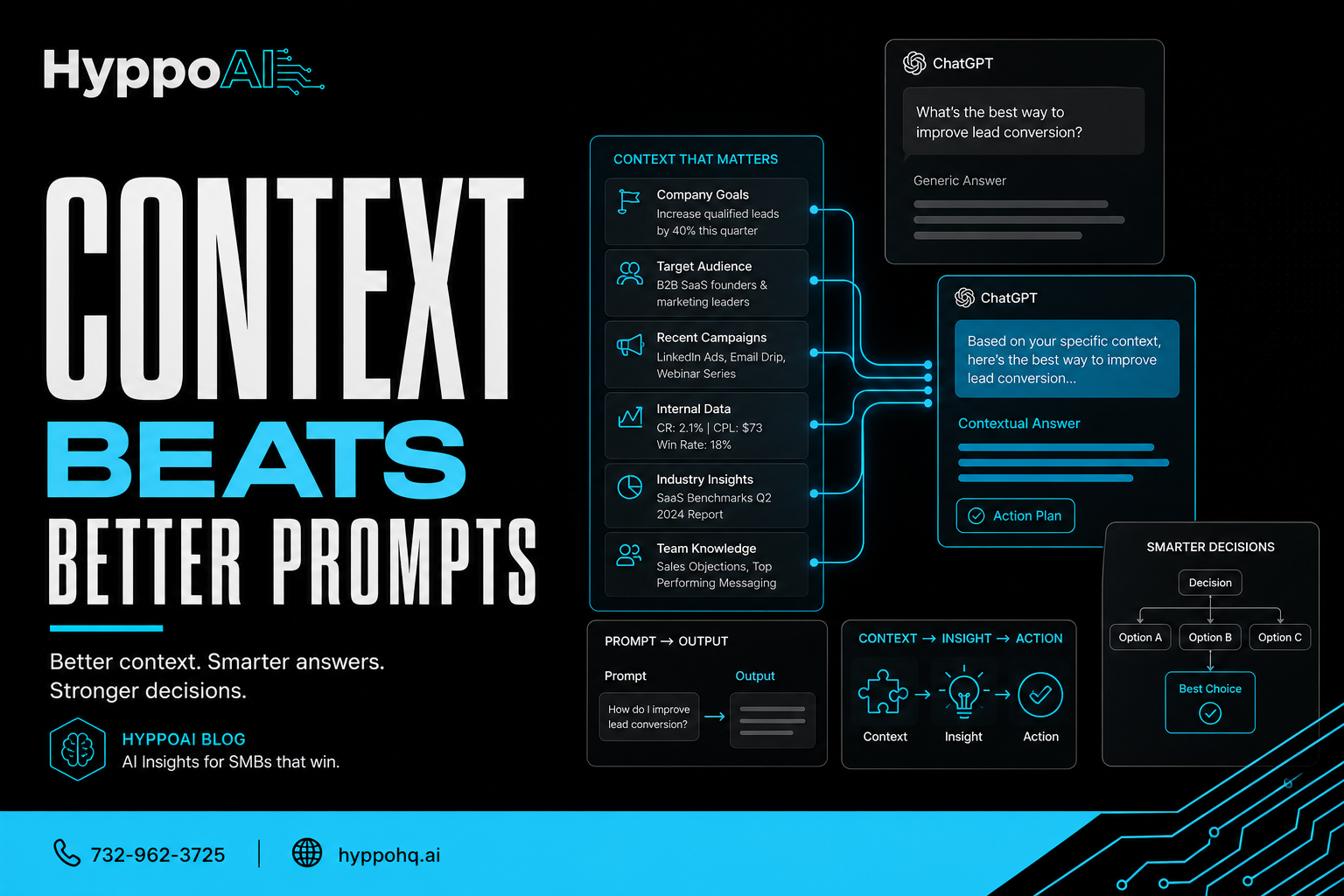
Why ChatGPT context matters more than better questions
Most people think the secret to better AI results is asking better questions.
That helps, but it is not the main lever.
If you want stronger outputs from ChatGPT, context matters more than clever wording. A polished prompt cannot rescue missing business details, unclear goals, or vague constraints. ChatGPT performs best when it understands the situation around the task, not just the task itself.
For SMBs, this matters a lot. Teams often test AI with one-line prompts, get generic results, and decide the tool is overrated. In reality, the issue is usually not the model. It is the missing context.
What context means in ChatGPT
Context is the information that helps ChatGPT understand what you are trying to do, why it matters, and what a good answer should look like.
That can include:
- Your business type
- Your customer
- The goal of the task
- Brand voice
- Constraints or rules
- Examples of what good looks like
- Relevant background information
- Tools, systems, or workflows involved
A question asks for an answer.
Context tells ChatGPT how to arrive at the right one.
Why better questions are not enough
A better question can improve clarity. But clarity without context still produces shallow output.
For example, asking:
- "Write a follow-up email for a lead"
is clear.
But it is still incomplete.
ChatGPT does not know:
- What industry you are in
- What the lead asked about
- What tone your business uses
- What offer you want to present
- What objection you need to address
- What action you want the reader to take
Without that information, the result will usually sound generic. It may be usable as a draft, but it will not feel tailored to your business.
Now compare that with a prompt that includes context:
- "Write a follow-up email for a roofing company lead who requested a quote three days ago. Use a direct, professional tone. Acknowledge that they may still be comparing options. Keep it under 150 words and end with a clear CTA to schedule a call this week."
That is not just a better question. It is a better context package.
Context reduces generic output
The biggest complaint people have about AI writing is that it sounds robotic, broad, or repetitive.
That usually happens when the model has to fill in too many blanks.
When context is thin, ChatGPT defaults to safe patterns. It gives average answers because it has no reason to be specific.
When context is rich, the output becomes more useful because the model can make better decisions about:
- Tone
- Structure
- Priorities
- Relevance
- Depth
- Examples
In simple terms, context narrows the target.
The narrower the target, the better the response.
Context helps ChatGPT act like a real assistant
Business owners do not need AI to be impressive. They need it to be useful.
Useful AI behaves less like a search bar and more like an assistant who understands the assignment.
That only happens when you provide enough context up front.
Think about how you brief a team member. You would not walk up and say, "Make this better," then disappear.
You would explain:
- What the project is
- Who it is for
- What success looks like
- What to avoid
- When you need it
ChatGPT works the same way.
The more your prompt resembles a real brief, the better the result tends to be.
The four types of context that matter most
If you want better outputs fast, focus on these four categories.
1. Business context
Tell ChatGPT what kind of company you run and who you serve.
Examples:
- "We are an AI company serving SMBs"
- "Our customers are local service business owners"
- "We help teams automate follow-up and lead handling"
This gives the model a frame of reference.
2. Task context
Explain the specific job you want completed.
Examples:
- "Write a sales email"
- "Summarize this meeting"
- "Create a social post from this case study"
- "Turn these notes into a standard operating procedure"
Be direct about the deliverable.
3. Outcome context
Define what success looks like.
Examples:
- "The goal is to book a demo"
- "The goal is to reduce no-shows"
- "The goal is to make this easier for a non-technical owner to understand"
This helps ChatGPT optimize for the right result, not just complete the task.
4. Constraint context
Set boundaries.
Examples:
- Word count
- Tone of voice
- Audience knowledge level
- Required points to include
- Claims to avoid
- Formatting instructions
Constraints do not limit quality. They improve it.
A simple before-and-after example
Here is the difference in practice.
Weak prompt
"Write a post about AI answering phones."
Stronger prompt with context
"Write a LinkedIn post for an AI company that serves SMBs. The audience is service business owners missing calls after hours. Explain how AI phone answering helps capture leads, reduce missed opportunities, and improve response time. Use a no-nonsense, confident tone. Keep it under 180 words with a strong opening hook and a practical takeaway."
The second version gives ChatGPT what it needs to produce something targeted and usable.
Why this matters for SMBs specifically
SMBs do not have time to babysit weak outputs.
If your team is using AI for marketing, operations, follow-up, training, or customer communication, prompt quality affects speed and ROI. The goal is not to spend more time rewriting prompts. The goal is to get reliable output faster.
That is why context matters so much.
For SMBs, better context can help:
- Reduce editing time
- Improve consistency across team members
- Create outputs that actually match the business
- Make AI more useful in day-to-day operations
- Turn one-off prompting into repeatable systems
This is where many companies miss the real opportunity. They treat prompting like a trick instead of a process.
How to give ChatGPT better context without overcomplicating it
You do not need a massive prompt every time.
Use a simple structure:
- Who we are
- Who this is for
- What I need
- Why it matters
- What good looks like
- Any limits or rules
Here is a practical template:
"We are [type of business] serving [audience]. I need help with [task]. The goal is to [outcome]. Use a [tone] tone. Include [key points]. Keep it within [constraints]."
That one framework can dramatically improve output quality.
Better context also compounds over time
This is the part many teams overlook.
When you consistently provide context, you start building reusable prompt patterns. Those patterns become internal systems. Over time, your team gets faster, more accurate, and more consistent with AI.
Instead of relying on one person who happens to be good at prompting, you create a repeatable way to get strong results.
That is where AI starts becoming operational, not experimental.
Final takeaway
If ChatGPT is giving you average results, do not assume you need smarter questions.
Start by giving it better context.
Better questions can sharpen the request. Better context improves the thinking behind the response.
That is the difference between getting generic content and getting output that actually fits your business.
If you want to make AI more practical for your team, HyppoAI helps SMBs build smarter systems around real business workflows. Visit https://hyppohq.ai or call +17329623725 to learn how we can help you turn AI into something useful, not just interesting.
