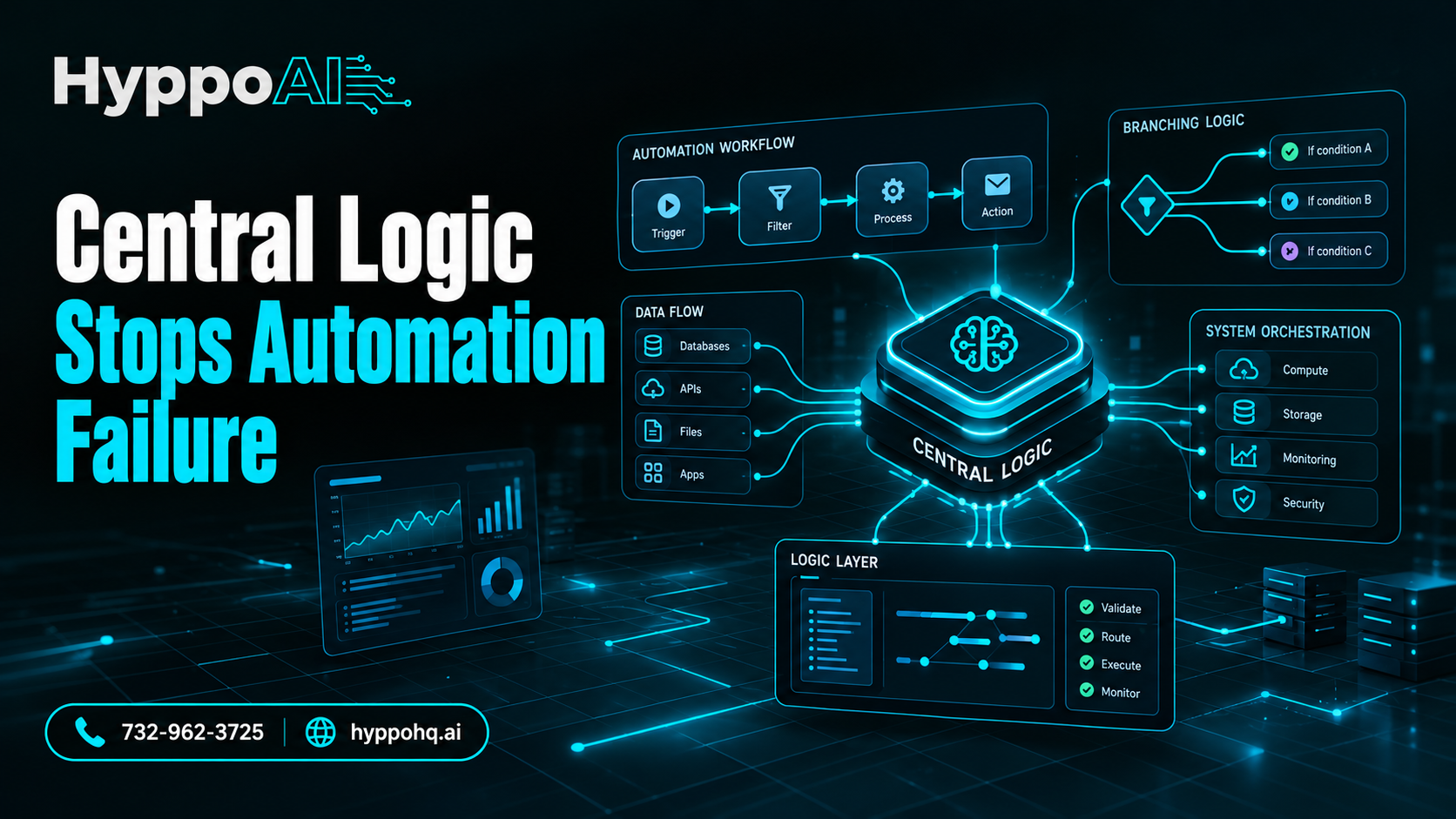
Why automations fail without a central logic layer
Automation usually fails for a simple reason: too many tools are making decisions in isolation.
A form submits. A CRM updates. A chatbot replies. A calendar books. An email sequence fires. On paper, that looks efficient. In practice, it often creates fragmented experiences, duplicate work, and inconsistent outcomes.
The missing piece is a central logic layer.
If your automations are acting like separate islands, your business is not really automated. It is just running a collection of triggers. And triggers alone are not enough when real customer journeys involve exceptions, context, timing, and priorities.
What a central logic layer actually does
A central logic layer is the decision-making brain behind your automation stack.
Instead of each app deciding what happens next on its own, the logic layer evaluates the situation and routes the right action based on business rules, customer data, intent, and timing.
Think of it as the system that answers questions like:
- Is this lead new, existing, or inactive?
- Should this person get a text, an email, a call, or nothing yet?
- Is this request urgent enough to escalate to a human?
- Did another workflow already handle this event?
- Does this customer belong in a different pipeline based on behavior?
Without that layer, tools only know their narrow task. They do not understand the full process.
Why automations break without central logic
When businesses start automating, they usually connect tools one by one. That is normal. The problem comes later, when the stack grows but the decision-making stays scattered.
1. Every tool follows its own rules
Your CRM may tag a lead one way. Your email platform may segment them another way. Your chatbot may ask questions without knowing prior answers.
Each system can be working correctly on its own and still create a broken experience together.
This is how businesses end up with:
- Duplicate follow-ups
- Conflicting messages
- Missed handoffs
- Incorrect lead routing
- Customers repeating themselves
2. Trigger-based automation cannot handle nuance
Most simple automations are built on “if this, then that.” That works for basic tasks, but business workflows are rarely that clean.
Real operations involve conditions like:
- Multiple actions happening at once
- Delays between touchpoints
- Priority levels
- Team availability
- Customer history
- Edge cases and exceptions
Without a central logic layer, every exception becomes a patch. Over time, those patches pile up and the system becomes fragile.
3. Data gets out of sync fast
Automation depends on accurate context.
If one platform has stale data, another may trigger the wrong action. A lead marked as contacted in one place may still receive an outreach sequence somewhere else. A booked customer may keep getting nurture content meant for prospects.
A central logic layer helps create a single source of truth for what should happen next.
4. No one can see the full journey
When logic is spread across apps, no one really owns the process end to end.
Your team may know where a workflow starts, but not why it failed in the middle. Troubleshooting becomes slow because the logic is hidden inside separate tools, zaps, bots, fields, and conditions.
That makes automation harder to trust and harder to scale.
Common signs your automation stack is missing a logic layer
If any of these sound familiar, you likely have an orchestration problem, not just a tool problem:
- Leads get multiple follow-ups from different systems
- Staff manually fix issues between automated steps
- Customers receive messages out of order
- Reporting does not match what actually happened
- Small workflow changes break other processes
- Your team says, “I think that automation handles it”
- You avoid improving workflows because they feel too risky to touch
These are not random glitches. They are symptoms of decentralized decision-making.
What better automation looks like
A strong automation system is not just connected. It is coordinated.
That means one central layer determines:
- What event happened
- What context matters
- What rule applies
- What action should happen next
- What should be prevented from happening
- When a human should step in
Example: lead intake without central logic
A prospect fills out a form.
Then this happens:
- The CRM creates a contact
- The email tool sends a welcome email
- The scheduler sends a booking prompt
- The chatbot follows up with qualifying questions
- A sales rep gets notified
Sounds fine, until the person is already an existing customer, or already booked, or submitted after hours, or selected a high-priority service.
Without central logic, every tool reacts independently.
Example: lead intake with central logic
A prospect fills out a form.
The logic layer checks:
- Is this a new or existing contact?
- What service did they request?
- Is the lead urgent?
- Have they already booked?
- What channel should be used first?
- Should this go to sales, support, or operations?
Then it triggers only the right next step.
That is the difference between automation that looks active and automation that is actually intelligent.
Why this matters for SMBs
Small and midsize businesses feel the pain of bad automation faster.
Large companies can sometimes absorb inefficiency with bigger teams. SMBs usually cannot. When automation misfires, it costs time, lead quality, trust, and revenue.
A central logic layer helps SMBs:
- Reduce manual cleanup
- Respond faster and more consistently
- Improve handoffs across teams
- Protect the customer experience
- Scale without adding chaos
It also makes future improvements easier. Instead of rewriting five disconnected automations, you update the core decision logic once and let downstream actions follow the new rules.
How to build a central logic layer
You do not need to rebuild your entire stack overnight.
Start by identifying where business decisions are being made today.
Audit your current workflows
Look for:
- Duplicate conditions across tools
- Rules buried inside individual apps
- Manual steps between automations
- Inconsistent contact statuses
- Workflows that frequently need exceptions
Define the decision points
Separate actions from logic.
For example:
- Logic: determine whether a lead is sales-ready
- Action: send a text or assign a rep
This distinction matters. Actions can live in many tools. Logic should be centralized.
Create a source of truth
Choose where key workflow states should be determined and stored. That may be a CRM, a database, or an orchestration layer, depending on your setup.
The goal is simple: every tool should reference the same reality.
Design for exceptions
Good automation is not just built for the happy path.
Map what should happen when:
- A customer replies unexpectedly
- A lead books before follow-up completes
- A human intervenes
- Data is incomplete
- Timing changes
If your system cannot handle exceptions, it is not ready to scale.
Central logic is the difference between busy and effective
Many businesses think they have an automation problem when they really have a systems design problem.
More tools will not fix scattered logic. More triggers will not fix inconsistent decisions. And more AI will not help if the underlying workflow has no central brain.
If you want automation that is reliable, scalable, and useful, start with orchestration.
Build one layer that decides what should happen, why it should happen, and when it should stop. Then let your tools execute from there.
That is how automation becomes an asset instead of a liability.
If your current workflows feel brittle, duplicated, or hard to trust, HyppoAI can help you design smarter automation systems for real business operations. Visit https://hyppohq.ai or call +17329623725 to talk through your setup.
