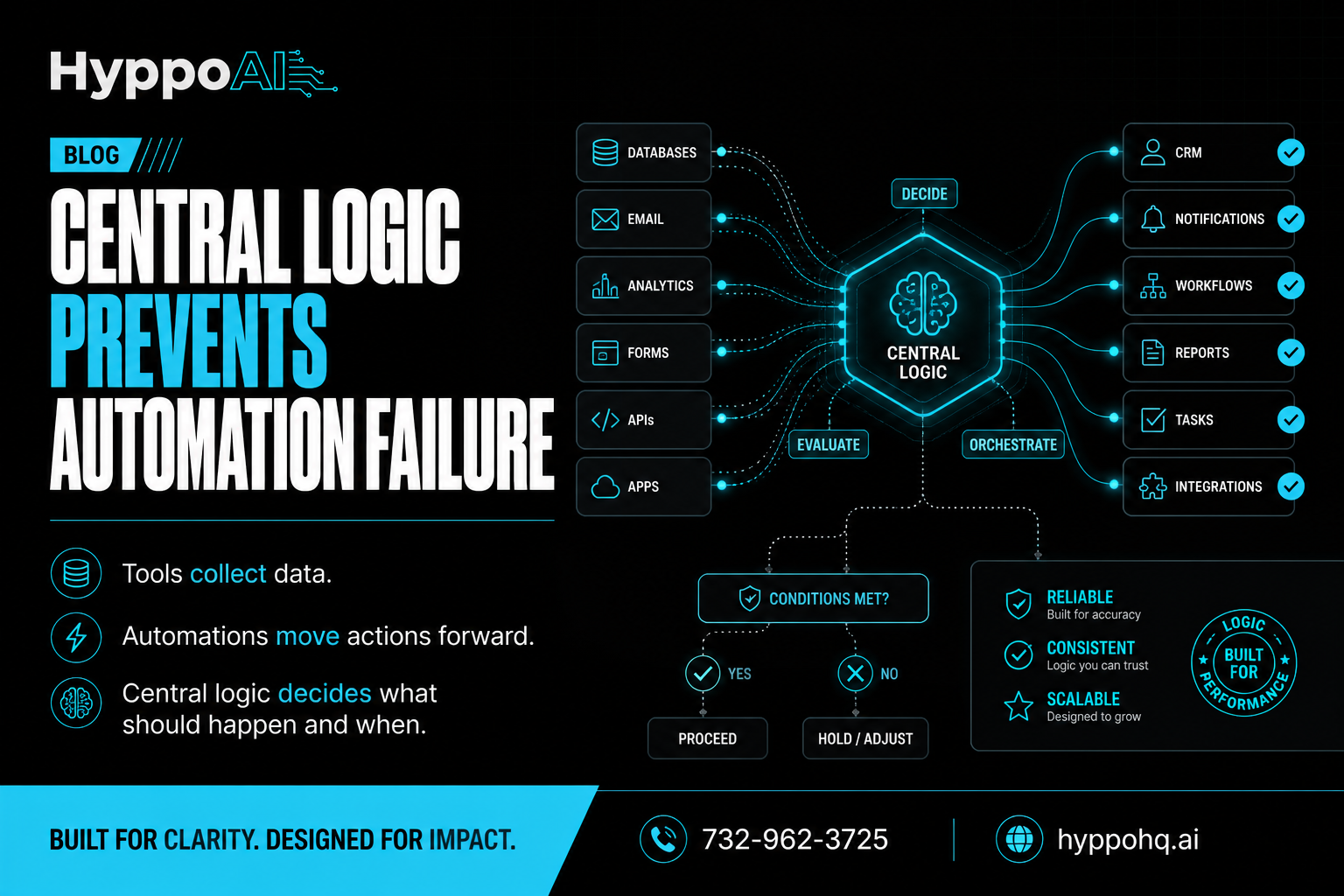
Why automations fail without a central logic layer
Automation promises speed, consistency, and scale. But many businesses discover the same hard truth after a few workflow builds: automations can still fail, even when every tool is technically working.
The problem is usually not the software itself. It is the lack of a central logic layer.
When systems do not share decision-making, they become brittle. One app triggers another. Data moves from point A to point B. Notifications fire. Tasks get created. But without a clear layer that determines what should happen, when it should happen, and why, the automation starts producing noise instead of outcomes.
For SMBs, this is a major issue. Small errors compound quickly when teams rely on lean operations. If your automation stack is missing central logic, you are not building an intelligent system. You are building a chain reaction.
What a central logic layer actually does
A central logic layer is the decision engine behind your workflows. It sits between your tools and your actions, using rules, context, and business priorities to guide what happens next.
Think of it like this:
- Your tools collect data
- Your automations move actions forward
- Your central logic layer determines what should happen and when
That last part is what most businesses skip.
They connect forms to CRMs, CRMs to email platforms, email platforms to task managers, and assume the workflow is complete. But moving information is not the same as making decisions.
A central logic layer helps answer questions like:
- Is this lead qualified enough to route to sales?
- Should this customer get an email, a text, or a human follow-up?
- Does this support ticket need escalation right now?
- Is this action still valid based on the latest data?
- Should this workflow pause, branch, or stop?
Without that layer, every workflow acts in isolation.
Why automations fail without a central logic layer
When businesses build automations tool by tool, they often focus on triggers and outputs. That works for simple tasks. But once processes involve multiple systems, timing, exceptions, and business rules, the cracks show.
1. Workflows become disconnected
One automation may create a contact. Another sends a follow-up. A third assigns a task. If each one runs independently, there is no shared awareness.
That creates problems such as:
- Duplicate outreach
- Conflicting updates
- Missed handoffs
- Repeated tasks
- Inconsistent customer experiences
A central logic layer gives your workflows a common source of truth for decision-making.
2. Context gets lost between tools
Most apps are good at their own job. Your CRM manages contacts. Your email platform sends campaigns. Your scheduling tool books meetings.
But each platform sees only part of the picture.
If your automation depends on full business context, fragmented tools will struggle. A lead may look sales-ready in one system but still be missing key qualification data in another. Without central logic, the wrong action can happen at the wrong time.
3. Exceptions break the system
Every real business process has edge cases.
Examples include:
- A customer submits a form twice
- A lead changes status mid-workflow
- Payment fails after onboarding starts
- A support request comes from a VIP account
- A prospect replies after being marked inactive
Basic automations often cannot handle these situations well. They follow a fixed path. A central logic layer allows your system to evaluate exceptions and respond intelligently.
4. Scaling creates chaos
A simple automation might work fine with 20 leads a month. At 200 or 2,000, hidden flaws become expensive.
What looked efficient at a small scale can turn into:
- More manual cleanup
- More customer confusion
- More team frustration
- More operational risk
Scaling bad logic just spreads failure faster.
5. Teams lose trust in automation
This is the real cost.
When automations misfire, people stop relying on them. They create manual workarounds. They double-check every action. They avoid new systems because previous ones felt unreliable.
Once trust drops, the value of automation drops with it.
Signs your business is missing a central logic layer
You do not need a technical audit to spot the issue. In many SMBs, the symptoms are obvious.
Watch for these red flags
- Different tools trigger overlapping actions
- Team members manually correct automated outputs
- Customers receive irrelevant or mistimed messages
- Lead routing feels inconsistent
- Reporting does not match what teams are seeing on the ground
- Small process changes require updates across multiple automations
- No one can clearly explain why a workflow made a decision
If that sounds familiar, your issue may not be automation volume. It may be automation design.
What better automation looks like
Strong automation is not just connected. It is coordinated.
A well-designed system uses a central logic layer to evaluate inputs before triggering outputs. That means your workflows are guided by business rules, not just app events.
A smarter setup typically includes
- Shared decision rules across systems
- Clear conditions for routing, pausing, escalating, or stopping actions
- Real-time awareness of status changes
- Fallback paths for exceptions and errors
- A way to update logic without rebuilding every automation
This approach creates systems that are easier to manage and far more resilient.
How SMBs can start building a central logic layer
You do not need to overengineer this. The goal is not complexity. The goal is control.
Start with your decision points
List the moments in your workflow where a choice needs to be made.
For example:
- Should this lead go to sales or nurture?
- Should this invoice trigger a reminder or an account review?
- Should this support request be answered automatically or assigned to a person?
These are logic decisions, not just automation steps.
Define business rules clearly
Document the criteria behind each decision.
Good rules are:
- Specific
- Measurable
- Consistent
- Easy to update
If your team cannot explain the rule simply, the automation will likely fail in practice.
Reduce tool-by-tool decision-making
Instead of embedding critical logic separately inside multiple apps, centralize it where possible. That keeps your workflows aligned and makes changes easier to manage.
Plan for exceptions
Assume edge cases will happen. Build for them upfront.
Ask:
- What if data is missing?
- What if timing changes?
- What if a user takes an unexpected action?
- What if two workflows touch the same record?
Resilient systems are designed around real-world variation.
Review outcomes, not just activity
A workflow firing successfully does not mean it succeeded.
Track whether the automation led to the right business result. That is how you know your logic is working.
Central logic is what makes automation useful
Automation without a central logic layer often looks impressive at first. Tools connect. Tasks move. Messages send. Dashboards update.
But if the system cannot consistently make the right decision based on the right context, it will fail where it matters most.
For SMBs, this is not just a technical issue. It is an operational one. Better automation comes from better logic.
If you want systems that scale, adapt, and actually reduce manual work, start by asking a better question. Not "What can we automate?" but "How will this system decide what to do?"
That is the difference between automation that runs and automation that works.
If your business is dealing with disconnected workflows, unreliable triggers, or AI systems that need better decision-making, HyppoAI can help. Visit https://hyppohq.ai or call +17329623725 to explore smarter automation built for SMBs.
