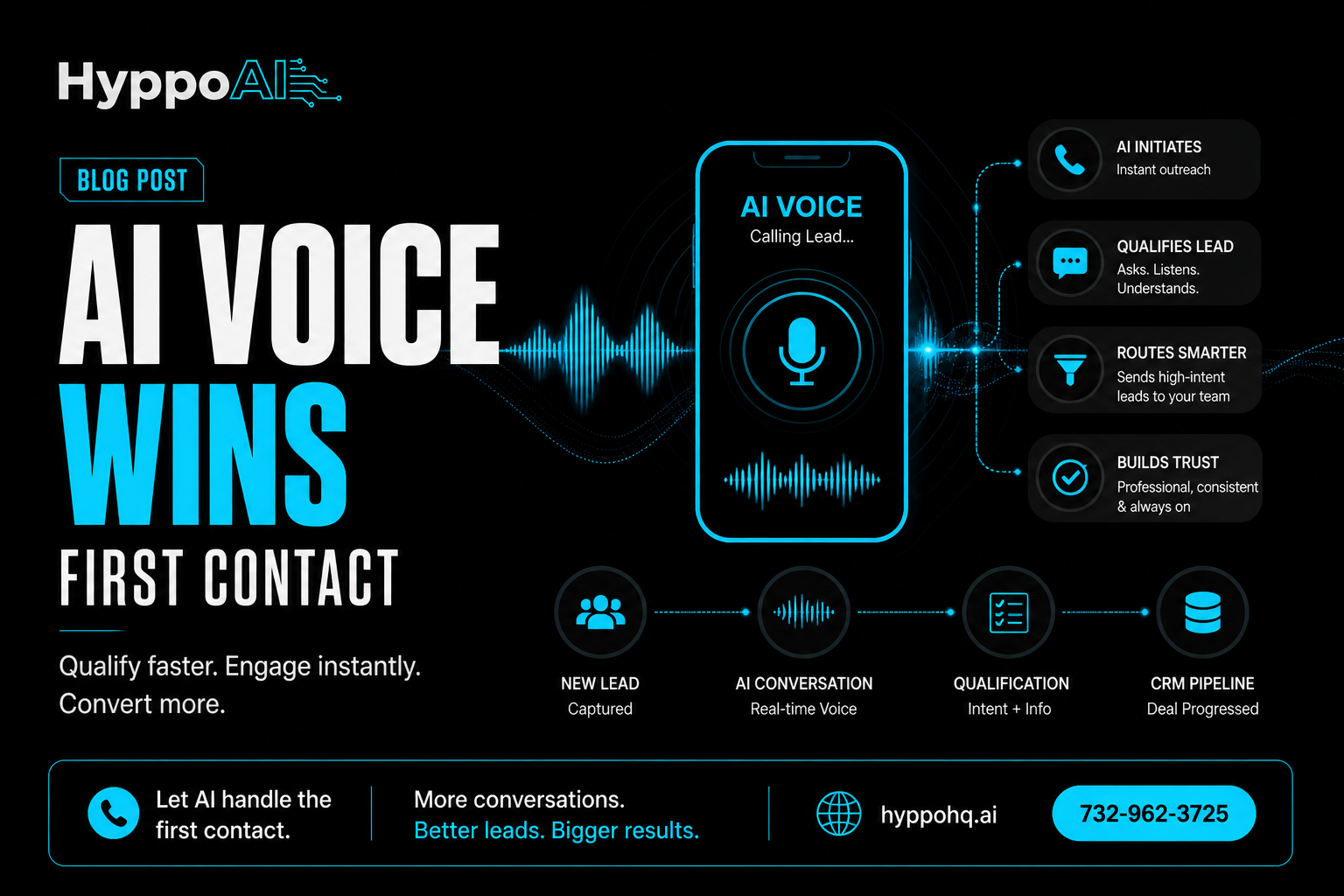
Why AI voice works best for first contact with leads
First contact can make or break a new lead.
When someone calls your business, they usually want one thing: an answer now. They do not want to wait on hold, leave a voicemail, or wonder if anyone will call back. That is why AI voice works so well at the top of the customer journey.
For small and mid-sized businesses, speed matters. Consistency matters. Availability matters. AI voice helps you deliver all three from the very first interaction.
Why first contact matters more than most businesses think
The first conversation shapes how a prospect sees your business.
If the call is answered quickly and professionally, trust starts building right away. If the call is missed, rushed, or inconsistent, that trust drops before your team even has a chance to help.
In many service businesses, first contact is not about closing the deal on the spot. It is about:
- answering the immediate question
- capturing lead details
- understanding intent
- routing the person correctly
- booking the next step
That makes first contact a process problem, not just a people problem.
AI voice is built for speed
The biggest advantage of AI voice for first contact is simple: it answers immediately.
That matters because many leads call more than one business. If your team is busy, off-hours, or unavailable, the next company that picks up first often gets the opportunity.
AI voice reduces that gap.
Instead of sending callers to voicemail, an AI voice system can:
- answer in seconds
- greet callers consistently
- ask the right qualifying questions
- collect names, phone numbers, and service needs
- transfer urgent calls when needed
- schedule or confirm next steps
For SMBs, this creates a major operational win. You do not need every call to wait for a human just to start the conversation.
Consistency beats improvisation at the top of the funnel
Human teams are valuable, but first contact often suffers from inconsistency.
Different team members may answer calls differently. Some may forget to ask key questions. Others may sound rushed during busy periods. Even strong staff can miss details when call volume spikes.
AI voice solves for that by following a structured flow every time.
What consistency looks like in practice
A well-designed AI voice workflow can:
- use the same professional greeting on every call
- ask the same core intake questions
- capture information in a repeatable format
- route calls based on clear logic
- reduce skipped steps and incomplete notes
That structure helps your business operate with less friction. It also creates cleaner data for follow-up, reporting, and lead management.
AI voice works because first contact is usually predictable
Many businesses assume every call is too unique for automation. In reality, first contact is often highly repetitive.
Most new callers want one of a few things:
- pricing information
- service availability
- appointment scheduling
- answers to common questions
- help reaching the right department
These are exactly the kinds of interactions AI voice handles well.
The goal is not to replace every conversation. The goal is to handle the repeatable front-end tasks so your team can focus on higher-value work.
It reduces missed calls and lost leads
A missed call is rarely just a missed call. It is often a missed revenue opportunity.
For SMBs, this is one of the strongest business cases for AI voice. If your business depends on inbound calls, every unanswered call creates risk.
AI voice helps close that gap by making sure more calls are handled in real time.
Why this matters operationally
When first contact is covered, your business can:
- capture more leads after hours
- reduce voicemail dependency
- respond during lunch breaks, meetings, and peak periods
- create a better caller experience without adding headcount
- improve follow-up quality with complete intake details
That is not just a customer service upgrade. It is a pipeline improvement.
AI voice creates a better handoff to humans
One of the best uses of AI voice is preparing the conversation before a human joins.
Instead of forcing your staff to start from zero, AI voice can gather context first. That means when a team member steps in, they already know who is calling and why.
This leads to better conversations and less repetition.
A stronger first-contact workflow
A typical flow might look like this:
- AI voice answers instantly.
- It identifies whether the caller is a new lead, existing customer, or urgent case.
- It collects key details.
- It routes, schedules, or escalates based on rules.
- Your team receives a cleaner handoff.
That is where efficiency compounds. The AI handles the repetitive opening, and your team handles the part that needs judgment.
It matches how customers want to interact
People still call because they want fast resolution.
For many situations, a phone call feels easier than filling out a form or waiting for an email reply. If the caller gets immediate engagement, the experience feels smooth and modern.
AI voice supports that expectation by being available when customers are ready, not only when your staff is free.
This is especially useful for businesses that serve local markets, manage appointments, or depend on quick lead response.
First contact is the best place to start with voice automation
Not every business should automate every phone interaction on day one.
But first contact is usually the best starting point because it has:
- clear goals
- repeatable questions
- measurable outcomes
- direct impact on lead capture
That makes it easier to implement, test, and improve.
You can measure success through practical metrics like:
- answer rate
- missed call reduction
- lead capture rate
- booking rate
- response time
- transfer accuracy
For a growing business, those numbers matter more than hype. They show whether the system is helping the business run better.
Common concerns about AI voice
Some business owners worry that AI voice will feel robotic or frustrate callers.
That concern usually comes from poor implementation, not the concept itself.
A strong AI voice setup should be:
- clear and concise
- aligned with your call flow
- designed for easy escalation
- focused on practical outcomes
The best systems do not try to sound clever. They try to be useful.
That is why AI voice performs best in first contact. The job is not to have a long, emotional conversation. The job is to answer, guide, capture, and route effectively.
Why this matters for SMB growth
SMBs do not always have the luxury of a fully staffed front desk or round-the-clock phone coverage.
But leads still come in. Calls still get missed. Opportunities still move fast.
AI voice gives smaller teams a way to operate with more coverage and control without immediately adding more overhead. It strengthens the front line of communication where speed and consistency matter most.
That is the real value: better first impressions, fewer missed opportunities, and a more reliable intake process.
Final takeaway
AI voice works best for first contact because first contact is where speed, structure, and availability have the biggest impact.
When a lead reaches out, the goal is simple: respond fast, capture the right information, and move the conversation forward. AI voice is uniquely well-suited to do that at scale.
If your business is missing calls, struggling with inconsistent intake, or looking for a smarter way to handle new leads, HyppoAI can help you explore voice automation that fits your workflow. Visit https://hyppohq.ai or call +17329623725 to learn more.
