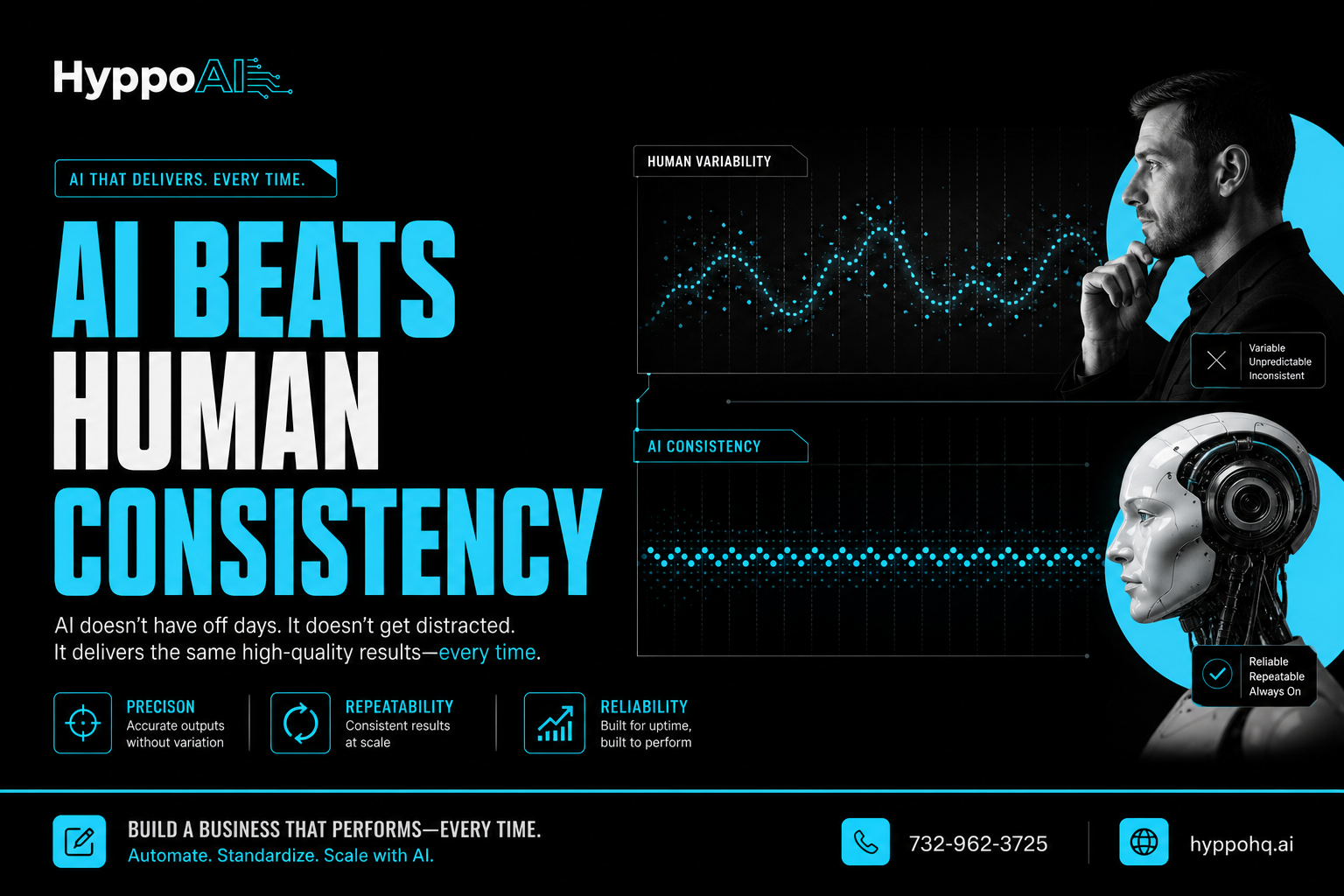
Why AI is better at consistency than people
Consistency is one of the biggest advantages AI brings to small and midsize businesses.
People are creative, adaptable, and essential for judgment. But people also get tired, distracted, overloaded, and inconsistent. That is not a flaw in character. It is just reality. Energy changes. Attention shifts. Priorities compete.
AI works differently.
When properly set up, AI can follow the same rules, apply the same standards, and complete the same process over and over without the normal variation that comes with human effort. For SMBs, that matters more than most teams realize.
Consistency is what makes businesses scalable
A business does not grow because it does something well once. It grows because it can do the right things repeatedly.
That includes:
- answering leads quickly
- following up on time
- using the same messaging standards
- documenting processes clearly
- handling routine tasks without delays
- maintaining quality across customer touchpoints
The challenge is that human consistency is hard to maintain at scale. Even top performers have off days. Even strong teams interpret instructions differently. Even well-run companies see breakdowns when volume increases.
AI helps reduce that variability.
Why people struggle with consistency
Humans are not machines, and that is often a strength. People can read context, build relationships, and make nuanced decisions. But when the goal is repeatable execution, people naturally introduce variation.
Common causes of inconsistency in human work
- fatigue during long workdays
- missed details under pressure
- different interpretations of the same task
- uneven follow-up habits
- emotional influence on communication
- shifting priorities between urgent tasks
- knowledge gaps between team members
For example, one employee may respond to every lead within five minutes, while another waits until the end of the day. One team member may use the approved script, while another improvises. One person logs notes carefully, while another forgets.
Over time, those small inconsistencies create bigger business problems.
Why AI is better at consistency than people
AI does not get bored with repetition. It does not forget a step because it had a rough morning. It does not change tone because it is stressed. It does not skip follow-up because the inbox feels overwhelming.
When trained and configured correctly, AI can execute a process the same way every time.
What AI does well in repeatable environments
- follows predefined workflows
- applies rules uniformly
- responds instantly at any hour
- maintains the same tone and structure
- logs information in a standardized way
- handles high volume without losing focus
- continues performing without fatigue
That reliability is valuable in areas where speed, structure, and repetition matter.
Where consistency creates the biggest impact for SMBs
Small businesses often lose opportunities not because they lack talent, but because they lack repeatable systems. AI helps close that gap.
Lead response and follow-up
One of the fastest ways to lose a sale is delayed follow-up. AI can respond immediately, ask the right qualifying questions, and keep the conversation moving.
That means:
- fewer missed leads
- faster response times
- more standardized qualification
- less dependence on memory or manual reminders
Customer communication
AI can help maintain a consistent brand voice across messages, FAQs, appointment reminders, and support interactions.
This improves:
- clarity
- professionalism
- response quality
- customer expectations
Internal operations
Repetitive internal tasks often break down when teams get busy. AI can support consistency in reporting, task routing, note-taking, data entry, and process enforcement.
This leads to:
- cleaner records
- fewer skipped steps
- better visibility across the business
- stronger operational discipline
Marketing execution
Many SMBs struggle to publish consistently. AI can help generate drafts, organize content workflows, and maintain cadence.
That does not replace strategy. It supports execution.
Consistency does not mean perfection
AI is better at consistency than people, but that does not mean AI is automatically better at everything.
Consistency is only useful when the process itself is sound.
If you give AI a weak workflow, it will repeat that weak workflow consistently. If you provide poor instructions, it may scale mistakes faster. That is why implementation matters.
Businesses get the best results when they use AI to handle structured, repeatable work while keeping humans involved in areas that require judgment, empathy, and strategic thinking.
The best model is AI plus people
This is not really a people-versus-AI conversation. Smart businesses use both for what each does best.
People are best for
- relationship building
- negotiation
- creative direction
- exception handling
- leadership decisions
- complex judgment calls
AI is best for
- repetitive tasks
- standardized communication
- instant responses
- workflow enforcement
- consistent documentation
- high-volume routine execution
When you combine human judgment with AI consistency, you get a stronger operating model.
People stop wasting energy on repetitive tasks. Teams spend less time fixing avoidable errors. Customers get faster, more reliable experiences.
That is where real leverage comes from.
What consistency looks like in practice
For an SMB, consistency is not abstract. It shows up in daily outcomes.
It can look like:
- every inbound lead gets a response
- every appointment gets a reminder
- every customer inquiry gets routed properly
- every interaction is documented the same way
- every process runs without depending on one person remembering everything
That kind of stability creates trust internally and externally.
Your team knows what to expect. Your customers know what to expect. Your business becomes easier to manage and easier to grow.
The hidden cost of inconsistency
Many companies normalize inconsistency because it feels familiar. They assume missed follow-up, uneven service, and process drift are just part of doing business.
They are not.
Inconsistency creates hidden costs like:
- lost revenue from slow responses
- lower conversion rates
- customer frustration
- training inefficiencies
- management overhead
- avoidable rework
AI helps reduce those costs by creating a more dependable operating layer.
How to start using AI for consistency
If you want better consistency, start with one process that is repetitive, measurable, and important.
Good starting points include:
- lead intake
- appointment scheduling
- customer follow-up
- FAQ handling
- review requests
- internal status updates
Then ask:
- What steps should happen every time?
- Where do people usually miss the process?
- What standards need to stay the same?
- What can be automated without reducing quality?
That is usually where AI delivers immediate value.
Final thought
People bring judgment, creativity, and connection. AI brings repeatability, speed, and consistency. For SMBs, that consistency can be the difference between chaotic growth and scalable operations.
If your business is relying on people to remember every step, maintain every standard, and follow up perfectly every time, you are building on a fragile system. AI gives you a more reliable foundation.
If you want to explore how HyppoAI can help your business build more consistent workflows, smarter follow-up, and stronger operations, visit https://hyppohq.ai or call +17329623725.
