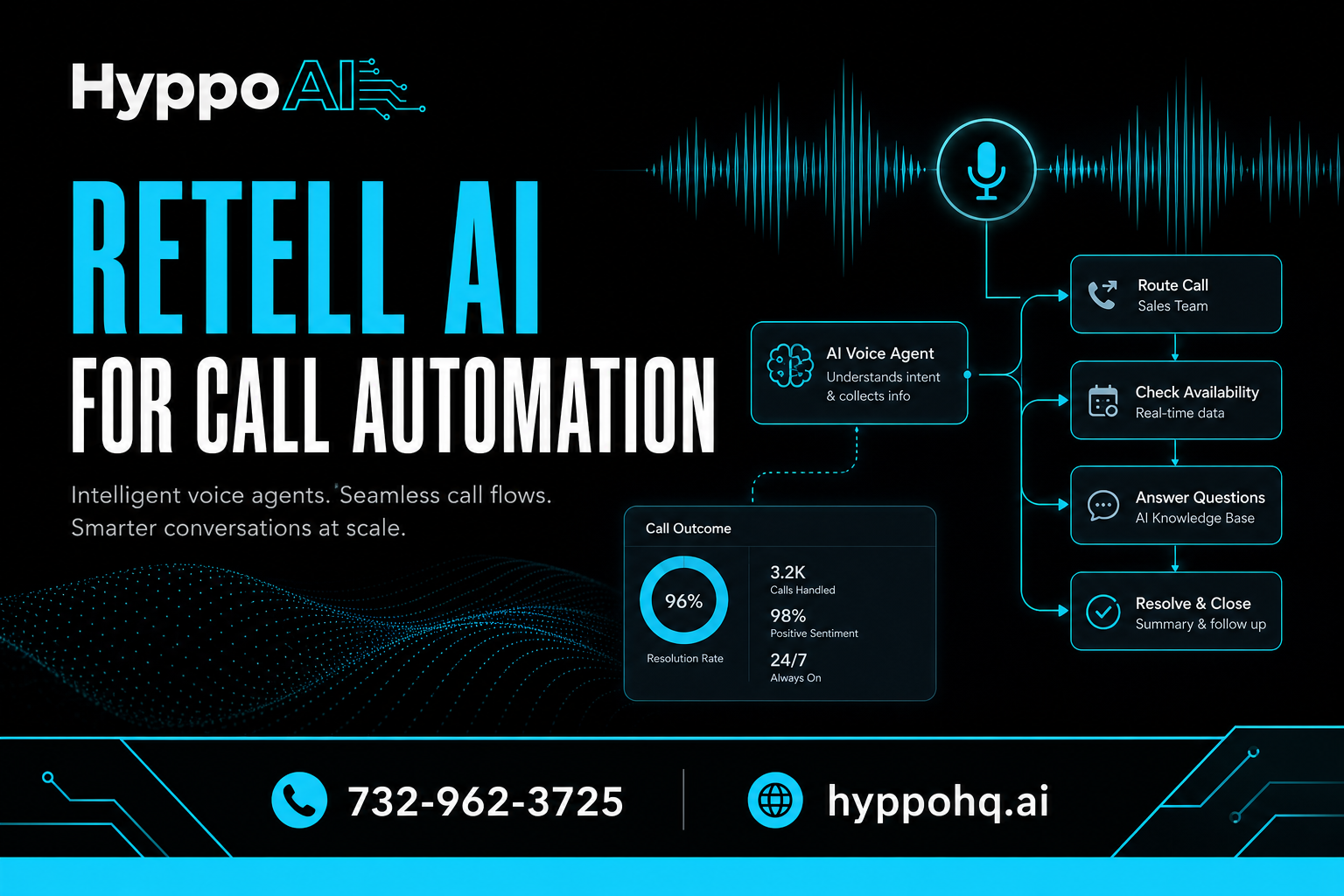
What Retell AI is used for in call automation
Retell AI is used for building AI voice agents that can answer calls, handle routine conversations, qualify leads, and move callers to the right next step.
For small and mid-sized businesses, that matters because the phone is still one of the fastest paths to revenue. Missed calls, long hold times, and inconsistent intake processes cost real opportunities. Call automation helps close that gap, and Retell AI is one of the tools businesses use to make it happen.
At a practical level, Retell AI sits inside voice automation workflows. It gives businesses a way to create conversational phone experiences that sound natural, respond in real time, and connect with the systems already running the business.
What Retell AI is designed to do
Retell AI is primarily used to power conversational AI over phone calls. Instead of a basic phone tree or rigid recorded prompts, it enables dynamic voice interactions.
That means an AI agent can:
- Answer inbound calls automatically
- Respond to common questions
- Collect caller information
- Qualify leads based on set criteria
- Route calls to the right person or department
- Book appointments or trigger next steps
- Support after-hours coverage
- Reduce pressure on front-desk or sales teams
In short, it helps businesses automate voice conversations without making the customer experience feel robotic.
Common use cases for Retell AI in call automation
Retell AI is not just for one type of workflow. It is used across several call-related functions, especially where speed, consistency, and availability matter.
1. Answering inbound calls 24/7
One of the most common uses is round-the-clock call handling. If a business cannot answer every call live, an AI voice agent can step in immediately.
This is useful for:
- After-hours call coverage
- Weekend overflow
- High call-volume periods
- Small teams with limited staff
Instead of sending callers to voicemail, the AI can engage them, gather context, and move the conversation forward.
2. Lead capture and qualification
Retell AI is often used to qualify inbound leads before they ever reach a human rep.
For example, the AI can ask structured questions such as:
- What service are you calling about?
- Is this for a residential or commercial need?
- What is your timeline?
- What location are you in?
That information can then be passed into a CRM or sent to a sales team, so follow-up is faster and more informed.
3. Appointment scheduling
Another strong use case is appointment booking. In service businesses, healthcare-adjacent operations, and local SMBs, scheduling is a major source of phone traffic.
An AI voice agent can:
- Check availability
- Offer time slots
- Confirm details
- Capture contact information
- Trigger reminders or follow-up workflows
This reduces back-and-forth and keeps calendars moving without depending entirely on staff availability.
4. Call routing and triage
Retell AI can also act as an intelligent front line for incoming calls. Instead of a caller pressing multiple menu options, the system can understand intent and route the call accordingly.
Examples include routing callers to:
- Sales
- Support
- Billing
- Specific locations
- Emergency or priority escalation paths
This creates a smoother caller experience and reduces wasted staff time.
5. FAQ and repetitive inquiry handling
A large share of business calls are repetitive. Customers ask the same questions about hours, pricing ranges, service areas, requirements, or next steps.
Retell AI can automate these conversations, giving callers immediate answers while freeing human teams to focus on higher-value interactions.
Why businesses use Retell AI instead of basic IVR
Traditional IVR systems are limited. They rely on button presses, fixed decision trees, and often create friction for callers.
Retell AI is used when businesses want something more conversational and flexible.
Key differences include:
- Natural language conversations instead of strict menu navigation
- Real-time responses that adapt to caller input
- Better lead intake and qualification
- A more modern customer experience
- Easier integration into broader automation workflows
For SMBs, this can mean fewer dropped opportunities and a more scalable front-end communication system.
Where Retell AI fits in a larger automation stack
Retell AI is most powerful when it is part of a broader call automation system.
On its own, it handles the voice interaction layer. But businesses often connect it with other tools to complete the workflow end to end.
That may include:
- CRM systems for lead logging
- Scheduling software for appointment booking
- Internal notifications for staff alerts
- SMS tools for confirmations and follow-up
- Automation platforms for workflow triggers
- Reporting systems for call outcomes and performance tracking
This is where strategy matters. The goal is not just to answer calls with AI. The goal is to connect the call to an operational result.
What Retell AI can improve for SMBs
For small and mid-sized businesses, the value is usually tied to efficiency and responsiveness.
Retell AI can help improve:
Faster response times
Callers get an immediate answer instead of voicemail or long hold times.
Better lead handling
Every inbound opportunity can be captured, categorized, and routed more consistently.
Lower operational strain
Teams spend less time on repetitive call tasks and more time on revenue-generating work.
Extended availability
The business can effectively stay responsive beyond normal business hours.
More consistent customer experience
Call handling becomes more standardized, which is especially useful for growing teams.
What Retell AI is not
It is important to keep expectations clear. Retell AI is not a magic fix for broken processes.
If the business has unclear routing logic, weak follow-up systems, or no defined intake process, adding voice AI alone will not solve the problem.
Strong call automation depends on:
- Clear workflow design
- Good scripting and prompt structure
- Defined escalation paths
- Clean integrations
- Ongoing testing and optimization
The technology can power the conversation, but the business still needs the right system behind it.
How to think about Retell AI strategically
If you are evaluating Retell AI, the best question is not just, “Can it answer calls?”
The better question is, “Which phone conversations should be automated, and what business outcome should each one drive?”
That shift in thinking helps identify the right use cases, such as:
- Capturing missed leads
- Handling first-touch intake
- Reducing front-desk overload
- Improving appointment conversion
- Routing urgent calls faster
- Supporting growth without adding equal headcount
When used strategically, Retell AI becomes part of a scalable communication system, not just a standalone tool.
Final takeaway
Retell AI is used for automating business phone conversations through AI voice agents that can answer calls, qualify leads, route inquiries, book appointments, and support customer communication at scale.
For SMBs, its real value comes from turning inbound calls into structured, repeatable workflows that save time and reduce missed opportunities.
If your business is exploring AI call automation, HyppoAI can help you design the right system around your workflows, goals, and customer experience. Visit https://hyppohq.ai or call +17329623725 to learn more.
