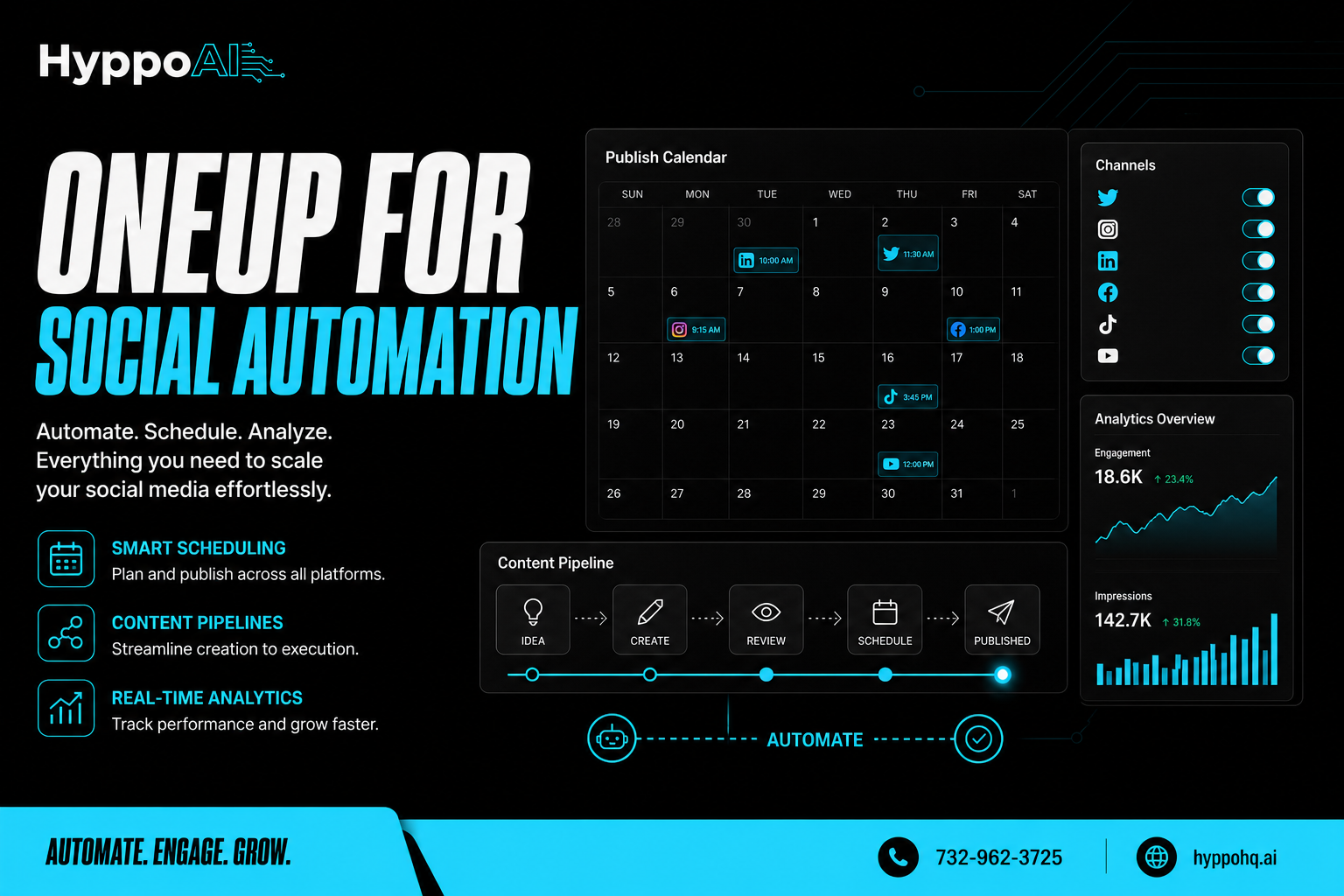
What OneUp is used for in social media automation
Social media automation helps small businesses stay visible without spending hours posting manually every day. One tool that often comes up in this conversation is OneUp.
If you have been wondering what OneUp is used for in social media automation, the short answer is simple: it helps businesses plan, schedule, and publish content across multiple social platforms from one place. For teams trying to stay consistent online, that can make a big difference.
At HyppoAI, we look at tools through a practical lens. The goal is not to automate for the sake of automation. The goal is to create cleaner systems, save time, and make sure marketing activity actually supports growth.
What is OneUp?
OneUp is a social media scheduling and management tool. Businesses use it to organize content, queue posts, and publish to multiple channels without logging into each platform separately.
Instead of handling every post manually, OneUp gives marketers and business owners a central dashboard for content distribution. That makes it useful for SMBs, agencies, and lean internal teams that need efficient workflows.
In social media automation, this kind of tool sits at the operational layer. It does not replace strategy, messaging, or creative direction. It supports execution.
What OneUp is used for in social media automation
The main use of OneUp is to automate repeatable publishing tasks. That includes scheduling posts in advance, managing posting calendars, and keeping content flowing consistently.
Here are some of the most common ways businesses use it:
- Scheduling posts ahead of time
- Publishing to multiple social channels from one platform
- Building a content queue for evergreen posts
- Managing recurring content themes
- Maintaining posting consistency during busy periods
- Supporting team workflows with a clearer content calendar
For many SMBs, consistency is the hardest part of social media. OneUp helps solve that by turning content publishing into a system instead of a daily scramble.
Key benefits of using OneUp
1. Saves time on manual posting
Posting content one platform at a time is inefficient. OneUp reduces that friction by letting teams prepare content in batches.
That means you can write captions, choose visuals, and schedule days or weeks of posts in one sitting.
2. Improves consistency
Most brands do not struggle because they lack ideas. They struggle because execution falls apart.
With OneUp, content can be scheduled in advance so your channels stay active even when internal priorities shift. That consistency helps with visibility, audience trust, and overall brand presence.
3. Supports multi-platform publishing
Businesses rarely rely on one channel alone. They may post on Facebook, Instagram, LinkedIn, X, or other platforms depending on their audience.
OneUp is used to simplify that multi-channel process. Rather than repeating the same task several times, teams can manage publishing from one system.
4. Helps organize content operations
Automation works best when paired with structure. OneUp can support a more organized workflow by giving teams a place to view upcoming posts, spot content gaps, and align publishing with campaigns.
This is especially useful for growing businesses that need process without adding unnecessary complexity.
Where OneUp fits in a broader automation stack
OneUp is a publishing tool, not a full marketing brain. That distinction matters.
A strong social media automation workflow often includes multiple layers:
- Content planning
- Caption writing
- Creative production
- Scheduling and publishing
- Performance review
- Lead follow-up or customer engagement
OneUp mainly supports the scheduling and publishing layer. Businesses may pair it with AI tools for caption generation, internal systems for approvals, and CRM or lead workflows for downstream conversion.
That is where a company like HyppoAI sees the bigger opportunity. Automation should not stop at posting. It should connect content operations to business operations.
What OneUp does not do
It is also helpful to understand what OneUp is not primarily used for.
It is not a replacement for:
- Brand strategy
- Audience research
- Offer positioning
- High-quality creative direction
- Human review for platform nuance
In other words, OneUp helps execute a plan. It does not build the entire plan for you.
If your messaging is unclear or your content lacks relevance, scheduling more of it will not solve the root issue. Automation amplifies systems, whether those systems are strong or weak.
Who should use OneUp?
OneUp can be useful for a range of users, especially those who need a practical way to manage social content at scale.
It is often a good fit for:
- Small business owners managing their own marketing
- Marketing teams with limited time
- Agencies handling multiple client accounts
- Service businesses that need consistent visibility
- Brands repurposing content across channels
For SMBs, the value usually comes down to efficiency. If social media feels too manual, too scattered, or too inconsistent, a scheduling tool like OneUp can help create order.
Best practices for using OneUp effectively
Using the tool well matters as much as choosing the tool.
Build content in batches
Create posts in groups rather than one at a time. This improves efficiency and makes it easier to maintain a consistent tone and message.
Create recurring content categories
Use repeatable themes such as:
- Educational tips
- Customer insights
- Behind-the-scenes updates
- Promotions
- FAQs
- Thought leadership
This makes scheduling easier and reduces content fatigue.
Customize by platform
Automation should not mean copy-paste everywhere. Different platforms reward different formats and tones. Use OneUp to streamline publishing, but tailor posts where needed.
Review performance regularly
Scheduled content is not set-and-forget forever. Review what performs well, what gets engagement, and what supports business goals.
Automation should create feedback loops, not blind repetition.
Why this matters for SMBs
Small and midsize businesses need leverage. They do not always have large teams, dedicated social managers, or endless time for content operations.
That is why tools like OneUp matter. They reduce repetitive work and help businesses stay active online with less friction.
But the real win is not just posting more often. The real win is creating a reliable system that supports visibility, trust, and growth.
When social media publishing becomes organized, the team can spend more time on strategy, customer conversations, and revenue-driving activity.
Final thoughts on what OneUp is used for in social media automation
So, what is OneUp used for in social media automation? It is primarily used to schedule, organize, and publish social media content more efficiently across multiple channels.
For businesses that want a cleaner content workflow, more consistency, and less manual effort, that can be a strong operational advantage. The key is to treat it as part of a larger system, not the whole strategy.
If your business is exploring smarter ways to automate marketing and operations, HyppoAI can help you think beyond simple scheduling. Visit https://hyppohq.ai or call +17329623725 to learn how AI-powered systems can support scalable growth.
