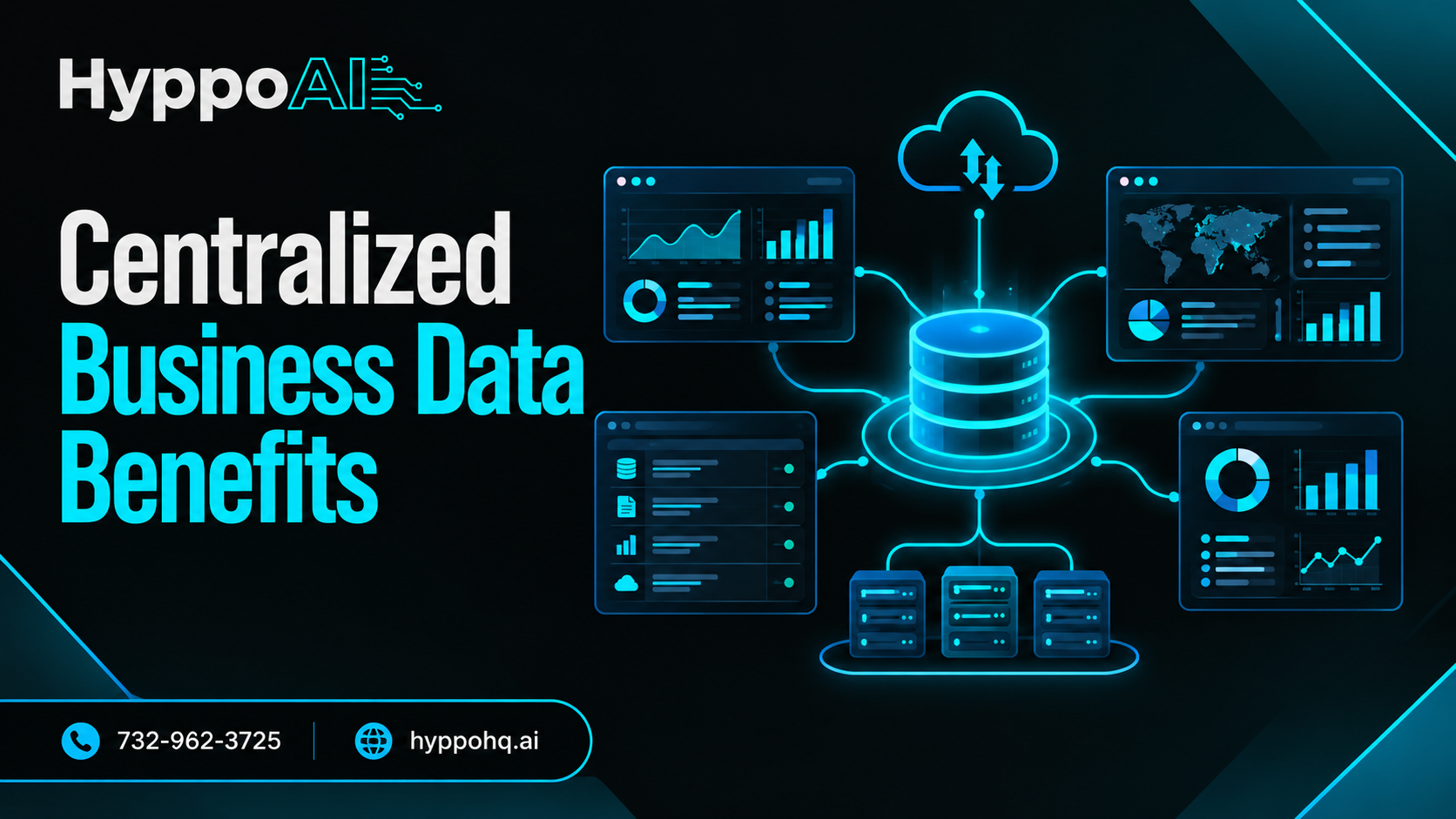
What happens when business data is centralized
Most small and midsize businesses do not have a data problem. They have a data location problem.
Customer details sit in a CRM. Sales notes live in inboxes. Operations data is buried in spreadsheets. Marketing reports are spread across platforms. Finance has its own system. Support has another. Everyone is working, but not everyone is working from the same source of truth.
That is where centralized business data changes the game.
When business data is centralized, your team stops guessing, stops duplicating work, and starts operating with more speed and confidence. The result is better decisions, cleaner workflows, and a stronger foundation for automation and AI.
What centralized business data really means
Centralized business data means your most important information is connected, organized, and accessible in a consistent way.
That does not always mean every tool disappears. It means your systems are aligned so the right data flows to the right people and processes without constant manual effort.
In practical terms, centralization often includes:
- Customer records in one connected system
- Shared visibility across sales, marketing, support, and operations
- Standardized data fields and naming conventions
- Fewer duplicate entries and conflicting records
- Reporting that pulls from the same trusted source
- Integrations that keep information updated automatically
This is not just an IT improvement. It is an operational advantage.
You get a single source of truth
The first thing that happens when business data is centralized is clarity.
Without centralization, different teams often work from different versions of the same information. One person has an old phone number. Another has a newer email. Sales thinks a lead is active. Support thinks the account is closed. Leadership sees reports that do not match.
A centralized system reduces those conflicts.
With one trusted source of truth, your business can:
- Make decisions faster
- Reduce internal back-and-forth
- Improve reporting accuracy
- Create more consistent customer experiences
When everyone sees the same information, alignment stops being a meeting topic and starts becoming normal operations.
Teams move faster with less manual work
Fragmented data slows everything down.
Employees waste time searching for records, updating multiple systems, fixing duplicate entries, and asking coworkers for context they should already have. These small delays add up quickly.
When data is centralized, workflows become simpler.
Common speed improvements include:
- Faster customer onboarding
- Quicker response times from sales and support
- Less copy-and-paste between tools
- Easier handoffs between departments
- Shorter reporting cycles
This matters for SMBs because speed is leverage. If your team can save even a few hours each week by reducing data friction, that time can be redirected toward revenue, service quality, and growth.
Decision-making gets sharper
Business owners and managers make better decisions when they trust the numbers in front of them.
Centralized business data improves visibility across the company. Instead of pulling reports from disconnected systems and trying to reconcile them manually, leaders can see what is happening in a more complete view.
That can help answer questions like:
- Which lead sources actually convert?
- Where are deals getting stuck?
- Which services are most profitable?
- Which customers need follow-up now?
- Where are operational bottlenecks forming?
Better data does not guarantee perfect decisions. But it does reduce blind spots, which is a major advantage in a fast-moving business.
Customer experience becomes more consistent
Customers notice when your business is disconnected.
They notice when they have to repeat information. They notice when follow-ups are missed. They notice when billing, support, and sales are not aligned.
When business data is centralized, every customer interaction can be more informed.
That often leads to:
- More personalized communication
- Fewer missed details
- Stronger follow-up processes
- Better service continuity across channels
- Higher trust in your brand
For SMBs, this consistency can be a major differentiator. You do not need to be the biggest company in your market to deliver a smooth, professional experience. You need connected systems and clean processes.
Automation becomes possible at a higher level
This is where centralization becomes even more valuable.
Automation depends on reliable data. If your information is incomplete, inconsistent, or spread across disconnected tools, automation breaks down quickly. Workflows trigger at the wrong time. Messages go to the wrong people. Reports become unreliable.
When data is centralized, automation becomes far more effective.
Examples include:
- Automatically assigning leads based on source or service type
- Triggering follow-up sequences after form submissions
- Updating pipeline stages based on customer actions
- Sending reminders for appointments, invoices, or renewals
- Routing support requests with the right context attached
The more connected your data is, the more useful your automations become.
AI gets more accurate and more useful
If your business wants to use AI well, centralized data is a major advantage.
AI tools perform better when they can access structured, current, and relevant business information. If your systems are fragmented, AI outputs are more likely to be incomplete or inconsistent.
Centralized business data helps AI support:
- Faster internal search and knowledge retrieval
- Smarter lead qualification
- Better customer communication workflows
- More accurate reporting summaries
- Stronger forecasting and operational insights
In short, centralization gives AI better context. Better context leads to better outputs.
For SMBs, that means AI can become practical instead of theoretical.
You expose process gaps faster
There is another benefit that business owners do not always expect.
When you centralize data, you start seeing where your processes are weak.
That might sound like a downside, but it is actually useful. Hidden inefficiencies become visible. You may find inconsistent intake steps, poor field naming, missing ownership, or unclear handoff rules.
These issues already exist. Centralization just makes them easier to identify and fix.
That visibility helps your business mature operationally.
Compliance and control often improve
When data is scattered, control is weak. Sensitive information may live in inboxes, personal devices, random spreadsheets, or disconnected apps with inconsistent permissions.
Centralization can help improve governance by making it easier to:
- Control who has access to what
- Track changes and activity
- Standardize data handling
- Reduce risk from outdated records
- Improve backup and retention practices
For growing businesses, this matters more over time. As headcount, customer volume, and system complexity increase, loose data practices become more expensive.
What to watch out for during centralization
Centralization is powerful, but it should be done thoughtfully.
Common mistakes include:
- Moving bad data into a new system without cleaning it
- Overcomplicating the setup from day one
- Ignoring how teams actually use information
- Failing to define ownership and standards
- Treating centralization as a one-time project instead of an ongoing discipline
The goal is not to create a perfect system overnight. The goal is to create a more usable, connected, and scalable operating environment.
Centralized data creates a stronger business foundation
What happens when business data is centralized? Your business gets clearer, faster, and easier to scale.
You reduce confusion. You improve execution. You create better customer experiences. You unlock stronger automation. And you give AI a better foundation to produce useful results.
For SMBs, this is not just a technical upgrade. It is a business advantage.
If your team is spending too much time chasing information, correcting records, or working across disconnected systems, centralization is worth serious attention.
HyppoAI helps businesses build smarter systems for automation, visibility, and growth. To learn more, visit https://hyppohq.ai or call +17329623725.
