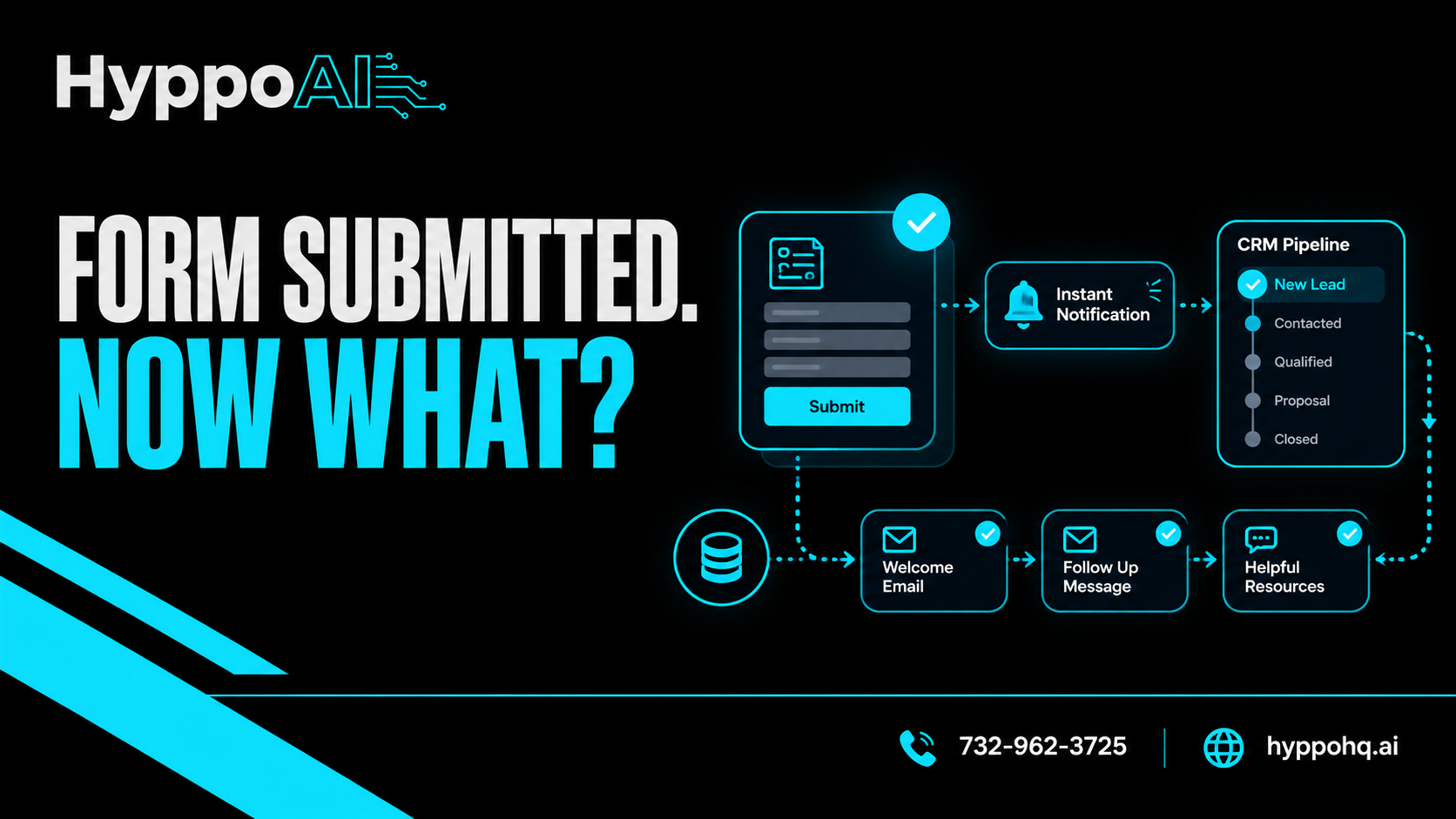
What happens after a form is submitted? AI follow-up explained
When someone fills out a form on your website, the real work starts.
Most business owners focus on getting the submission. Fewer think about what happens in the next 30 seconds, 5 minutes, or 24 hours. That gap is where leads get lost, opportunities cool off, and revenue slips away.
If you have ever wondered what happens after a form is submitted, the answer depends on your systems. In some businesses, the lead sits in an inbox waiting for someone to notice it. In others, that submission triggers an immediate, structured follow-up process powered by automation and AI.
For SMBs, speed and consistency matter. A form submission is not just data. It is intent. Someone raised their hand and asked for more information, pricing, a callback, or a next step.
The moment a form is submitted
At the simplest level, a website form collects information and sends it somewhere. Usually that includes details like:
- Name
- Email address
- Phone number
- Service requested
- Message or notes
Once the user clicks submit, the website passes that information into one or more systems. What happens next depends on how your business is set up.
Basic workflow
In a basic setup, the form submission may:
- Send an email notification to your team
- Store the submission in your website backend
- Add the contact to a spreadsheet or CRM
This works, but it is often slow and manual. If nobody checks the inbox quickly, the lead waits.
Automated workflow
In a more advanced setup, the submission can instantly trigger:
- A confirmation email or text to the lead
- Internal alerts to the right team member
- CRM contact creation or update
- Lead scoring or qualification
- Appointment scheduling options
- AI-driven follow-up sequences
That is where the process becomes operational instead of reactive.
Why follow-up speed matters
The biggest issue after a form is submitted is delay.
A lead who fills out your form is usually comparing options. They may contact two or three businesses in the same hour. The company that responds first and clearly often wins attention first.
Fast follow-up helps you:
- Confirm the request was received
- Build trust immediately
- Reduce lead drop-off
- Route inquiries to the right person
- Increase booked calls and appointments
If your process relies on someone manually checking submissions, you are creating friction where there should be momentum.
Where form submissions usually go wrong
Many SMBs have forms on their site, but no real post-submission system.
Common breakdowns include:
1. The lead only goes to email
If the only action is an email notification, the submission can be missed, buried, or delayed.
2. No instant response is sent
The prospect submits a form and hears nothing back. That silence creates uncertainty.
3. No routing logic exists
All submissions go to the same inbox, even when different services or locations need different handling.
4. No follow-up sequence is in place
If the lead does not respond to the first outreach, the conversation dies too early.
5. Data is not centralized
The form lives on the website, notes live in email, and contact records live somewhere else. That creates operational gaps.
What a smarter post-submission process looks like
A strong system answers one question clearly: what should happen next, every time?
Here is a practical model.
Step 1: Capture the lead cleanly
The form should collect the information your team actually needs without creating unnecessary friction.
Good forms are:
- Short enough to complete quickly
- Clear about the next step
- Connected to your internal systems
- Designed to reduce junk or incomplete submissions
The goal is not just more submissions. It is better submissions.
Step 2: Confirm instantly
Right after the form is submitted, the lead should receive a confirmation.
This can be:
- An on-screen thank-you message
- An automated email
- A text confirmation
- A combination of all three
This immediate response reassures the prospect that their request was received and sets expectations for what happens next.
Example confirmation elements
- Thank you, we received your request
- A realistic response time
- A scheduling link if appropriate
- A reminder to watch for a call, text, or email
Step 3: Route the submission correctly
Not every lead should follow the same path.
Routing rules can direct submissions based on:
- Service type
- Location
- Urgency
- Existing customer status
- Budget or qualification answers
This prevents delays and gets the right inquiry to the right person or workflow.
Step 4: Create or update the contact record
A form submission should not live in isolation.
It should feed into a CRM or lead management system so your business can:
- Track the inquiry
- See prior conversations
- Assign ownership
- Measure response times
- Report on conversion outcomes
Without this step, follow-up becomes inconsistent and hard to manage.
Step 5: Trigger follow-up automatically
This is where AI and automation become valuable.
Instead of waiting for a team member to manually respond, the system can start follow-up immediately. Depending on the business, that might include:
- A personalized email response
- A text asking a qualifying question
- An invitation to book a call
- A task for a sales rep
- An AI assistant that continues the conversation
This does not replace your team. It removes the lag between interest and engagement.
How AI improves what happens after a form is submitted
AI helps businesses respond faster, stay consistent, and handle lead volume without dropping the ball.
AI can help with:
- Drafting personalized responses based on form inputs
- Qualifying leads with follow-up questions
- Prioritizing high-intent inquiries
- Routing leads to the right workflow
- Nudging unresponsive leads automatically
- Summarizing submissions for your team
For SMBs, that means fewer missed opportunities and less manual overhead.
What businesses should measure
If you want to improve results, track what happens after submission instead of only counting form fills.
Useful metrics include:
- Time to first response
- Contact rate
- Appointment booking rate
- Lead-to-customer conversion rate
- Number of missed or unworked submissions
These numbers reveal whether your form process is actually producing business outcomes.
A simple test for your current system
Submit your own website form and see what happens.
Ask:
- Do you get an instant confirmation?
- How long until a real response arrives?
- Is the message clear and useful?
- Does the lead enter your CRM correctly?
- Is there a second follow-up if no one replies?
If the process feels slow or unclear to you, it likely feels the same to your prospects.
The bottom line
What happens after a form is submitted matters as much as the form itself.
A submission should trigger a system, not create a waiting game. The businesses that win are usually not the ones with the fanciest form. They are the ones with the fastest, clearest, and most reliable follow-up.
For SMBs, that is where AI can create real operational leverage. Better routing, instant responses, cleaner handoffs, and consistent follow-up all help turn interest into action.
If your business is getting form submissions but not enough conversations, appointments, or customers, the issue may not be lead volume. It may be what happens next.
Want to improve your post-submission workflow with AI? Visit HyppoAI at https://hyppohq.ai or call +17329623725 to learn how smarter automation can help your business respond faster and convert more leads.
