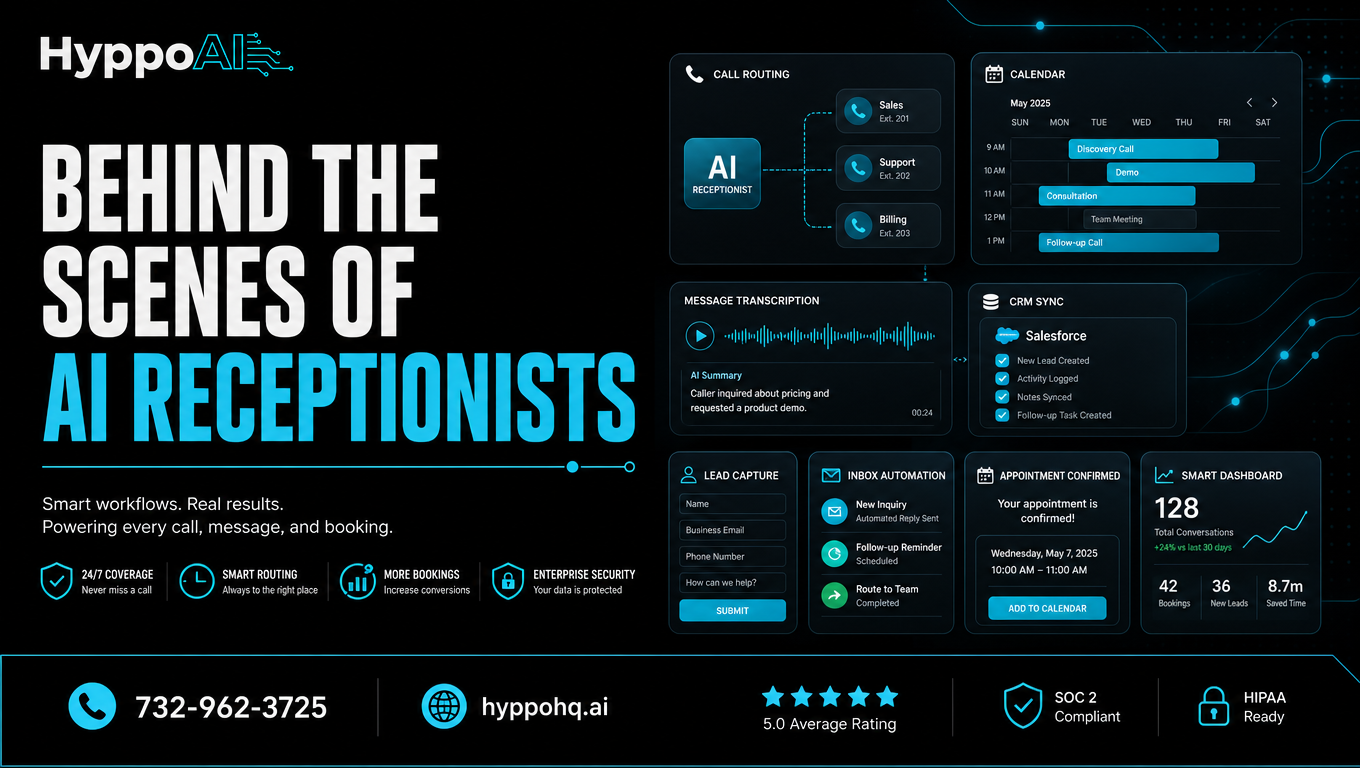
What AI receptionists do behind the scenes for SMBs
When most business owners think about an AI receptionist, they picture one thing: a voice answering the phone.
That is the visible part.
What matters more is everything happening behind the scenes.
An AI receptionist is not just a talking bot. It is a system built to answer calls, understand intent, collect information, route conversations, trigger follow-up, and keep your team from losing leads when nobody is available.
For SMBs, that matters because missed calls are rarely just missed calls. They are missed estimates, missed appointments, missed service requests, and missed revenue.
The real job of an AI receptionist
At a high level, an AI receptionist acts like a front-line operator for your business.
It is designed to:
- answer inbound calls instantly
- respond after hours or during peak times
- handle common questions
- gather caller details
- qualify leads
- route urgent calls
- book appointments or pass requests into your workflow
- log conversations for follow-up
The key point is this: the voice is only the interface. The real value comes from the workflow behind it.
What happens the moment a call comes in
When someone calls your business, an AI receptionist does not just pick up and read a script.
Behind the scenes, it typically works through a sequence like this.
1. It identifies the call context
The system first recognizes that a new call has come in and applies the right business logic.
That may include:
- business hours vs after hours handling
- new lead vs existing customer pathways
- department-based routing rules
- location-specific responses
- urgency detection for time-sensitive situations
This matters because not every caller needs the same experience.
A new prospect asking for a quote should not be handled the same way as an existing customer checking on an appointment.
2. It listens for intent
A strong AI receptionist is built to detect why the caller is reaching out.
That can include intents such as:
- booking a service
- requesting pricing
- asking about availability
- checking business hours
- speaking to a team member
- following up on an existing job
- reporting something urgent
Instead of forcing callers through rigid menu trees, the system interprets natural language and moves the conversation in the right direction.
3. It asks the right follow-up questions
This is where the system starts doing real operational work.
Based on the caller's intent, the AI receptionist can ask structured questions to collect the details your team actually needs.
For example, it may gather:
- name
- phone number
- email address
- service address
- type of service needed
- preferred appointment time
- budget or project scope
- urgency level
That information can be standardized so your team gets cleaner, more useful lead data than they often get from rushed voicemail messages.
How AI receptionists help qualify leads
Not every call deserves the same level of urgency.
One of the most useful behind-the-scenes functions of an AI receptionist is lead qualification.
It separates signals from noise
A business owner or office manager should not have to stop everything for every inbound call.
An AI receptionist can help sort:
- serious buyers from casual browsers
- serviceable requests from out-of-area inquiries
- urgent jobs from routine questions
- existing customers from first-time callers
That does not mean blocking people. It means organizing demand so your team can respond intelligently.
It creates consistent intake
Human call handling varies. One employee asks three questions. Another asks none. Someone else forgets to log the callback number.
AI receptionists help create a consistent intake process so every caller goes through the same core workflow.
That consistency improves:
- speed to lead
- internal handoff quality
- scheduling accuracy
- follow-up performance
- reporting on where calls are coming from
What happens after the call ends
This is the part many people never think about.
A useful AI receptionist does not stop working when the caller hangs up.
Behind-the-scenes actions after the conversation
Depending on how the system is set up, it can trigger actions such as:
- sending a call summary to your team
- logging the interaction in your CRM or internal system
- assigning the lead to the right person
- sending a text confirmation to the caller
- flagging urgent calls for immediate review
- creating follow-up tasks
- updating pipeline or intake records
This is where AI receptionists become operational tools, not just answering tools.
If your team still has to manually listen to voicemails, rewrite notes, and guess what the caller wanted, the process is still broken.
Why this matters for SMBs
Large companies can afford missed opportunities, bloated admin processes, and delayed response times.
Most SMBs cannot.
That is why the behind-the-scenes work matters so much.
Faster response without adding headcount
An AI receptionist can help your business stay responsive even when:
- your team is busy
- the front desk is unavailable
- calls come in after hours
- call volume spikes unexpectedly
That can reduce the pressure to hire just to cover basic call handling.
Better customer experience
Callers want quick answers and clear next steps.
When calls are handled consistently, people are less likely to feel ignored or lost in the process.
Fewer missed leads
A missed call often becomes a lost lead within minutes, especially in competitive local markets.
If an AI receptionist captures the inquiry, gathers details, and starts the next step immediately, your business has a much better chance of converting that opportunity.
What AI receptionists do not do well on their own
It is also important to be realistic.
An AI receptionist is not magic.
It still depends on good setup, clear workflows, and business-specific logic.
If the system is poorly configured, it can:
- ask irrelevant questions
- route calls incorrectly
- create friction for callers
- collect incomplete information
That is why implementation matters.
The best results come when the AI is aligned with how your business actually operates, not when it is dropped in as a generic script.
What to look for in an effective AI receptionist
If you are evaluating solutions, look beyond the voice quality.
Ask what the system does operationally.
Key questions to ask
- Can it qualify leads based on my business rules?
- Can it handle after-hours and overflow calls?
- Can it route urgent requests differently?
- Can it capture structured customer data?
- Can it trigger follow-up actions for my team?
- Can it support consistent intake across every call?
- Can it adapt to different call types without sounding robotic?
Those are the questions that reveal whether you are getting a real business system or just a voice layer.
The bottom line
What AI receptionists actually do behind the scenes is simple to explain but powerful in practice.
They answer calls, yes.
But more importantly, they organize conversations into actions.
They help businesses capture demand, qualify leads, reduce missed opportunities, and create cleaner handoffs for sales and service teams.
For SMBs, that is the difference between a phone line that rings and a system that works.
If you want to see how HyppoAI helps businesses use AI receptionists and voice automation more effectively, visit https://hyppohq.ai or call +17329623725 to learn more.
