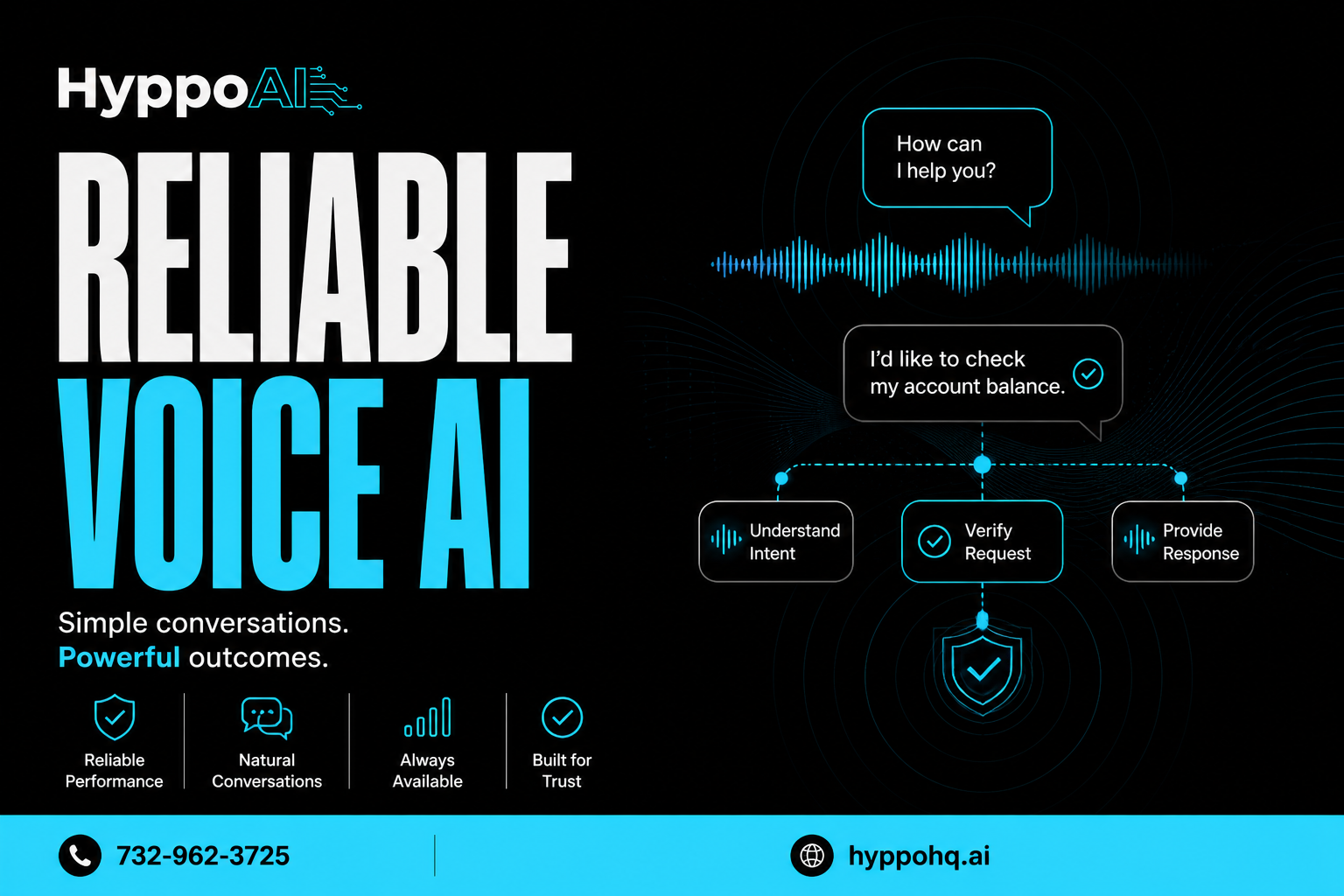
Voice AI for simple conversations: reliable by design
Voice AI gets judged on the hardest possible example: messy, emotional, edge-case conversations. But that is not where it creates the most value first.
In real business settings, voice AI is most reliable when it handles simple conversations with clear goals, predictable flows, and limited decision paths. That is where it can answer fast, stay consistent, and reduce missed opportunities without adding complexity.
For SMBs, that matters. Most inbound calls are not deeply nuanced. They are basic requests like:
- What are your hours?
- Do you service my area?
- Can I book an appointment?
- Can you send me pricing info?
- Who should I talk to next?
When designed correctly, voice AI can manage these conversations reliably and free up human staff for higher-value work.
Why simple conversations are the right starting point
Reliability in voice AI comes from structure, not magic. The more predictable the conversation, the better the system performs.
Simple conversations usually have three advantages:
- A clear intent from the caller
- A limited set of acceptable responses
- A defined next step
That combination makes automation practical.
For example, if a caller wants to confirm business hours, the AI does not need to reason broadly. It needs to identify the question, retrieve the right answer, speak it clearly, and offer the next action if needed.
That is a very different challenge from handling a complex billing dispute or an emotionally charged complaint.
What “reliably” actually means
Reliable voice AI is not just about sounding human. It is about doing the job consistently.
In business terms, reliability usually means:
- Answering calls quickly
- Understanding common requests accurately
- Giving approved, consistent information
- Moving callers to the right next step
- Escalating when confidence is low
- Capturing details without dropping the lead
A system can have a natural voice and still fail operationally. On the other hand, a system that is slightly less conversational but highly accurate can create real business value.
That is the standard that matters.
Where voice AI performs best
Voice AI is strongest in narrow, repeatable workflows. These are conversations with a beginning, middle, and end.
Common high-reliability use cases
- Answering after-hours calls
- Responding to FAQs
- Qualifying new leads
- Booking or requesting appointments
- Routing calls to the right department
- Collecting contact information
- Confirming service areas
- Handling basic follow-up calls
These use cases work because the system is not trying to do everything. It is trying to do a few things very well.
For many SMBs, that alone solves a major problem: missed calls and inconsistent front-desk coverage.
How reliable voice AI is designed
Good performance does not happen by accident. Reliable voice AI depends on design choices behind the scenes.
1. Tight conversation scope
The first rule is simple: define the job.
A voice AI agent should know exactly what kinds of conversations it is supposed to handle. If the scope is too broad, failure rates rise. If the scope is focused, performance improves.
For example, “handle inbound calls for appointment requests and FAQs” is a strong scope.
“Handle every possible customer conversation” is not.
2. Structured prompts and logic
Reliable systems use clear instructions, business rules, and fallback paths.
That includes things like:
- Approved answers to common questions
- Rules for when to ask follow-up questions
- Logic for routing specific call types
- Escalation triggers for uncertainty
- Required fields before ending a call
This is what turns AI from a demo into an operational tool.
3. Controlled knowledge sources
Voice AI should pull from trusted business information, not guess.
If the system is answering questions about services, hours, locations, or availability, the source data must be current and controlled. Reliability drops fast when the AI is working from outdated or vague information.
4. Strong fallback behavior
No voice AI should pretend to know everything.
Reliable systems are built to recognize uncertainty and recover safely. That might mean:
- Asking the caller to repeat the request
- Reframing the question simply
- Transferring to a human
- Taking a message for callback
This is one of the biggest differences between a risky system and a usable one.
Why simple does not mean low value
Some businesses underestimate simple conversations because they seem small. But simple conversations often make up a large share of total call volume.
If those calls go unanswered, delayed, or mishandled, the cost adds up:
- Lost leads
- Frustrated customers
- Slower response times
- Interrupted staff workflows
- Inconsistent caller experience
A reliable voice AI system can improve all of those areas without replacing your team. It acts more like a front-line filter and responder.
That is especially useful for SMBs where every missed call can mean missed revenue.
The real limit: complexity and ambiguity
Voice AI is not equally strong in every situation.
It becomes less reliable when conversations involve:
- Multiple competing intents
- Unclear or emotional language
- Exceptions to normal policy
- Complex troubleshooting
- Negotiation or judgment calls
That does not mean voice AI has no role there. It means the role should change.
In more complex situations, the best use of voice AI is often to:
- Gather initial details
- Identify urgency
- Route intelligently
- Summarize context for a human handoff
That hybrid model is usually more effective than forcing full automation where it does not belong.
How SMBs should evaluate voice AI
If you are considering voice AI, do not start by asking whether it can handle everything.
Start by asking:
- What are our most common simple call types?
- Which of those are repetitive and time-sensitive?
- Where are we missing calls or slowing response?
- What information must always be accurate?
- When should the AI hand off to a person?
These questions lead to better implementation decisions.
The goal is not maximum automation. The goal is reliable automation where reliability matters most.
What success looks like
A successful voice AI deployment usually looks boring in the best way.
Calls get answered.
Basic questions get resolved.
Leads get captured.
Appointments get requested.
Staff gets interrupted less.
Customers get a faster first response.
That is what practical AI should do. It should remove friction, not create it.
Final takeaway
Voice AI handles simple conversations reliably when the workflow is clear, the knowledge is controlled, and the handoff rules are defined. That is where businesses see real operational value first.
For SMBs, the opportunity is straightforward: automate the repetitive conversations that happen every day, keep humans focused on the exceptions, and build from there.
If your business wants to explore voice automation that is designed for real-world reliability, visit HyppoAI at https://hyppohq.ai or call +17329623725 to start the conversation.
