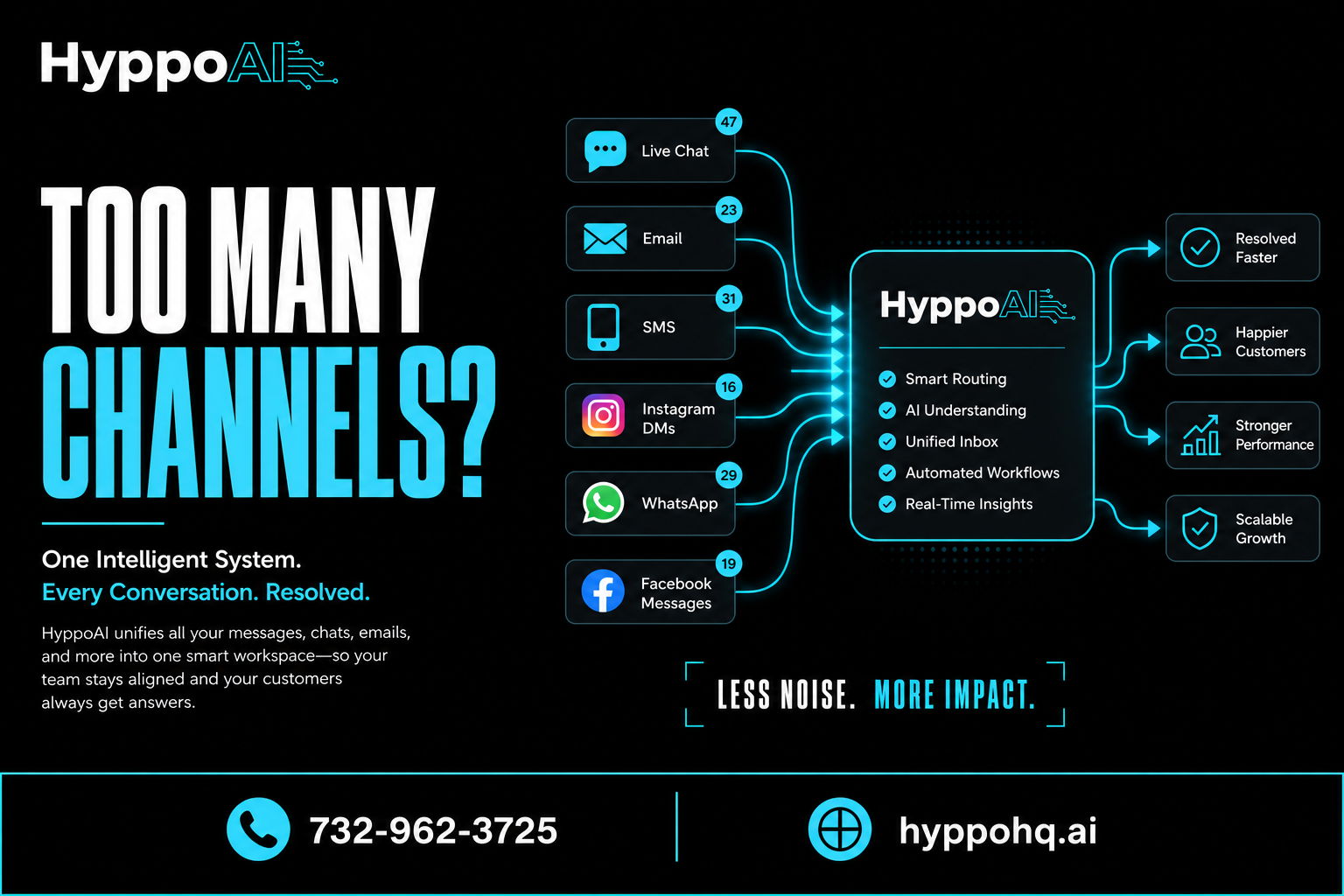
Too many message channels? Here’s what happens next
Customer communication used to be simple.
A phone call. An email. Maybe a website form.
Now it comes from everywhere at once: text, Instagram DMs, Facebook Messenger, web chat, Google Business Profile, voicemail, email, contact forms, and review platforms.
More channels can create more opportunity. But without a system, they also create more delay, more confusion, and more missed revenue.
If your business is receiving messages from too many places, the issue is not just volume. The real problem is fragmentation.
Why too many channels become a business problem
Most SMBs do not struggle because customers are reaching out. They struggle because each channel creates a separate workflow.
That means:
- Messages land in different apps
- Response times vary by platform
- Team members duplicate work
- Important context gets lost
- Leads go cold while someone figures out who owns the reply
When this happens, communication stops being an asset and starts becoming operational drag.
The customer sees one business. Internally, your team is managing six or seven disconnected inboxes.
That gap creates friction fast.
What happens when messages come from too many channels
1. Response times get slower
Every extra channel adds one more place your team has to monitor.
Even if each inbox only gets a few messages a day, the switching cost is real. People check one app, then another, then another. In the process, messages sit unanswered longer than they should.
For a customer, delay feels the same no matter the reason.
If they do not hear back quickly, they move on.
2. Leads fall through the cracks
This is one of the biggest hidden costs.
A lead might send a DM after hours, fill out a website form the next morning, and then call later that day. Without a unified system, those can look like three separate interactions instead of one buying journey.
The result:
- No clear ownership
- No complete customer history
- No reliable follow-up
- Higher chance the lead gets missed entirely
Businesses often think they have a lead generation problem when they actually have a lead management problem.
3. Your team becomes reactive
When messages are spread across too many channels, work becomes driven by whatever pops up first.
That creates a constant state of interruption.
Instead of following a clear process, your staff spends the day chasing notifications, searching for context, and deciding what needs attention now.
Reactive teams do not scale well. They get busy, but not always productive.
4. Customer experience becomes inconsistent
One person gets a fast, helpful text reply.
Another waits two days for an email response.
A third gets asked the same questions twice because the person replying cannot see the earlier conversation from another channel.
Inconsistent communication weakens trust.
Customers do not judge your internal complexity. They judge the experience they receive.
5. Reporting gets blurry
If conversations live in separate tools, it becomes difficult to answer basic questions like:
- Which channels generate the best leads?
- How fast are we responding?
- Where are prospects dropping off?
- How many inquiries become appointments or sales?
Without visibility, improvement becomes guesswork.
You cannot optimize what you cannot clearly track.
6. Good employees burn time on low-value work
Skilled team members should not spend large parts of the day copying details between systems, checking inboxes manually, or trying to reconstruct conversation history.
That is expensive labor being used for simple coordination tasks.
Over time, it also creates frustration.
The more your operations depend on human memory and manual checking, the more fragile the process becomes.
The real issue is not the channels themselves
More communication channels are not automatically bad.
Customers want convenience. They will reach out where it is easiest for them.
That is normal.
The problem starts when the business accepts messages in many places but has no structured way to capture, route, prioritize, and respond to them.
In other words, the issue is not channel count.
It is system design.
Signs your business has a channel overload problem
You may be dealing with this if:
- Team members ask, “Did anyone reply to this?”
- Customers follow up multiple times before getting an answer
- You rely on one person to remember where messages came in
- Leads disappear after the first contact
- Staff members are always busy but conversion stays flat
- You cannot easily measure response time across platforms
- Conversations are scattered between phones, inboxes, and apps
If any of these sound familiar, the fix is usually operational, not motivational.
Your team does not need more pressure. It needs a better workflow.
How to fix it
Centralize intake
Start by reducing the number of places your team has to check manually.
That does not mean turning off customer channels. It means creating a central system that pulls inquiries into one place whenever possible.
A centralized workflow helps your business:
- See all incoming conversations faster
- Assign ownership clearly
- Keep conversation history connected
- Reduce duplicate replies
- Improve accountability
Standardize triage
Not every message needs the same response path.
Some are new leads. Some are support questions. Some are spam. Some need immediate attention.
Create simple rules for what happens next based on message type.
For example:
- New lead inquiries go to sales follow-up
- Existing customer issues go to support
- Urgent requests trigger immediate alerts
- Routine questions get fast automated responses
This removes guesswork and speeds up execution.
Use automation where it actually helps
Automation should not make communication feel robotic. It should remove delay and manual busywork.
That can include:
- Instant acknowledgment messages
- Smart routing by channel or intent
- After-hours response handling
- Lead capture and qualification
- Appointment request collection
- Follow-up reminders
For SMBs, this is where AI can make a measurable difference.
Instead of expecting staff to monitor every inbox all day, AI-supported workflows can capture inbound communication, keep the process moving, and make sure fewer opportunities go untouched.
Build one source of truth
Your team should not have to search five platforms to understand one customer interaction.
A good system creates one usable record of the conversation and next step.
That improves:
- Speed
- Handoffs
- Follow-up quality
- Customer experience
- Reporting accuracy
When context is easy to access, decisions get faster and better.
Why this matters more as you grow
Small communication problems compound quickly.
At lower volume, teams can sometimes patch over a messy process with effort. As inquiry volume increases, that stops working.
Growth puts pressure on whatever system already exists.
If your channels are fragmented now, scaling will magnify the issue.
That is why businesses that want to grow need communication workflows that are designed, not improvised.
The bottom line
When messages come from too many channels, the first thing you lose is speed. After that, you lose visibility, consistency, and often leads.
The solution is not to tell customers to contact you in fewer ways.
The solution is to create a smarter system behind the scenes.
With the right structure, your business can stay accessible across channels without becoming disorganized internally.
HyppoAI helps SMBs design AI-powered workflows that reduce missed messages, improve follow-up, and make customer communication easier to manage at scale.
If your team is juggling too many inboxes and too many handoffs, visit https://hyppohq.ai or call +17329623725 to see how HyppoAI can help simplify the process.
