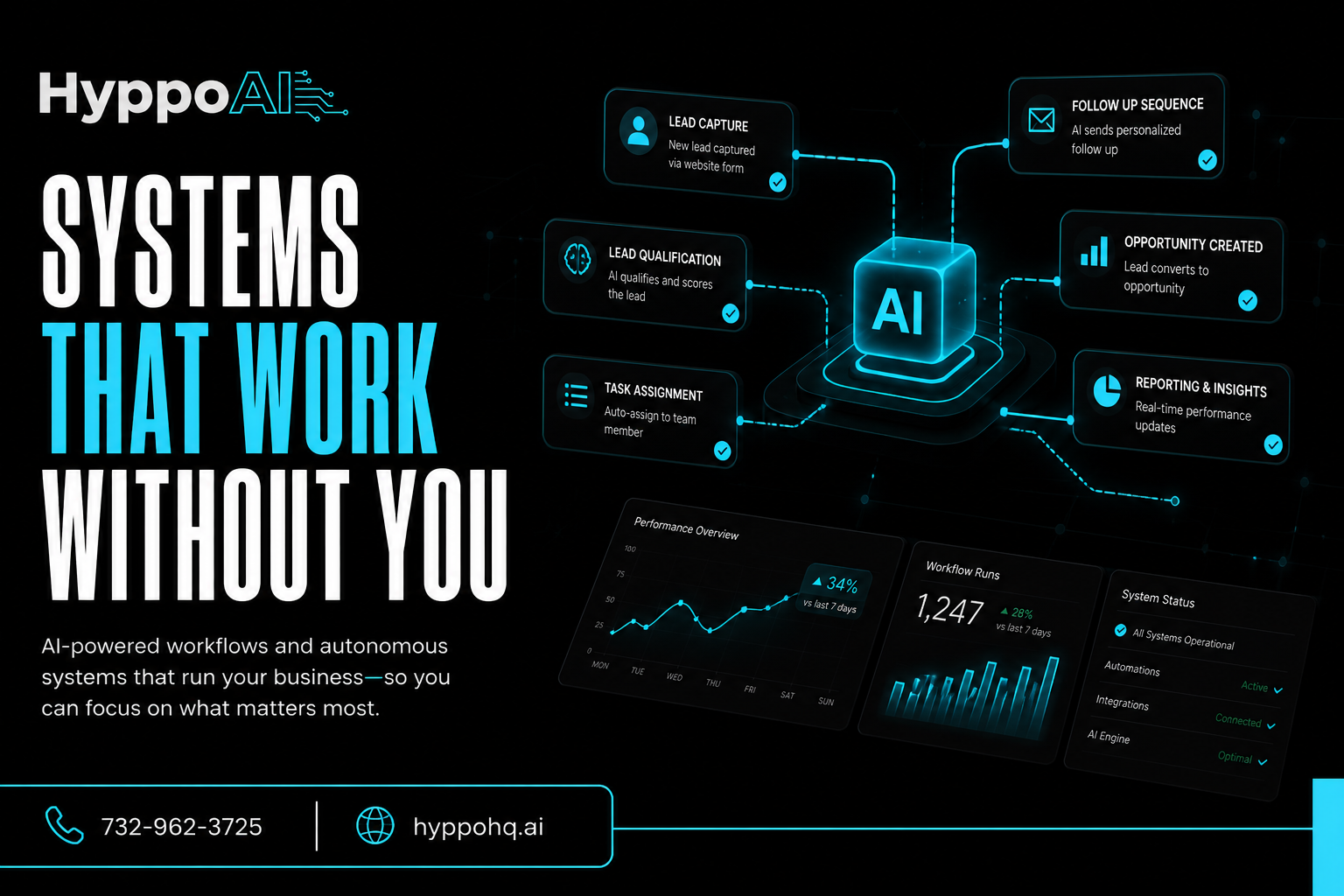
Systems that work when you are not: What it really means
If your business only moves when you are answering, approving, following up, or fixing, then your business is still depending on your constant presence.
That is the real problem many small and mid-sized businesses face. They are busy, they are growing, and they are working hard, but the operation is still manual at its core. Every lead, every reply, every appointment, and every handoff depends on someone being available right now.
When people talk about having systems working when you are not, they are talking about removing that dependency.
It does not mean replacing people. It does not mean becoming robotic. And it definitely does not mean losing control.
It means building repeatable processes, supported by the right tools, so the business can keep moving even when you are off the clock, in a meeting, on a job, or asleep.
What systems working when you are not actually means
At the simplest level, it means your business can:
- capture opportunities automatically
- respond to customers quickly
- route information to the right place
- complete routine tasks without manual effort
- maintain consistency without constant supervision
A system is not just software. A system is the combination of:
- a trigger
- a process
- a rule
- an outcome
For example, if a new lead fills out a form on your website, a working system might instantly:
- log the lead in your CRM
- send a confirmation text or email
- notify your team
- assign follow-up based on service type
- book the next step automatically
That is a system working when you are not.
Why this matters for SMBs
Large companies have teams for operations, support, sales, and follow-up. Most SMBs do not.
That means owners and small teams often carry too much operational weight. They answer calls, reply to messages, chase leads, confirm appointments, and solve preventable bottlenecks.
The result is predictable:
- slower response times
- missed leads
- inconsistent customer experience
- team burnout
- stalled growth
Systems solve this by creating reliability.
When your business has reliable systems, work does not pile up just because you are unavailable for an hour, a day, or a weekend. The business keeps moving.
The difference between being busy and being operationally sound
A lot of businesses confuse hustle with strength.
If you are constantly putting out fires, answering everything personally, and manually checking every step, you may feel productive. But that does not mean the business is built to scale.
Operationally sound businesses are different. They do not rely on memory, heroics, or nonstop availability. They rely on defined workflows.
Signs your business is too dependent on you
You may need stronger systems if:
- leads go cold when you are busy
- customers wait too long for replies
- appointments are booked manually every time
- your team asks the same questions repeatedly
- tasks get dropped during busy periods
- you cannot take time off without things slowing down
If any of that sounds familiar, the issue is not effort. The issue is system design.
What these systems can look like in practice
For SMBs, systems that work when you are not often show up in practical, high-impact areas.
Lead capture and follow-up
A prospect reaches out after hours. Instead of waiting until morning, your system responds immediately, gathers the right details, and moves the lead into the next step.
That matters because speed often determines whether you win or lose the opportunity.
Appointment scheduling
Instead of back-and-forth messages, a scheduling system lets customers book based on real availability. Confirmations and reminders happen automatically.
That reduces no-shows and saves admin time.
Customer communication
Routine questions do not always need a manual response. With structured automation or AI-assisted workflows, businesses can answer common questions quickly and consistently.
Internal handoffs
When one step is completed, the next person or process is triggered automatically. That can mean task creation, status updates, notifications, or document collection.
Missed call recovery
If someone calls and no one answers, the system can follow up instantly by text, collect intent, and keep the lead engaged.
That turns lost moments into real opportunities.
Where AI fits into the picture
AI makes systems more flexible, responsive, and useful.
Traditional automation follows fixed rules. AI can help handle more variable communication and decision support within those rules.
For example, AI can help businesses:
- respond conversationally to inbound inquiries
- qualify leads based on context
- summarize conversations for the team
- route requests to the right department
- support after-hours communication
- reduce repetitive admin work
For SMBs, this is powerful because it extends capacity without requiring a large team.
That said, AI works best when it is part of a clear system. If the process is broken, AI will not magically fix it. Strong outcomes come from combining good workflows with smart automation.
What systems do not do
There is a common fear that systems make a business feel impersonal.
That usually happens only when automation is poorly designed.
Good systems do not remove the human element. They protect it.
By taking repetitive tasks off your plate, systems give your team more time for the work that actually needs judgment, empathy, and expertise.
In other words, systems should handle the predictable so people can focus on the valuable.
How to start building systems that work without you
You do not need to automate everything at once.
The best place to start is with the points where delay, inconsistency, or manual effort are costing you the most.
Start with these questions
Ask yourself:
- Where are leads getting lost?
- What tasks happen over and over?
- Where does the team wait on one person?
- What only works when someone remembers to do it?
- What breaks after business hours?
Those answers usually reveal your biggest opportunities.
Focus on one workflow first
A good first system might be:
- after-hours lead response
- missed call follow-up
- appointment booking and reminders
- intake collection
- review request automation
Start with one workflow, make it reliable, then expand.
Build for consistency, not complexity
The goal is not to create a giant maze of tools. The goal is to create simple, dependable processes that reduce friction.
A strong system should be:
- easy to understand
- easy to maintain
- aligned with your customer journey
- measurable over time
The long-term business impact
When systems work when you are not, the benefits go beyond convenience.
You create a business that is more:
- responsive
- scalable
- predictable
- efficient
- resilient
You also create freedom.
Freedom does not just mean taking time off. It means being able to focus on higher-level decisions instead of getting trapped in repetitive operational work.
That is where real growth happens.
Owners should be thinking about strategy, service quality, and expansion, not spending every day manually patching the same process gaps.
Final thought
If your business depends on you being available every minute, the issue is not commitment. The issue is infrastructure.
Systems that work when you are not are what turn effort into scale. They help your business respond faster, operate more consistently, and grow without adding chaos.
If you want to build smarter workflows and practical AI systems for your business, HyppoAI can help. Visit https://hyppohq.ai or call +17329623725 to learn how to create operations that keep working even when you are not.
