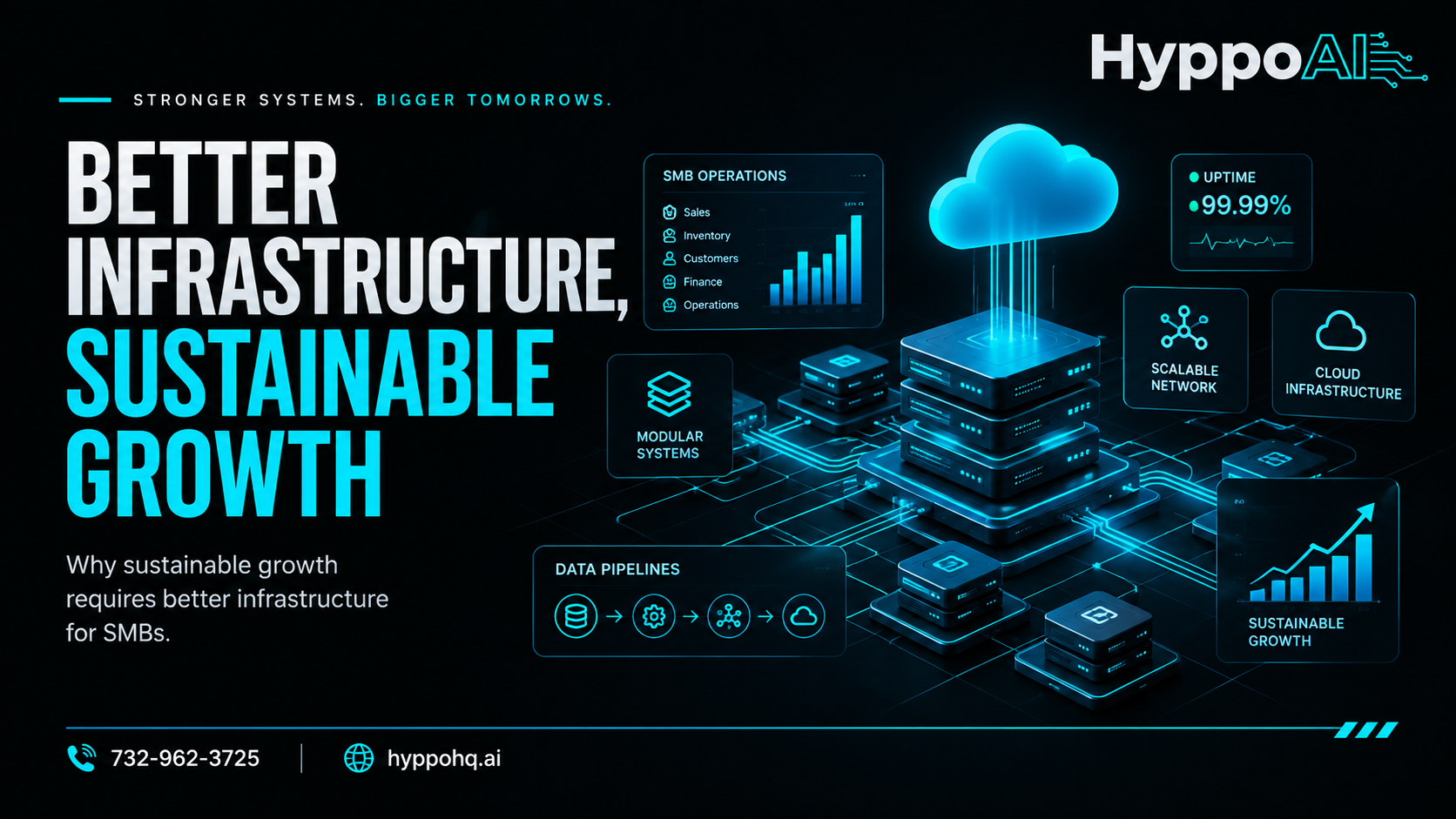
Sustainable growth requires better infrastructure for SMBs
Growth is exciting.
But for most small and mid-sized businesses, growth also exposes every weak process, disconnected tool, and manual bottleneck hiding in the background.
That is why sustainable growth requires better infrastructure.
Not more hustle. Not more tabs open. Not more people patching broken workflows.
Better infrastructure means your business can handle more leads, more customers, more tasks, and more complexity without losing speed, quality, or control. For SMBs, that is the difference between scaling with confidence and stalling under pressure.
Growth without infrastructure creates drag
A lot of businesses think growth problems are sales problems.
Sometimes they are really systems problems.
When demand increases, the cracks show up fast:
- Leads go unanswered
- Follow-ups happen late or not at all
- Team members duplicate work
- Customer information lives in too many places
- Reporting becomes unreliable
- Owners become the bottleneck for every decision
At first, these issues look manageable. Over time, they become expensive.
You do not just lose efficiency. You lose momentum.
Sustainable growth depends on whether your internal operations can support the pace you are trying to create.
What better infrastructure actually means
Infrastructure is not just servers, software, or IT support.
In a modern SMB, infrastructure includes the systems that keep work moving consistently across sales, service, operations, and communication.
That can include:
- CRM and lead management systems
- Automated follow-up workflows
- Scheduling and routing systems
- AI tools that handle repetitive tasks
- Internal documentation and process logic
- Dashboards for visibility and decision-making
- Integrations that reduce manual data entry
Good infrastructure creates reliability.
It gives your business a repeatable way to operate, even as volume increases.
That matters because sustainable growth is not about getting bigger once. It is about staying effective as you grow again and again.
Why SMBs feel the pain first
Large companies usually have layers of support, specialized teams, and more operational redundancy.
SMBs do not.
That means when systems are weak, the impact lands directly on the owner, leadership team, and frontline staff. One missed handoff can affect revenue. One slow response can cost a lead. One manual process can consume hours every week.
For SMBs, infrastructure is not a luxury project. It is a growth requirement.
The faster your business moves, the more important it becomes to remove friction from the core workflow.
Common signs your infrastructure is holding back growth
If any of these sound familiar, your systems may be limiting your next stage of growth:
- Your team relies on memory instead of process
- Important tasks live in inboxes or text threads
- New hires take too long to ramp up
- You cannot easily see where leads drop off
- Customers get inconsistent experiences
- Reporting takes manual effort every week
- You are adding headcount just to keep up with admin work
These are not just operational annoyances.
They are indicators that your current setup will struggle under more demand.
Better infrastructure improves more than efficiency
Most people think infrastructure is about saving time.
That is part of it, but the bigger value is leverage.
When your systems are stronger, your business gains:
Better responsiveness
Fast response times matter. Strong infrastructure helps your team capture inquiries, route requests, and follow up without delay.
Better consistency
Customers should not get a great experience only when your best employee is available. Systems make quality more repeatable.
Better decision-making
If your data is fragmented, decisions become reactive. Better infrastructure gives leaders clearer visibility into performance and bottlenecks.
Better scalability
You should not need to rebuild the business every time volume increases. Strong systems let you grow on a stable foundation.
Better use of AI
AI works best when the underlying process is clear. If your workflows are chaotic, AI can amplify confusion. If your infrastructure is solid, AI can amplify output.
The connection between AI and infrastructure
This matters especially for businesses adopting AI.
AI is not magic. It performs best when it sits on top of organized workflows, clean inputs, and defined business logic.
If a company wants AI to help with lead handling, customer communication, scheduling, reporting, or internal operations, the supporting infrastructure has to be there.
For example:
- An AI receptionist needs call routing logic
- Automated follow-up needs a connected CRM
- AI reporting needs consistent data sources
- Workflow automation needs clear triggers and actions
Without the right infrastructure, AI becomes another disconnected tool.
With the right infrastructure, AI becomes a force multiplier.
That is why sustainable growth requires better infrastructure first, not just more software layered onto old problems.
How to build infrastructure that supports growth
You do not need to overhaul everything at once.
The smart move is to strengthen the systems closest to revenue, service delivery, and operational visibility.
Start with bottlenecks
Look for the points where work slows down, gets lost, or depends too heavily on one person.
Ask:
- Where are leads waiting?
- Where is manual work repeating?
- Where do errors happen most often?
- Where do customers experience delays?
Fixing bottlenecks usually creates immediate gains.
Standardize the core workflow
Before you automate, define the process.
Document what should happen from first inquiry to closed deal, from onboarding to service delivery, and from issue to resolution.
Clarity comes before automation.
Connect your systems
If your tools do not talk to each other, your team becomes the integration layer.
That is expensive and unreliable.
Connecting core systems reduces duplicate work and improves speed across the business.
Automate repetitive tasks
Once the process is clear, repetitive work is the next target.
That may include:
- Lead capture and routing
- Appointment confirmations
- Follow-up reminders
- Status updates
- Internal notifications
- Basic customer responses
This is where SMBs can create major leverage without adding unnecessary complexity.
Build for visibility
Leaders need a clear view of what is happening.
If reporting is delayed or inconsistent, growth decisions become guesswork. Dashboards and structured reporting help teams act earlier and with more confidence.
Infrastructure is a strategic advantage
Businesses often wait too long to improve infrastructure because the current setup still technically works.
But working is not the same as scaling.
The question is not whether your systems function today.
The question is whether they can support the business you are trying to become.
Sustainable growth requires infrastructure that can absorb pressure, reduce friction, and create consistency at scale. That is how businesses protect margins, improve customer experience, and free up leadership to focus on strategy instead of constant firefighting.
In other words, better infrastructure is not back-office overhead.
It is a strategic advantage.
Final thought
If your business is growing but your operations feel heavier, slower, or more fragile, that is the signal.
Do not just push harder.
Strengthen the system.
At HyppoAI, we help SMBs build smarter operational foundations with AI and automation that support real, sustainable growth. Visit https://hyppohq.ai or call +17329623725 to see how better infrastructure can help your business scale with less friction.
