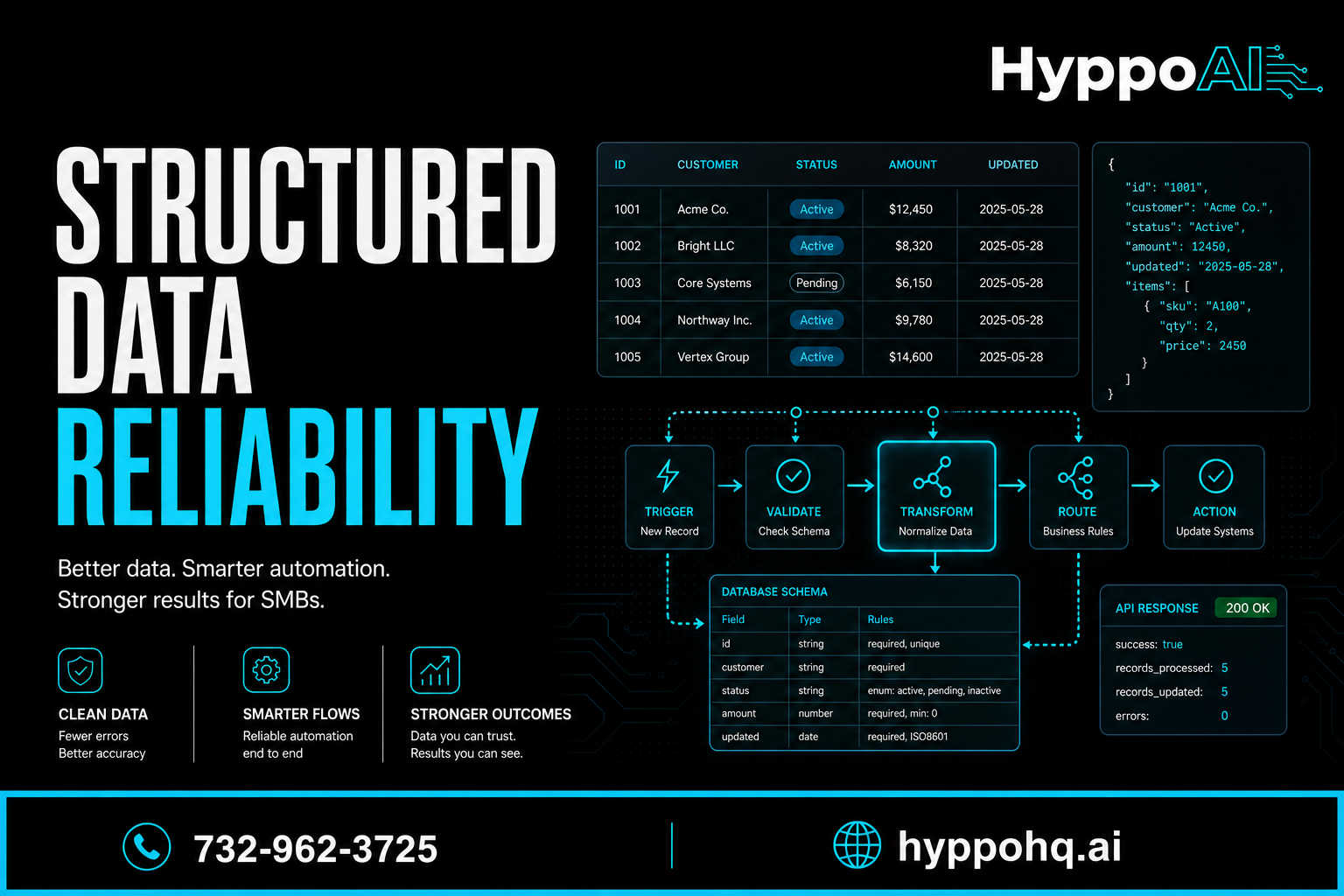
Structured data improves automation reliability for SMBs
Automation often gets blamed when workflows fail.
But in many cases, the real problem is not the automation itself. It is the data feeding it.
If your systems rely on inconsistent customer records, messy form entries, unclear labels, or disconnected tools, even the best automation will produce unreliable results. That is why structured data matters.
For SMBs, structured data improves automation reliability by making information easier for software, AI tools, and operational systems to understand and act on consistently.
What structured data actually means
Structured data is information organized in a predictable format.
Instead of scattered notes, free-text fields, and inconsistent naming, structured data uses defined fields and standard formats. Think:
- First name and last name in separate fields
- Phone numbers stored in one consistent format
- Lead status chosen from a set list
- Appointment dates stored as actual date fields
- Service types selected from predefined categories
This structure gives automation systems clear rules.
When data is standardized, tools can trigger the right actions with less guesswork. When data is unstructured, automations have to interpret messy inputs, and that is where reliability drops.
Why automation breaks without structure
Most automation failures are not caused by the workflow logic alone. They happen because the input data is incomplete, inconsistent, or ambiguous.
For example, imagine a lead intake system where one employee enters "Palm Bay," another types "PalmBay," and another uses "PB." If your automation routes leads by city, those small differences can create missed assignments, incorrect reporting, or failed follow-up.
The same issue shows up in many places:
- Duplicate contact records
- Missing required fields
- Different spellings for the same service
- Notes entered where dropdowns should be used
- Inconsistent timestamps across platforms
- CRM stages that mean different things to different team members
Automation depends on patterns. Structured data creates those patterns.
How structured data improves automation reliability
When your data is organized, your systems become more dependable. Here is how structured data improves automation reliability in practical terms.
1. It reduces failed triggers
Automations usually run on conditions.
If a field changes, a tag gets added, a form gets submitted, or a status updates, the system takes action. But those triggers only work if the data is consistent.
Structured data ensures:
- Required fields are present
- Values match expected formats
- Workflows can detect the right events
- Actions fire at the right time
That means fewer silent failures and fewer manual fixes.
2. It improves AI accuracy
AI tools are powerful, but they still depend on clean inputs.
If your AI receptionist, chatbot, lead qualification system, or internal assistant is pulling from messy records, the output becomes less reliable. Structured data gives AI better context.
This can help AI systems:
- Identify customer intent more accurately
- Route inquiries correctly
- Personalize responses with confidence
- Summarize conversations consistently
- Update records without introducing errors
Better structure leads to better decisions.
3. It makes reporting more trustworthy
If your automation is generating dashboards, notifications, or performance reports, unreliable data creates unreliable insights.
Structured data improves reporting because it standardizes what each field means and how it is recorded. That makes it easier to answer questions like:
- Which lead sources convert best?
- How fast is follow-up happening?
- Which services drive the most revenue?
- Where are leads getting stuck?
Without structure, reporting becomes a manual cleanup project.
4. It simplifies integrations
Most SMBs use multiple tools.
Your CRM, scheduling platform, phone system, invoicing software, and AI tools all need to exchange information. Structured data acts like a shared language between systems.
When fields are clearly defined and consistently formatted, integrations become easier to build and maintain.
That means:
- Fewer sync errors
- Cleaner handoffs between tools
- Lower maintenance overhead
- More dependable end-to-end workflows
5. It supports scale
A process that works manually for 20 leads a month may break at 200.
As volume grows, weak data practices create bigger problems. Structured data helps businesses scale because it reduces exceptions and makes workflows repeatable.
The more your business relies on automation, the more valuable structure becomes.
Signs your data may be hurting reliability
Not sure whether data structure is the issue? Watch for these common warning signs:
- Team members frequently fix automation mistakes by hand
- Reports never quite match across platforms
- Duplicate records keep appearing
- Leads are routed to the wrong person
- Follow-up sequences skip contacts or send at the wrong time
- AI-generated outputs need constant correction
- Your team uses notes to explain what a field "really means"
If these issues are familiar, your automation may not need more complexity. It may need better data discipline.
Practical ways to create more structured data
You do not need to rebuild everything at once. Start with the workflows that matter most.
Standardize key fields
Identify the fields that drive your most important automations, such as:
- Lead source
- Service type
- Location
- Appointment status
- Sales stage
- Contact method
Then define exactly how each one should be used.
Replace free text where possible
Free text has its place, but it should not control critical workflows.
Use:
- Dropdowns
- Checkboxes
- Radio buttons
- Date selectors
- Required fields
These inputs reduce variation and make automation more reliable.
Clean up duplicates and naming issues
If your systems already contain inconsistent records, cleanup matters.
Start by reviewing:
- Duplicate contacts
- Old tags and labels
- Conflicting status names
- Unused custom fields
- Broken field mappings between tools
Even small cleanup projects can improve workflow performance.
Define ownership
Structured data is not just a technical issue. It is an operational one.
Someone on the team should own:
- Field definitions
- Naming conventions
- Input standards
- Data audits
- Integration rules
Without ownership, structure tends to drift over time.
Audit your highest-value automations
Look at the automations that affect revenue, speed to lead, scheduling, and customer communication.
Ask:
- What data triggers this workflow?
- Is that data always present?
- Is it standardized?
- Could a human enter it in multiple ways?
- What happens when the field is blank or incorrect?
This process often reveals reliability gaps fast.
Structured data is a business advantage, not just a technical detail
For SMBs, reliability matters more than novelty.
A flashy automation that fails 15 percent of the time creates more operational drag than value. A simpler system built on structured data will usually outperform a more advanced setup built on inconsistent inputs.
That is the real takeaway: structured data improves automation reliability because it gives your systems clarity.
Clear inputs create consistent outputs.
And consistent outputs are what make automation useful at scale.
Final thoughts
If your business is investing in AI, workflow automation, or better operational systems, structured data should be part of the conversation from the start.
It helps reduce errors, improve reporting, support integrations, and make automation more dependable as your business grows.
HyppoAI helps SMBs build practical AI and automation systems that actually work in the real world. To learn more, visit https://hyppohq.ai or call +17329623725.
