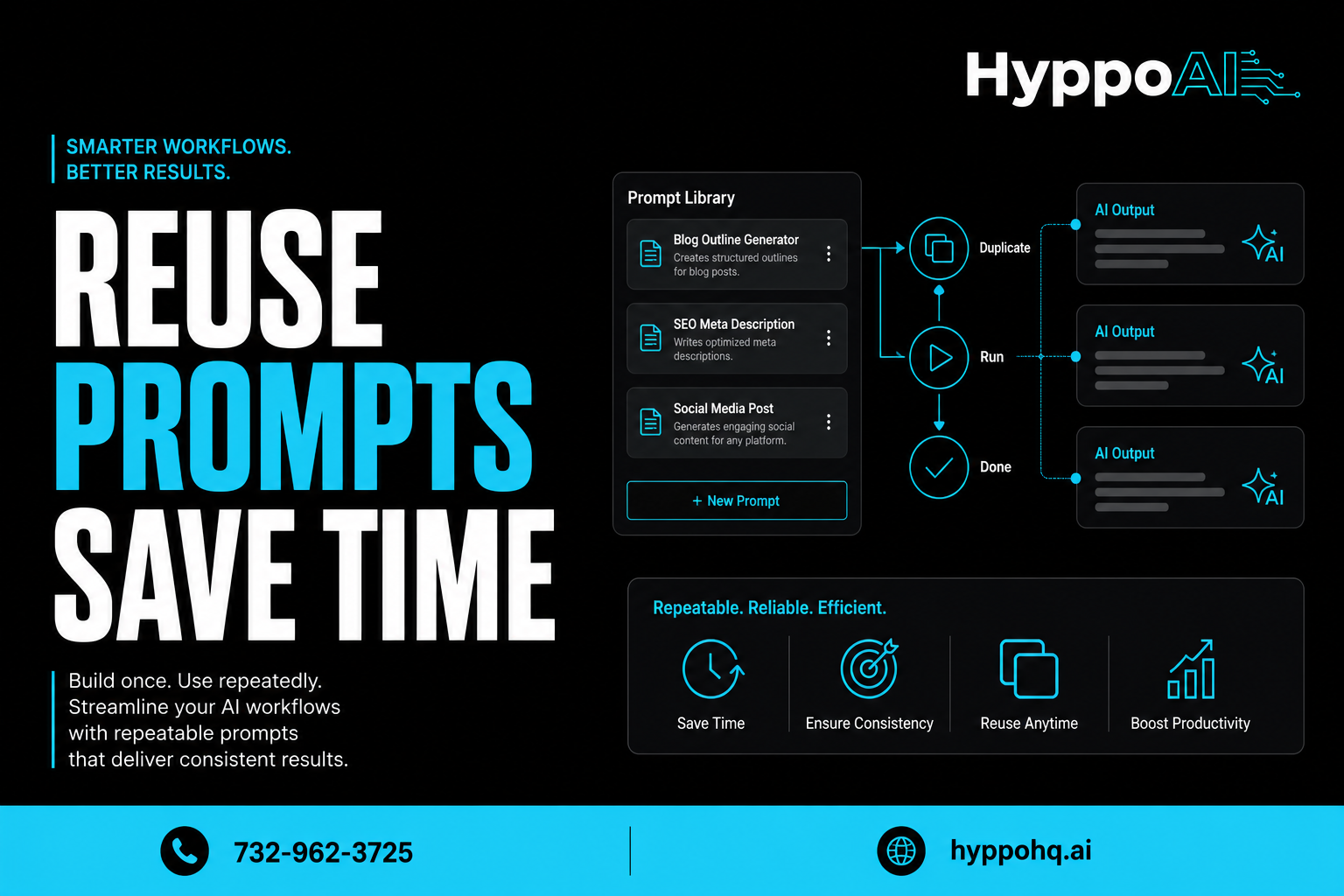
How to save time by reusing prompts that work
If your team uses AI regularly, there is a good chance people are solving the same problem over and over.
One person writes a solid prompt for a sales email. Another rebuilds a similar one for a follow-up message. Someone else creates a new version for social captions, support replies, or internal summaries. The result is predictable: wasted time, inconsistent outputs, and avoidable frustration.
The fix is simple. Reuse prompts that already work.
A proven prompt is not just a shortcut. It is a repeatable system. When you save, refine, and reuse effective prompts, you reduce guesswork and make AI more useful across the business.
Why reusing prompts saves so much time
Most teams lose time in two places:
- figuring out how to ask the AI for the right result
- rewriting instructions that already worked before
When you reuse prompts, you eliminate both.
Instead of starting from a blank page, you start from a tested framework. That means:
- faster output creation
- fewer revisions
- more consistent tone and structure
- easier delegation across team members
- less dependence on one person knowing the “right way” to prompt
For SMBs, this matters even more. Small teams do not have time for repeated trial and error. Reusing prompts helps you move faster without sacrificing quality.
What counts as a reusable prompt
A reusable prompt is any prompt that reliably produces a useful output with only small edits.
That could include prompts for:
- social media captions
- customer follow-up emails
- blog outlines
- meeting summaries
- proposal drafts
- FAQ responses
- review reply suggestions
- ad copy variations
- internal SOP creation
The key is reliability. If a prompt consistently gives you a strong first draft, it should be saved.
Build prompts like templates, not one-off requests
The biggest shift is mindset.
Do not think of prompts as disposable commands. Think of them as operating templates.
A strong reusable prompt usually includes:
1. A clear role
Tell the AI who it should act like.
Examples:
- Act as a sales copywriter for a local service business
- Act as a customer support specialist
- Act as a project manager summarizing next steps
This improves relevance and reduces vague output.
2. A defined task
Be specific about what you want created.
Examples:
- Write a follow-up email after a missed sales call
- Turn these notes into a concise meeting summary
- Create three caption options for a product launch
3. Context
Add the business, audience, offer, or situation.
Examples:
- Target audience is small business owners
- Tone should be direct, confident, and practical
- The goal is to book a demo, not hard sell
4. Output format
Tell the AI exactly how to structure the response.
Examples:
- Use bullet points
- Keep it under 150 words
- Provide three variations
- Include a CTA at the end
5. Variables you can swap later
This is what makes the prompt reusable.
Use placeholders like:
- [business type]
- [target audience]
- [offer]
- [tone]
- [word count]
- [platform]
Once those variables are built in, one prompt can be used dozens of times.
A simple example of prompt reuse
Here is the difference between a one-time prompt and a reusable one.
One-time prompt
Write an Instagram caption for my business about saving time with AI.
Reusable prompt
Act as a direct-response social media copywriter for [business name]. Write 3 Instagram caption options about [topic] for [target audience]. Use a [tone] voice, keep each caption under [word count], include a clear CTA, and avoid filler. Format each option separately.
The second version takes a little longer to build once. After that, it becomes a repeatable asset.
Create a prompt library your team can actually use
Saving prompts in random chats is not a system.
If you want prompt reuse to save real time, create a simple prompt library. It does not need to be complicated.
You can store prompts in:
- a shared document
- a spreadsheet
- a project management tool
- a knowledge base
- a notes app with folders by use case
Organize the library by business function, such as:
- marketing
- sales
- support
- operations
- content
- leadership
For each prompt, include:
- prompt name
- use case
- full prompt text
- variables to replace
- example output
- notes on what worked
This makes it easier for anyone on the team to get value from AI without starting from scratch.
Improve prompts over time
A reusable prompt should not stay static forever.
The best prompts get better through use.
After each use, ask:
- Did the output need heavy editing?
- Was the tone right?
- Were the instructions clear enough?
- Should examples be added?
- Can the format be simplified?
Small refinements compound quickly. A prompt that was decent in week one can become a major time-saver by month two.
Common mistakes to avoid
Prompt reuse works best when you avoid a few common problems.
Saving bad prompts too early
Not every prompt deserves a place in your library. Save the ones that consistently produce useful results.
Making prompts too rigid
A good template creates structure, not unnecessary complexity. If a prompt is overloaded with rules, it may become harder to use than writing a new one.
Forgetting the audience
A prompt that works for internal documentation may fail for customer-facing content. Reuse the structure, but keep the audience and goal aligned.
Not documenting the best outputs
Sometimes the real value is not just the prompt, but the prompt plus the example result. Save both when possible.
Where prompt reuse creates the fastest wins
If you are just getting started, focus on high-frequency tasks.
These usually offer the fastest return:
- weekly social posts
- sales outreach and follow-ups
- customer support responses
- blog and email drafts
- call summaries and action items
- review responses
- onboarding and SOP documentation
If a task happens repeatedly, it is a strong candidate for prompt reuse.
Reusing prompts is really about operational efficiency
This is bigger than writing faster.
When your team reuses prompts that work, you create consistency in how AI supports the business. That means:
- better quality control
- faster onboarding for new team members
- less duplicated effort
- more predictable output across departments
In other words, prompt reuse turns AI from a novelty into a system.
For SMBs, that shift matters. The goal is not to use AI more just for the sake of it. The goal is to get useful work done faster, with less friction.
Start small and systemize what works
You do not need a massive library to see results.
Start with three to five prompts your team uses often. Save them. Label them clearly. Improve them after each use. Then expand from there.
That simple habit can save hours every week.
If your business wants practical ways to turn AI into repeatable workflows, HyppoAI helps SMBs build smarter systems that actually save time. Visit https://hyppohq.ai or call +17329623725 to learn more.
