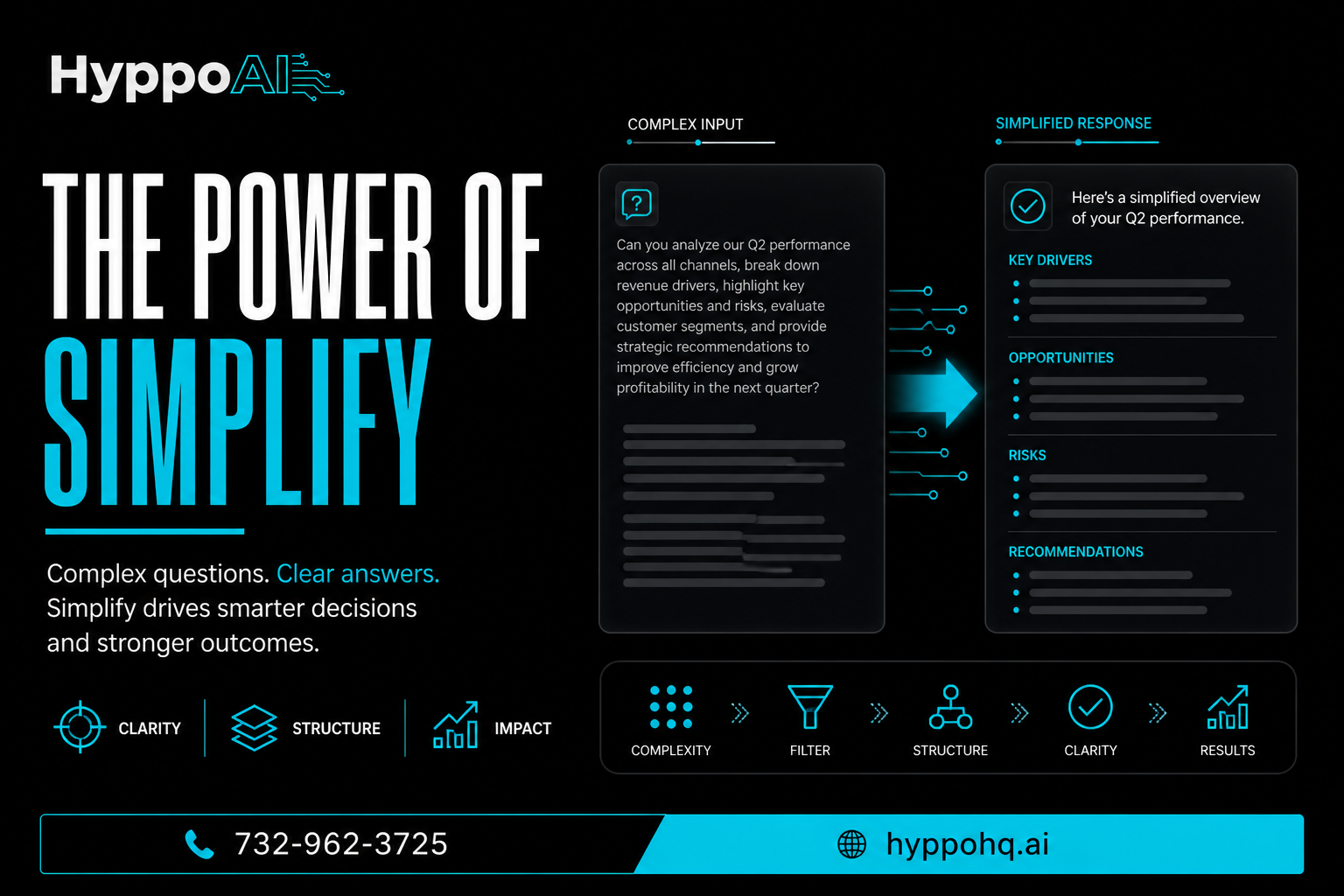
The power of asking ChatGPT to simplify responses
When people use ChatGPT, they often ask for one thing: make it shorter.
That sounds reasonable. But shorter is not always better.
If your real goal is clarity, speed, and usefulness, the better instruction is usually simpler: simplify this.
That small shift changes the output in a big way. Instead of just cutting words, ChatGPT starts reducing complexity. It removes friction. It keeps the meaning while making the message easier to understand.
For business owners, marketers, and teams trying to move fast, that matters.
Shorter and simpler are not the same thing
A shorter response only reduces length. It does not automatically improve understanding.
In fact, asking for something shorter can create new problems:
- Important context gets removed
- Jargon stays in place
- The writing becomes compressed but still confusing
- The reader has to work harder to understand the point
A simplified response does something different.
It focuses on:
- Clear language
- Direct structure
- Fewer ideas competing at once
- Better readability
- Faster comprehension
That is the difference between cutting words and improving communication.
Why simplification works better with AI
ChatGPT is good at following instructions, but it is especially useful when your instruction reflects the real outcome you want.
If you say, “make this shorter,” the model may:
- Trim examples
- Remove nuance
- Keep the same difficult wording
- Deliver a condensed version of the same complexity
If you say, “simplify this,” the model is more likely to:
- Replace technical language with plain English
- Break long thoughts into smaller ideas
- Clarify the main takeaway
- Prioritize understanding over compression
That makes the answer more usable for real people.
For SMB teams, that is a practical advantage. You are not creating content just to save space. You are creating content so customers, employees, and prospects can act on it.
The hidden cost of asking for shorter answers
When people ask for shorter responses, they are often reacting to overload.
They do not actually want less information. They want less friction.
Those are not the same thing.
A short answer can still feel dense. It can still be vague. It can still miss the point.
That creates a common workflow problem:
- You ask ChatGPT for an answer
- The answer is too long
- You ask it to make it shorter
- The answer gets tighter but not clearer
- You spend more time editing it yourself
Now the tool is saving less time than it should.
A better prompt reduces that back-and-forth.
What to ask instead of “make it shorter”
If you want better results, give ChatGPT a more precise goal.
Try prompts like:
- Simplify this for a busy business owner
- Rewrite this in plain English
- Make this easier to understand
- Explain this at an eighth-grade reading level
- Keep the meaning, but remove unnecessary complexity
- Turn this into a clear, direct summary
- Simplify this without losing the key point
Each of these prompts tells the model to optimize for clarity, not just brevity.
Better prompt examples
Here is a simple comparison.
Weak prompt: Make this shorter.
Better prompt: Simplify this into plain English for a small business owner who has no technical background.
Weak prompt: Cut this down.
Better prompt: Keep the main point, remove jargon, and make this easier to scan.
Weak prompt: Summarize this.
Better prompt: Summarize this in three simple bullet points with one clear takeaway.
The more specific your clarity goal, the better the output.
Where simplification matters most
This approach is useful across almost every business function.
Marketing content
If your copy sounds smart but does not convert, it may be too complex.
Ask ChatGPT to simplify:
- Website copy
- Email campaigns
- Social captions
- Product descriptions
- Ad messaging
Clearer messaging usually performs better because people understand the value faster.
Sales communication
Sales teams often deal with offers, proposals, and follow-ups that become too wordy.
Simplification helps with:
- Prospect emails
- Pitch decks
- Objection handling
- Meeting recaps
- Follow-up messages
A prospect should not need to decode your message.
Internal operations
AI is also useful inside the business.
Use simplification for:
- SOPs
- Training documents
- Team updates
- Process explanations
- Customer support templates
If your team can understand instructions faster, execution improves.
Simplify first, then shorten if needed
This is the best sequence for most use cases.
First ask ChatGPT to simplify. Then, if you still need less length, ask it to shorten the simplified version.
That order matters.
Why?
Because once the message is clear, trimming it becomes safer. You are reducing clean information instead of compressing confusion.
A practical workflow looks like this:
- Draft the original content
- Ask ChatGPT to simplify it
- Review for accuracy and tone
- Ask ChatGPT to shorten it to your target length
- Finalize for the platform or audience
This produces stronger output than jumping straight to “shorter.”
A simple framework for better prompts
If you want consistently better AI writing, use this formula:
Action + audience + constraint + goal
For example:
- Simplify this for first-time customers and keep it under 100 words
- Rewrite this in plain English for a non-technical manager
- Make this easier to scan with bullets and a stronger takeaway
- Explain this simply for a small business owner who wants a fast answer
This gives ChatGPT enough direction to produce something useful, not just compressed.
What business leaders should remember
The real value of AI writing is not word reduction.
It is decision support, communication speed, and clearer execution.
If your prompt focuses only on length, you may miss the bigger opportunity.
The strongest AI users are not just asking for less. They are asking for better.
That is the mindset shift.
- Do not just remove words
- Remove confusion
- Do not just compress information
- Improve understanding
- Do not just save space
- Save attention
That is where AI becomes more practical for SMBs.
Final takeaway
Asking ChatGPT to simplify is usually more powerful than asking it to be shorter because clarity creates value. Shortness alone does not.
If you want answers that are easier to use, easier to share, and easier to act on, start with simplification. Then shorten only if the format requires it.
That one prompt change can improve everything from marketing copy to internal communication.
If your business is exploring practical AI workflows that actually save time, HyppoAI helps SMBs use AI more effectively. Visit https://hyppohq.ai or call +17329623725 to learn more.
