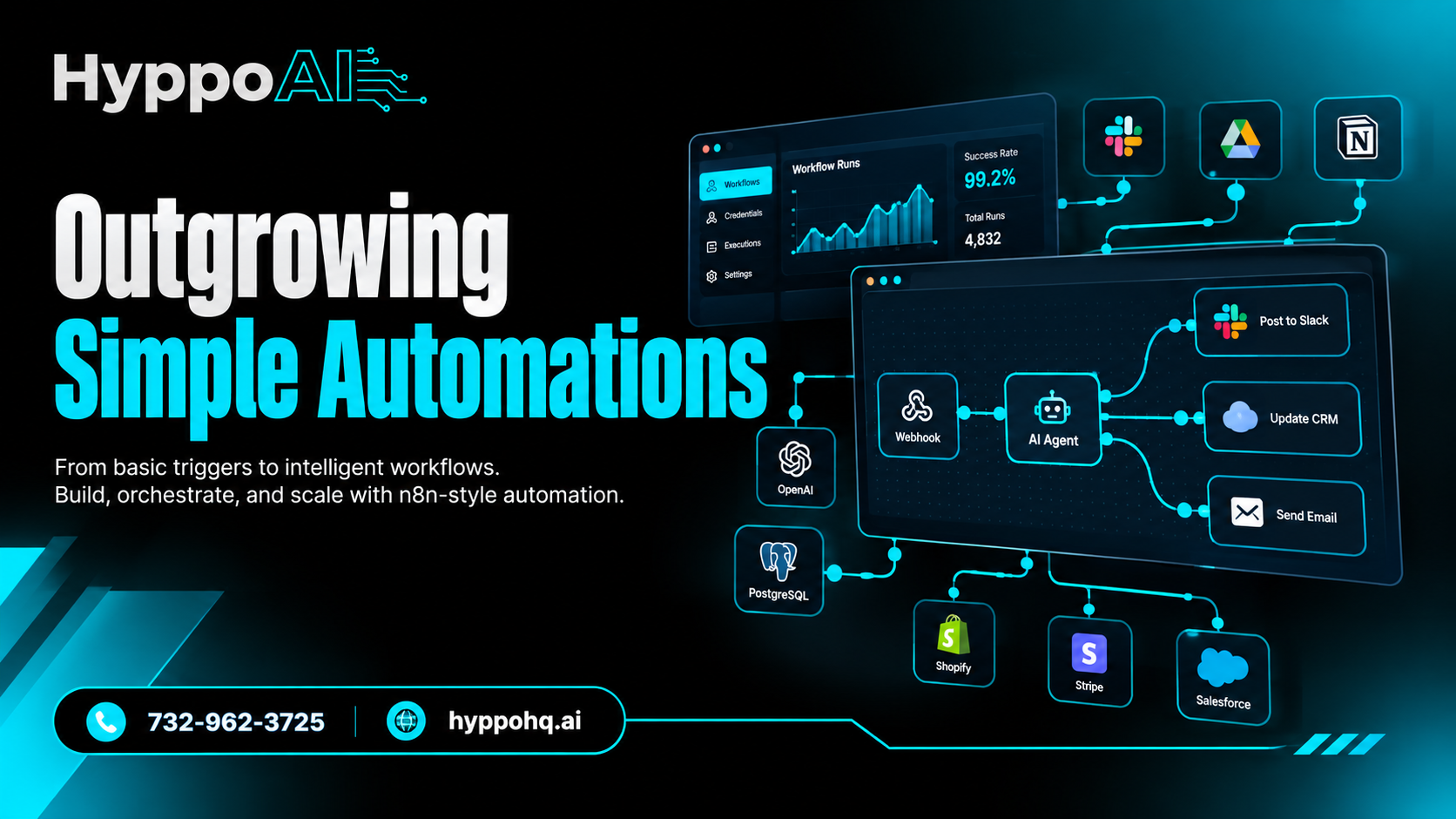
When businesses outgrow simple automations and need n8n
Simple automations are great at the beginning.
They save time, reduce repetitive work, and help teams move faster without hiring more people. For many small and midsize businesses, a basic automation tool is the right first step.
But growth changes the equation.
What worked when you had a few leads, a handful of apps, and one simple workflow can start to create friction. Tasks fail silently. Data gets stuck between systems. Teams build workarounds. And suddenly your “automation” still needs a person watching it every day.
That is usually the moment businesses start looking at n8n.
Why simple automations stop being enough
Most businesses do not outgrow automation because automation was a bad idea. They outgrow simple automation because the business itself becomes more complex.
A few common signs show up first:
- You need more than one trigger or condition in a workflow
- Your apps do not connect cleanly without custom logic
- You are moving data across sales, support, operations, and marketing
- You need approvals, branching paths, or exception handling
- Your team is manually fixing failed automations every week
- You want more control over data, timing, and workflow behavior
Simple tools are designed to be easy. That is their strength.
But ease often comes with limits. Once your processes involve multiple teams, multiple systems, and business rules that cannot be reduced to “if this, then that,” those limits become expensive.
The real cost of staying on basic automation
A lot of businesses wait too long to upgrade because the current setup still kind of works.
That is the trap.
The issue is not whether a simple automation can run. The issue is whether it can run reliably, at scale, and without constant human intervention.
When it cannot, the hidden costs add up:
- Missed leads because follow-up logic breaks
- Duplicate records in your CRM
- Delays between customer actions and internal responses
- Manual re-entry of data across tools
- Team members wasting time checking automation status
- Poor reporting because systems are out of sync
At that point, the business is not really automated. It is partially automated and manually patched.
That creates operational drag right when speed matters most.
Why n8n becomes the next logical step
n8n is a strong fit when your workflows need more flexibility than plug-and-play automation platforms can provide.
It gives businesses the ability to build automations that reflect how operations actually work, not just how a template says they should work.
What makes n8n different
n8n stands out because it is built for more advanced workflow logic and customization.
That matters when your business needs:
- Multi-step workflows across many apps
- Conditional logic and branching
- Custom API connections
- Data transformation between systems
- Error handling and retry logic
- Better visibility into how workflows run
In plain terms, n8n helps when your automation needs to think more like your operation.
Instead of forcing your process into a rigid tool, you can build workflows around real business requirements.
Common business scenarios where n8n makes sense
Not every company needs n8n on day one. But many growing SMBs reach a stage where it becomes the better tool.
Here are a few examples.
Lead management across multiple channels
If leads come in from forms, calls, ads, chat, and referral partners, basic automations can get messy fast.
n8n can help route leads based on source, urgency, service type, geography, or availability. It can also update your CRM, notify your team, trigger follow-up, and log the full workflow in one system.
Customer follow-up with business rules
A simple sequence is easy.
A real follow-up system is not.
If timing changes based on customer behavior, service category, appointment status, or internal notes, you need more than a one-size-fits-all automation. n8n gives you the control to build follow-up logic that matches the customer journey.
Operations that touch multiple systems
As businesses grow, information often lives in too many places.
Your CRM, scheduling software, invoicing platform, support inbox, and internal dashboards all hold part of the picture. n8n can act as the connective layer that keeps those systems aligned.
AI workflows that need orchestration
For businesses using AI, the challenge is often not the model itself. It is the workflow around it.
You may need to capture data, clean it, send it to an AI system, review the output, trigger actions, and store results. n8n is useful when AI is part of a larger operational process rather than a standalone feature.
How to know if your business is ready for n8n
A good rule is simple: if your team spends too much time managing automations instead of benefiting from them, it is time to reassess.
You may be ready for n8n if:
- Your workflows cross departments
- Your automations need custom logic
- Reliability matters more than convenience
- You need to connect tools that do not have easy native integrations
- You are scaling volume and cannot afford process breakdowns
- You want automations that support operations, not just tasks
This does not mean every process needs to be rebuilt from scratch.
It means your business may need a more capable automation layer.
What to avoid during the transition
Moving from simple automations to n8n is not about adding complexity for the sake of it.
The goal is better systems, not more complicated ones.
A few best practices help:
Start with the highest-friction workflow
Do not migrate everything at once. Start with the process causing the most delays, errors, or manual work.
Map the process before building
If the workflow is unclear on paper, it will be messy in automation too. Document triggers, decisions, handoffs, and exceptions first.
Build for reliability, not novelty
The best automation is not the most impressive. It is the one that runs consistently and supports the team without constant maintenance.
Keep human checkpoints where they matter
Not every decision should be fully automated. In many cases, the best system combines automation with smart review points.
n8n is not just a tool decision
It is an operations decision.
When businesses outgrow simple automations, they are usually dealing with a bigger issue: their systems have not caught up with their growth.
n8n can help solve that by giving teams a more flexible way to connect tools, standardize workflows, and reduce manual effort.
For SMBs, that matters because efficiency is not optional. Every missed handoff, broken process, or delayed response affects revenue, customer experience, and team capacity.
The right automation setup should make the business more scalable, not more fragile.
Final thought
Simple automations are a strong starting point. But they are not always a long-term operating system.
If your workflows have become more complex, your team is doing too much manual cleanup, or your tools are no longer working together cleanly, n8n may be the next logical step.
HyppoAI helps SMBs design practical AI and automation systems that actually support growth. If you are evaluating whether your business has outgrown basic automation, visit https://hyppohq.ai or call +17329623725 to start the conversation.
