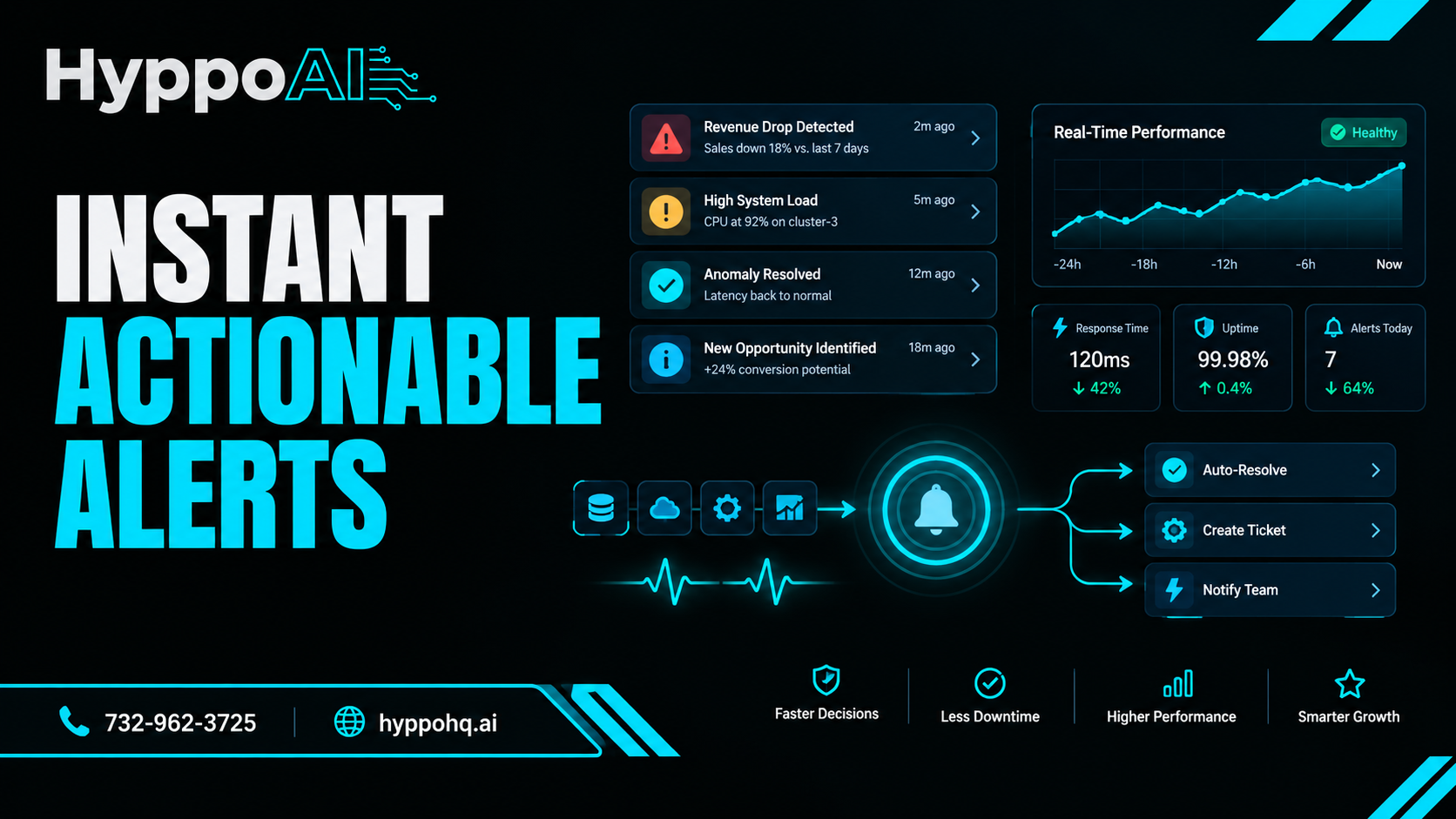
Instant and actionable alerts for faster business decisions
Speed matters, but speed without context creates noise.
That is the real difference between a basic notification and an alert that is both instant and actionable. One interrupts your day. The other helps you make a better decision right now.
For small and midsize businesses, this matters more than ever. Teams are lean. Owners are juggling sales, operations, staffing, and customer experience at the same time. If an important signal gets buried in a dashboard or delayed in an inbox, the cost is real.
Instant and actionable alerts help close that gap. They surface the right issue, at the right time, with enough clarity to move fast.
What instant and actionable alerts actually mean
An instant alert is delivered as soon as a meaningful event happens.
An actionable alert tells you what happened, why it matters, and what to do next.
That sounds simple, but many businesses are still dealing with systems that create one of two problems:
- Alerts that arrive too late to be useful
- Alerts that arrive on time but lack context
Neither supports fast decision-making.
A strong alerting system should answer a few core questions immediately:
- What happened?
- How urgent is it?
- Who needs to act?
- What action should they take?
When those pieces are present, alerts become operational tools instead of background noise.
Why timing changes outcomes
A delayed response can turn a small issue into a larger one.
Think about common business scenarios:
- A high-intent lead comes in after hours and no one follows up quickly
- A customer inquiry sits unanswered while a competitor responds first
- A recurring service issue spikes and the team notices only after reviews drop
- A workflow fails silently and creates downstream delays for staff and customers
In each case, the business had a signal. The problem was not lack of data. The problem was lack of immediate, usable visibility.
Instant alerts reduce that lag.
For SMBs, that can mean:
- Faster lead response times
- Fewer missed opportunities
- Better customer experiences
- Less manual checking across tools
- More confidence in day-to-day operations
Actionable alerts reduce decision fatigue
Business owners and managers already make hundreds of decisions every week. If every alert requires extra digging, the system adds friction instead of removing it.
Actionable alerts reduce decision fatigue by packaging the signal with the next step.
For example, instead of sending a vague message like:
- New lead received
A more actionable alert might say:
- New lead received from website form. Requested pricing for service X. No response sent yet. Assign follow-up within 5 minutes.
That is a very different experience.
The second alert helps the team act without opening multiple platforms, searching for context, or guessing priority.
The best alerts create momentum
When alerts are clear, people move faster.
When they are vague, people hesitate.
That hesitation shows up as:
- Slower response times
- Inconsistent follow-up
- More internal back-and-forth
- More tasks slipping through the cracks
Good alerting removes ambiguity. It turns information into momentum.
What this looks like in real operations
Instant and actionable alerts can support nearly every part of an SMB operation. The key is choosing the moments that truly matter.
Sales and lead management
In sales, timing is often the difference between a conversation and a missed opportunity.
Useful alerts may include:
- New inbound lead notifications with source and intent
- Missed call alerts that trigger immediate follow-up
- Lead re-engagement prompts when a prospect replies after inactivity
- Escalation alerts for high-value opportunities
These alerts help teams prioritize where attention creates the biggest return.
Customer service
Customer experience often breaks down in the gaps between systems, people, and response windows.
Actionable alerts can help by flagging:
- Unanswered messages past a set threshold
- Repeat complaints on the same issue
- Urgent customer requests needing escalation
- Appointment or scheduling conflicts before they become problems
This allows teams to solve issues earlier, before frustration grows.
Operations and workflows
Operational delays are expensive because they multiply quietly.
Alerts can identify:
- Failed automations
- Bottlenecks in approvals or handoffs
- Tasks sitting untouched beyond SLA targets
- Capacity issues that require staffing adjustments
Instead of waiting for a weekly review, teams can correct course in real time.
Why AI makes alerts more useful
Traditional systems often rely on static rules. That works for simple triggers, but it can create too many notifications or miss more nuanced patterns.
AI improves alerting by adding context, prioritization, and pattern recognition.
That may include:
- Filtering out low-value noise
- Highlighting unusual activity worth attention
- Ranking alerts by urgency or business impact
- Summarizing what changed across multiple inputs
- Suggesting the next best action
For SMBs, this matters because teams do not have time to monitor every dashboard all day. AI can help surface what actually needs attention now.
Better signals, fewer distractions
The goal is not more alerts.
The goal is better alerts.
If every event generates a notification, people start ignoring all of them. That is when even critical issues get missed.
A smarter approach focuses on signal quality:
- Only alert when action is needed
- Include enough detail to guide a response
- Route alerts to the right person or team
- Make urgency obvious
- Track whether action was taken
That is how alerting becomes reliable instead of overwhelming.
How to know if your current alerts are failing
Many businesses normalize weak alerting because they are used to patching around it manually.
A few warning signs:
- Team members say they did not see the issue in time
- Important tasks depend on someone constantly checking a dashboard
- Leads or customer requests are followed up inconsistently
- Notifications are frequent, but action is still slow
- Managers spend too much time chasing status updates
If that sounds familiar, the issue may not be your team. It may be the way information reaches them.
Building an alert system that drives action
If you want better outcomes, start by auditing the moments where speed matters most.
Ask:
- Which events have the biggest business impact?
- Where do delays currently happen?
- What context does the team need to act immediately?
- Who should receive each type of alert?
- What should happen if no one responds?
Then design alerts around decisions, not just events.
That shift is important.
A system built around events says, something happened.
A system built around decisions says, something happened and here is what to do next.
The real business impact
When alerts are instant and actionable, businesses become more responsive without adding more manual work.
That can lead to:
- Higher conversion from inbound demand
- Faster internal execution
- Better accountability across teams
- Fewer preventable service issues
- More control for owners and operators
For SMBs, that is not just a convenience. It is a competitive advantage.
The businesses that respond faster, prioritize better, and resolve issues earlier usually create better customer outcomes and stronger growth.
At HyppoAI, we believe AI should help businesses act, not just observe. If you are ready to improve how your team handles critical moments, visit https://hyppohq.ai or call +17329623725 to learn how smarter alerting and automation can support your operation.
