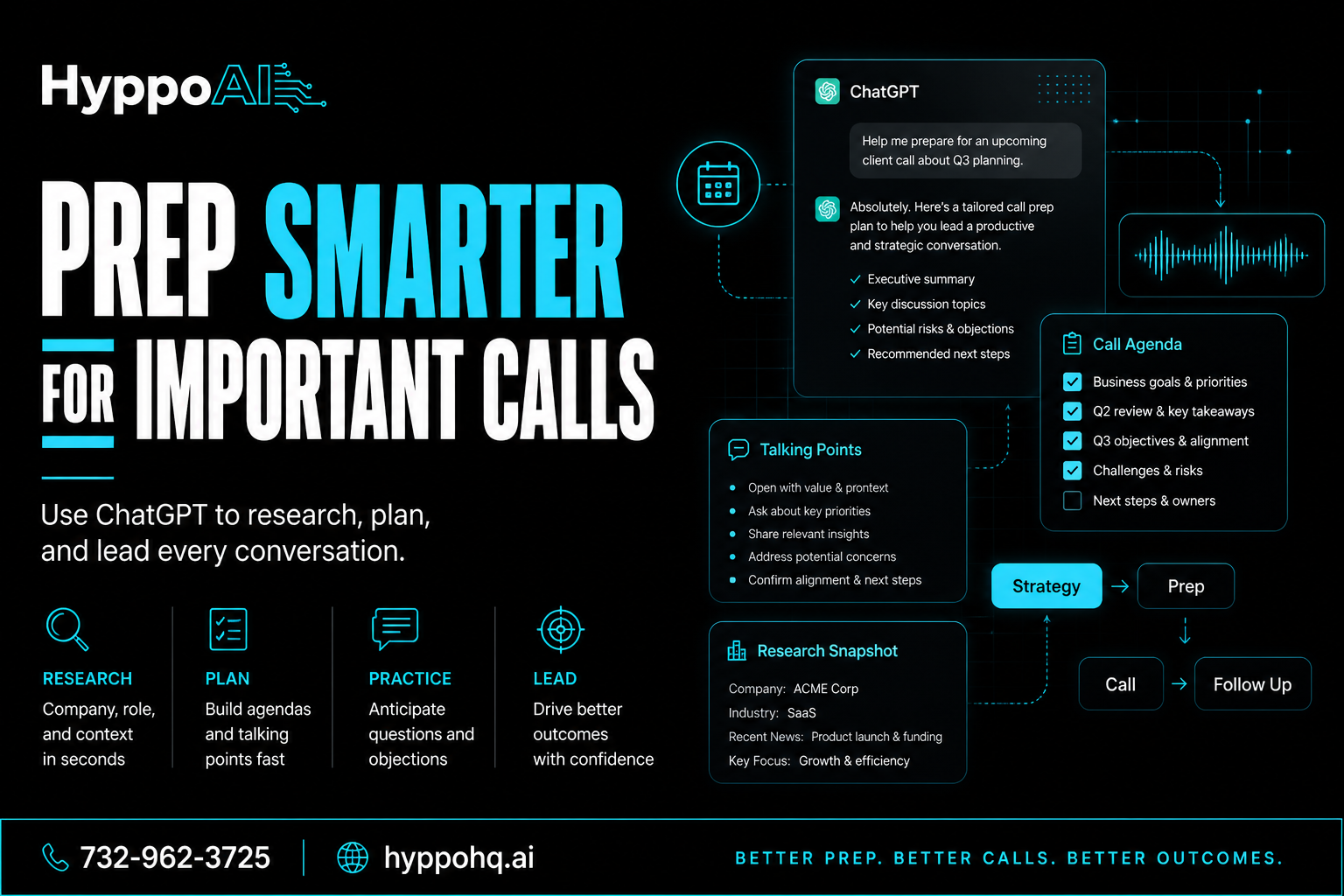
How to use ChatGPT to prepare before important calls
Important calls can move a deal forward, save a client relationship, or open a new opportunity. The problem is that most people go into them underprepared. Notes are scattered, goals are fuzzy, and key questions get missed.
That is where ChatGPT can help.
If you use it the right way, ChatGPT becomes a fast prep partner. It can help you organize background information, clarify your objective, draft talking points, anticipate objections, and even simulate the conversation before you get on the call.
For SMB teams, this matters. You do not always have time for long prep sessions, but you still need to sound sharp, confident, and informed. A simple AI workflow can close that gap.
Why call prep matters more than most people think
A lot can go wrong on an important call when preparation is weak:
- You forget the real goal of the conversation
- You spend too much time on low-value details
- You miss key discovery questions
- You get caught off guard by objections
- You leave without a clear next step
Strong preparation helps you stay focused. It lets you guide the conversation instead of reacting to it.
ChatGPT is useful here because it can turn rough inputs into a clear structure quickly. Even if your notes are messy, you can use AI to shape them into something practical.
What ChatGPT can help you prepare
Before an important call, ChatGPT can support several parts of your workflow:
1. Summarizing context
Paste in meeting notes, emails, CRM details, or a short description of the contact. Ask ChatGPT to summarize:
- Who the person or company is
- What has happened so far
- What the likely priorities are
- What risks or open questions exist
This gives you a cleaner starting point.
2. Defining the goal
Many calls feel unproductive because the goal is unclear. ChatGPT can help you turn a vague objective into a specific one.
For example, instead of saying, "I need this call to go well," you can ask ChatGPT to help define:
- The ideal outcome
- The minimum acceptable outcome
- The decision you want by the end of the call
- The next step you need secured
That shift alone can improve how you show up.
3. Building a call agenda
A good call agenda keeps the conversation moving. ChatGPT can draft a simple structure such as:
- Opening and rapport
- Purpose of the call
- Key discussion points
- Discovery questions
- Objections or concerns
- Next steps and close
You can keep this loose or make it highly specific depending on the situation.
4. Drafting better questions
Important calls often depend on asking better questions, not just giving better answers. ChatGPT can generate:
- Discovery questions
- Clarifying questions
- Follow-up questions
- Decision-making questions
- Risk-identification questions
This is especially helpful for sales calls, client calls, hiring calls, and partnership conversations.
5. Practicing tough scenarios
One of the best uses of ChatGPT is roleplay. You can ask it to act like:
- A skeptical prospect
- A rushed executive
- An unhappy client
- A vendor pushing back on pricing
- A partner with concerns about timing
Then practice your response. That kind of rehearsal can make the real call feel easier.
A simple ChatGPT workflow before important calls
Here is a practical workflow you can use in 10 to 20 minutes.
Step 1: Give ChatGPT the background
Start with a short prompt that includes the context.
Example:
"I have an important call tomorrow with a small business owner who is interested in AI automation. We had one intro call already. They are concerned about missed leads, follow-up speed, and whether implementation will be complicated. Summarize the context and identify the likely priorities."
This helps ChatGPT organize the situation before you go deeper.
Step 2: Ask for the call objective
Next, ask ChatGPT to define what success should look like.
Example:
"Based on this context, help me define the primary objective for the call, two secondary objectives, and the ideal next step to secure before the call ends."
Now you know what you are aiming for.
Step 3: Build talking points and questions
Once the goal is clear, ask for a structured prep sheet.
Example:
"Create a call prep outline with key talking points, five discovery questions, three likely objections, and concise responses to each objection."
This gives you a practical guide you can review right before the meeting.
Step 4: Roleplay the conversation
This is where preparation gets stronger.
Example:
"Act as the prospect on this call. Be skeptical but reasonable. Ask me questions about cost, setup time, and results. After each answer, give me feedback on how to improve my response."
That feedback loop can tighten your communication fast.
Step 5: Create a closing plan
A strong close matters. Ask ChatGPT to help you finish the call with clarity.
Example:
"Give me three concise ways to close this call and secure a clear next step without sounding pushy."
This reduces the chance that the call ends with vague language like, "Let’s circle back sometime next week."
Best practices when using ChatGPT for call prep
To get better results, keep these points in mind:
Be specific with your prompts
The more relevant information you provide, the better the output. Include:
- Who the call is with
- What type of call it is
- What happened before
- What concerns are already known
- What outcome you want
Use AI to support judgment, not replace it
ChatGPT can help you think faster, but it should not make the decision for you. Review the output and adjust it based on your knowledge of the person, the relationship, and the business context.
Keep sensitive information in mind
Be thoughtful about what you paste into any AI tool. Avoid sharing confidential details unless your internal policies allow it and your tools are configured appropriately.
Ask for concise outputs
Long AI responses are not always useful right before a call. Ask for:
- Bullet points
- Short scripts
- Objection-response pairs
- One-page summaries
That makes the prep easier to use in real time.
Common use cases for SMB teams
For small and mid-sized businesses, ChatGPT can be especially useful before:
- Sales discovery calls
- Client onboarding calls
- Renewal or retention conversations
- Vendor negotiations
- Team performance conversations
- Hiring interviews
- Partnership discussions
In each case, the goal is the same: show up more prepared, ask better questions, and leave with a clearer outcome.
Final thought
If you want to use ChatGPT to prepare before important calls, keep it simple. Start with context, define the objective, generate questions, rehearse the hard parts, and plan the close. That process can help you sound more confident and make better decisions in the moment.
If your business is looking for practical AI systems that improve everyday workflows, HyppoAI helps SMB teams put AI to work in ways that are useful, efficient, and grounded in real operations. Visit https://hyppohq.ai or call +17329623725 to learn more.
