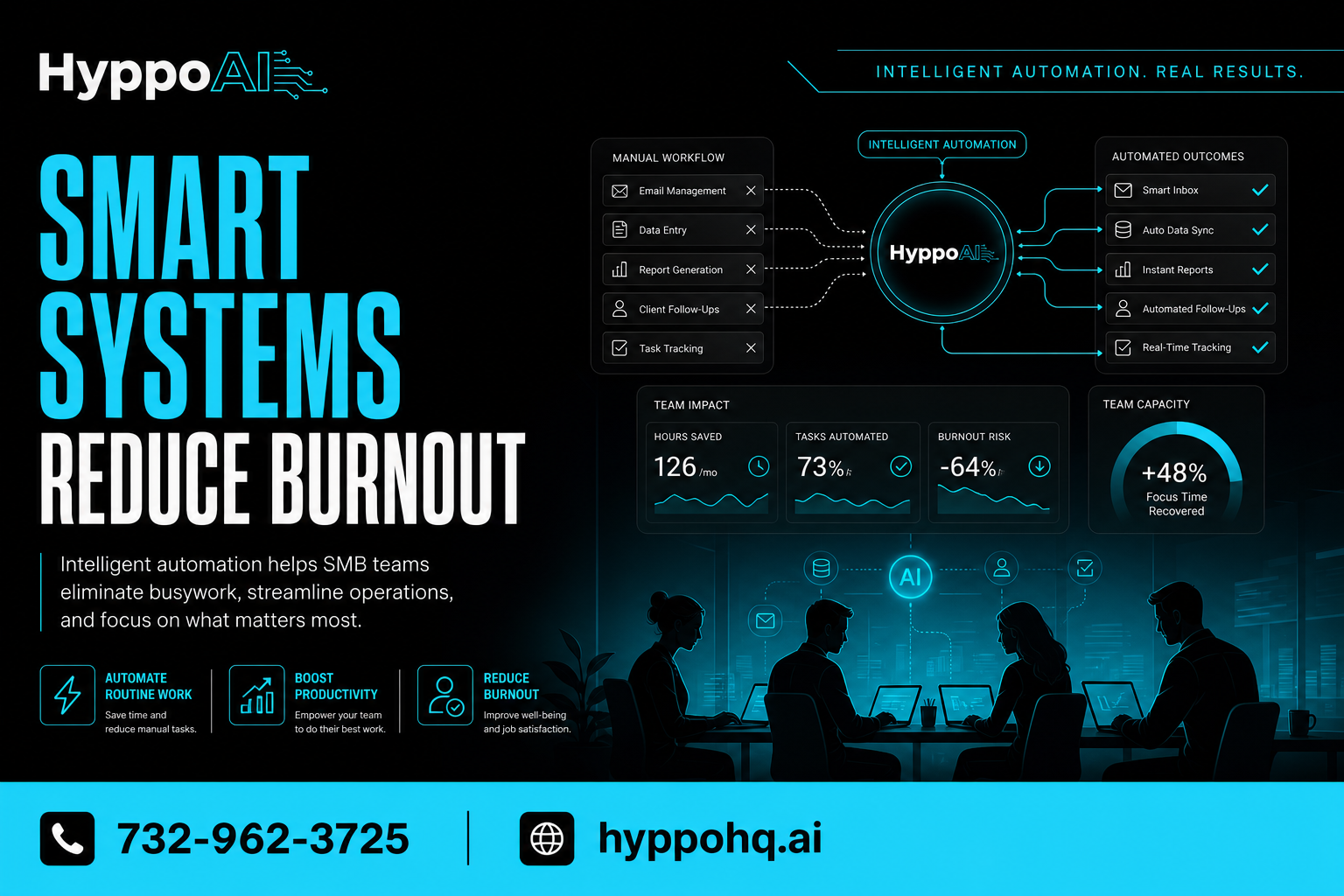
How smart systems reduce burnout for SMB teams
Burnout is often treated like a people problem.
In reality, it is usually a systems problem first.
When small and midsize businesses rely on manual handoffs, scattered tools, missed follow-ups, and constant context switching, even great employees start to wear down. The issue is not effort. It is friction.
Smart systems reduce burnout by removing unnecessary work, creating consistency, and helping teams spend more time on decisions that matter. For SMBs, that can mean fewer dropped balls, faster response times, and a healthier pace of work without sacrificing growth.
Why burnout happens in growing businesses
Most SMB teams do not burn out because they are lazy or unmotivated. They burn out because the business grows faster than the operating system behind it.
That usually looks like:
- Repeating the same tasks every day
- Chasing updates across email, chat, and spreadsheets
- Answering routine customer questions manually
- Following up on leads inconsistently
- Switching between too many apps to complete one job
- Handling urgent work that could have been prevented with better workflows
When this becomes normal, people stay busy but feel less effective. That is one of the fastest paths to burnout.
What smart systems actually do
Smart systems are not about replacing people. They are about protecting people from low-value work.
A smart system combines automation, clear workflows, and AI-assisted support to reduce the mental load on a team. Instead of relying on memory and manual effort, the business builds repeatable processes that keep work moving.
The goal is not more activity
The goal is better energy allocation.
A healthy team should not spend its best hours on tasks like:
- Copying data between tools
- Sending the same updates over and over
- Sorting inbound requests manually
- Scheduling follow-ups one by one
- Answering the same basic questions repeatedly
Those jobs drain attention. Smart systems give that attention back.
5 ways smart systems reduce burnout
1. They eliminate repetitive admin work
Repetition is one of the biggest energy leaks in any business.
If your team is manually logging customer details, assigning tasks, sending reminders, or updating records across multiple platforms, they are doing work that software should handle.
Automation can take over routine steps such as:
- Lead capture and routing
- Appointment reminders
- Status updates
- Internal notifications
- Data syncing between tools
This reduces the volume of small tasks that interrupt the day and pile up into stress.
2. They reduce context switching
Context switching is expensive.
Every time someone jumps from email to CRM to chat to a scheduling tool to a spreadsheet, they lose time and focus. Over a week, that creates fatigue that is hard to measure but easy to feel.
Smart systems reduce switching by centralizing information and triggering the next step automatically. Instead of asking, “What do I need to do next?” the workflow already knows.
That makes work feel clearer and lighter.
3. They create more predictable operations
Unclear processes create constant urgency.
When nobody knows who owns the next step, or when follow-up depends on one person remembering it, the business runs on tension. Teams stay reactive because the system is unreliable.
Smart systems improve predictability by defining:
- What happens next
- Who gets notified
- When follow-up happens
- What data is captured
- How exceptions are handled
Predictable operations reduce the emotional weight of work. People can trust the process instead of carrying everything in their heads.
4. They improve customer communication
A lot of burnout comes from preventable customer friction.
Missed calls, delayed replies, inconsistent updates, and forgotten follow-ups create unnecessary pressure on staff. Then the team has to recover the relationship while managing everything else.
Smart systems help by making communication faster and more consistent through:
- Automated confirmations
- AI-assisted responses to common questions
- Lead follow-up sequences
- Call routing and intake support
- Status notifications
Customers feel informed. Teams deal with fewer avoidable escalations.
5. They protect time for high-value work
The best employees usually burn out first when they become the default solution for every problem.
If your top people are buried in routine work, they have less time for strategic thinking, customer relationships, process improvement, and revenue-generating activity.
Smart systems create space for the work humans do best:
- Solving exceptions
- Building relationships
- Making judgment calls
- Improving service quality
- Driving growth decisions
That shift matters. Burnout drops when people feel their work is meaningful and manageable.
Signs your business needs smarter systems
Not every process needs AI or automation right away. But if these issues sound familiar, your team may already be paying the price of outdated workflows:
- Employees are always busy but key tasks still slip
- Customers ask for updates that should have been automatic
- Leads go cold because follow-up is inconsistent
- Team members rely on memory instead of systems
- Managers spend too much time checking status manually
- The same questions and tasks come up every day
- Growth creates chaos instead of efficiency
If that is happening, the answer is usually not “work harder.”
It is “build better systems.”
How to start without overwhelming the team
The mistake many businesses make is trying to automate everything at once.
That creates more confusion, not less.
A better approach is to start with one high-friction area where burnout shows up clearly.
Good places to begin
Focus on processes that are:
- Repetitive
- Time-sensitive
- Easy to standardize
- Customer-facing
- Frequently dropped or delayed
For many SMBs, that includes:
- Lead intake and follow-up
- Appointment scheduling
- Missed call handling
- Internal task routing
- FAQ responses
- Review or feedback requests
When one workflow improves, the team feels the difference quickly. That builds trust and momentum for broader changes.
Smart systems support people, not replace them
There is still confusion in the market about AI and automation.
Some business owners worry that smart systems make work impersonal. Others worry they are too complex for a growing team.
The truth is simpler.
Good systems make human work more sustainable.
They do not remove the need for people. They remove the need for people to act like software.
That is the real advantage.
When your team no longer has to remember every detail, chase every update, and manually push every task forward, they can operate with more clarity and less strain.
That is how smart systems reduce burnout in a practical, measurable way.
The long-term payoff
Reducing burnout is not just a culture win. It is an operations win.
When teams are less overloaded, businesses often see:
- Better response times
- More consistent follow-up
- Fewer mistakes
- Higher customer satisfaction
- Stronger retention
- More capacity without immediate headcount increases
For SMBs, that matters.
You do not always need a bigger team first. Sometimes you need a better system behind the team you already have.
If you want to explore how smarter workflows and AI can reduce burnout in your business, HyppoAI can help you identify the bottlenecks and build practical systems around them. Visit https://hyppohq.ai or call +17329623725 to start the conversation.
