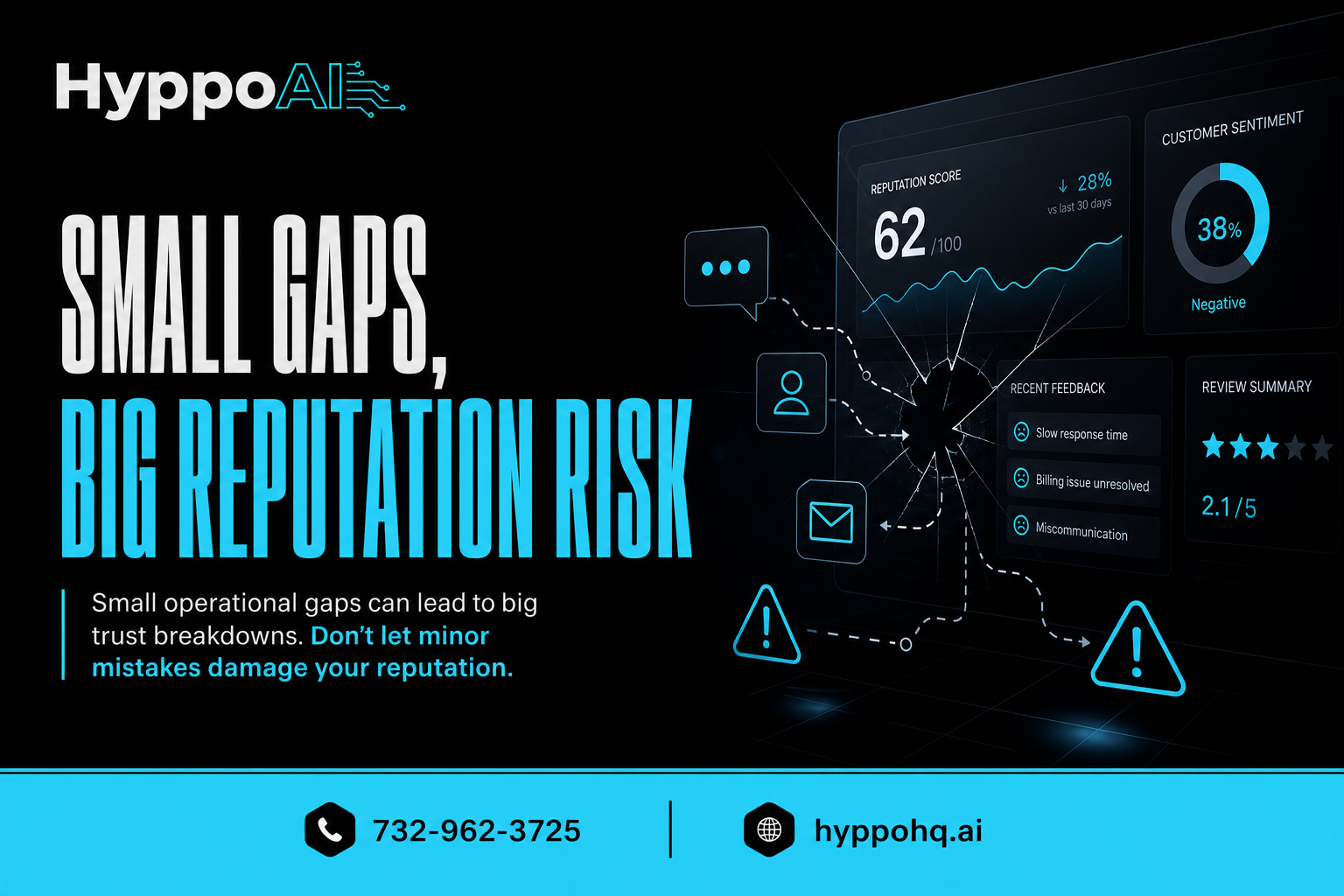
How small gaps create big reputation issues for SMBs
Reputation problems rarely start with one massive mistake.
More often, they begin with small gaps that seem harmless in the moment: a missed call, a slow reply, an unanswered review, a lead that never gets a follow-up, or a handoff that falls through the cracks.
For small and midsize businesses, those little misses add up fast. Customers do not always complain directly. They just move on, tell someone else, or leave a review that reflects the friction they experienced.
That is the real issue: reputation is not built only by your best moments. It is shaped by the consistency of your systems.
Why small gaps matter more than most businesses think
Most business owners focus on big-picture reputation drivers like branding, offers, pricing, and service quality. Those things matter, but they are only part of the story.
Customers also judge your business on the micro-experiences:
- How fast you respond
- Whether someone answers the phone
- If they get clear next steps
- Whether promises are followed through
- How easy it feels to do business with you
When those areas are inconsistent, trust starts to weaken.
A customer may not say, "Your operational gaps damaged my confidence." They will say:
- "No one got back to me"
- "It was hard to reach someone"
- "I had to follow up multiple times"
- "I went with another company"
That is a reputation issue, even if your actual service is excellent.
The hidden cost of tiny breakdowns
Small gaps create problems in ways that are easy to underestimate.
They lower trust before you ever make the sale
A prospect often forms an opinion before speaking with your team. If your phone rings too long, your form response is delayed, or your messaging feels disconnected, they start questioning reliability.
In many cases, buyers assume the pre-sale experience reflects the post-sale experience.
If reaching you feels difficult now, they expect support will feel difficult later.
They create negative word of mouth
People talk about friction. They remember confusion, delays, and poor communication. Even if the core service was good, a clunky process can become the story they share.
For SMBs, that matters because local and referral-driven businesses depend heavily on trust signals.
They reduce review quality and volume
Customers are more likely to leave a review after an emotionally clear experience. If the process felt smooth, they remember confidence. If it felt disorganized, they remember stress.
Even worse, some happy customers never leave positive reviews because no one followed up and asked at the right time.
They waste marketing spend
If you are paying for traffic, ads, SEO, or social media, every missed connection becomes more expensive. Generating interest is only half the equation. If your follow-up systems are weak, your reputation and return on investment both suffer.
Common small gaps that become big reputation issues
Many businesses do not have a reputation problem at the brand level. They have a gap problem at the process level.
Here are some of the most common ones.
Missed calls
When no one answers, customers rarely wait around. They call the next option.
A missed call is not just a missed lead. It can also create the impression that your business is unavailable, understaffed, or unreliable.
Slow response times
Speed communicates professionalism. Even a strong business can look disorganized if response times are inconsistent.
This is especially true when customers are comparing multiple providers.
Inconsistent follow-up
A prospect who expressed interest should not feel forgotten. If your team relies on memory, sticky notes, or manual reminders, follow-up will eventually break down.
Poor review management
Ignoring reviews sends a message. So does responding too late or inconsistently. Reviews are public trust assets, and they shape how future customers evaluate your business.
Weak handoffs between people or systems
When information gets lost between the front desk, sales, service, and support, customers feel the disconnect immediately.
They do not care which department dropped the ball. They only see one brand: yours.
Why this happens in growing SMBs
Small gaps usually are not caused by a lack of effort. They happen because growth adds complexity faster than most businesses update their systems.
What worked when you had fewer leads, fewer calls, and fewer moving parts stops working at scale.
Common reasons include:
- Too much dependence on manual follow-up
- No clear response-time standard
- Limited after-hours coverage
- Separate tools that do not communicate well
- No consistent process for reviews or lead routing
- Staff stretched across too many roles
The result is predictable: good people, good intentions, inconsistent execution.
How to identify your reputation gaps
If you want to protect your reputation, start by auditing the customer journey.
Ask simple, practical questions
Look at the process from the customer perspective:
- What happens when someone calls after hours?
- How long does it take to respond to a new inquiry?
- Who owns follow-up, and how is it tracked?
- Are review requests sent consistently?
- Where do handoffs commonly fail?
- What do customers have to repeat more than once?
These questions often reveal where trust is leaking.
Review your signals
Pay attention to patterns in:
- Missed calls
- Unanswered messages
- Response times
- Review themes
- No-show rates
- Lead-to-close conversion drops
A reputation issue does not always show up first in reviews. Sometimes it shows up in silence, lost opportunities, or stalled growth.
How AI can help close the gaps
For SMBs, AI is most valuable when it improves consistency.
It is not about replacing human relationships. It is about making sure avoidable breakdowns stop damaging trust.
AI can improve first response coverage
If your business cannot answer every inquiry instantly, AI can help ensure customers still get acknowledged, routed, and guided quickly.
That first response matters because it reassures the customer that your business is active and attentive.
AI can support follow-up workflows
Leads often go cold because no one had time to follow up properly. AI-supported systems can help prompt, organize, and automate key parts of that process so fewer opportunities slip through.
AI can create more consistent customer communication
Consistency builds trust. AI tools can help standardize messaging, reduce delays, and ensure basic communication steps happen on time.
AI can surface operational blind spots
When you can see where calls are missed, where response times lag, and where customers disengage, you can fix root causes faster.
That is where reputation protection becomes an operational advantage.
What to do next
If small gaps are creating big reputation issues, the solution is not guesswork. It is system design.
Start here:
- Map your customer journey from first contact to follow-up.
- Identify where delays, misses, or confusion happen.
- Prioritize the gaps that affect trust the most.
- Put systems in place to reduce inconsistency.
- Use automation and AI where speed and reliability matter most.
The goal is simple: make it easy for customers to trust you.
Because in a competitive market, reputation is not only about what you promise. It is about what customers experience in the small moments.
Those moments decide whether they call back, leave a review, refer a friend, or choose someone else.
If you want to build a stronger reputation through better systems and smarter AI for your business, HyppoAI can help. Visit https://hyppohq.ai or call +17329623725 to learn how to close the gaps that quietly cost you trust, leads, and growth.
