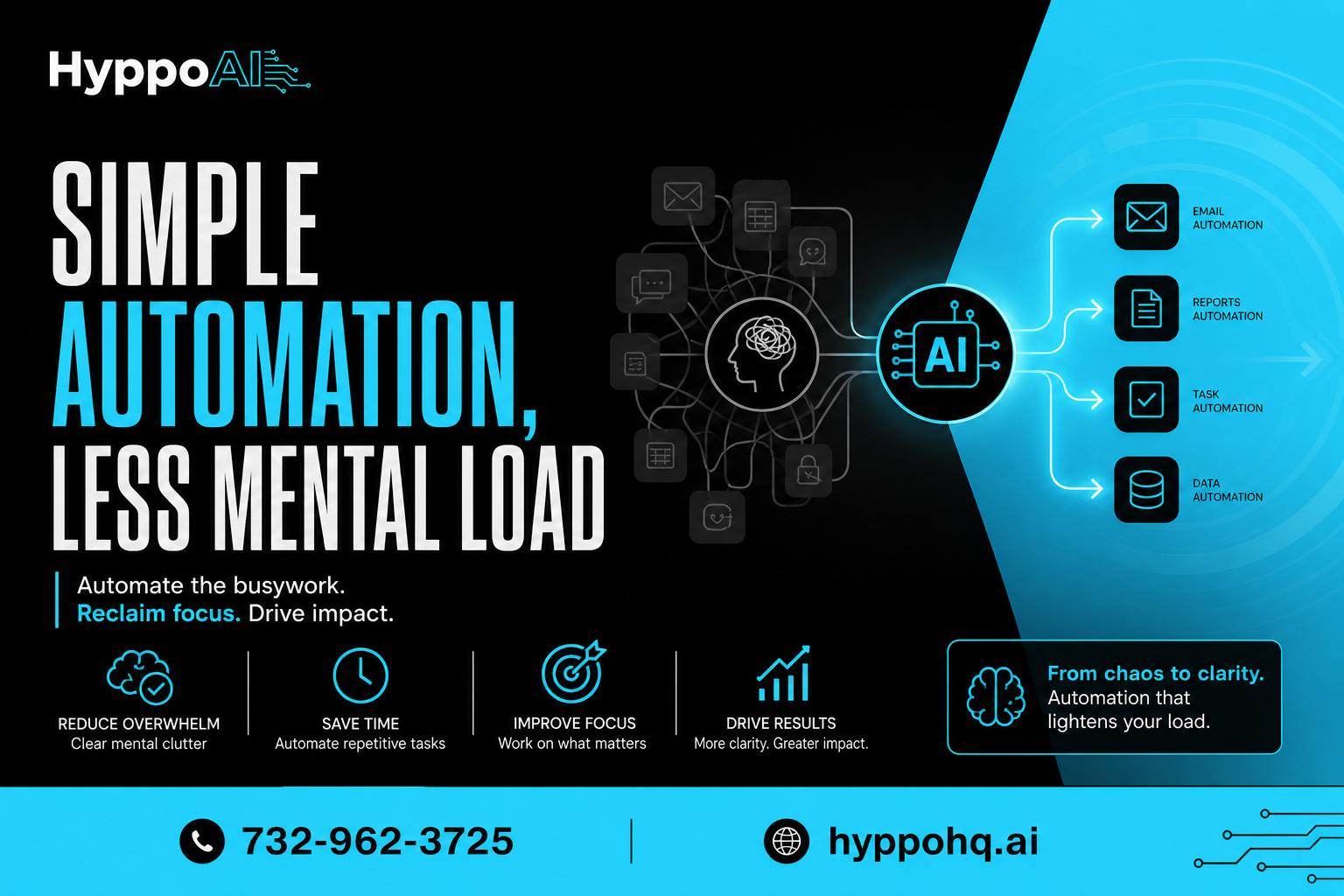
How simple automation reduces daily mental load
Every business owner and operator knows the feeling: too many tabs open, too many follow-ups to remember, and too many small tasks competing for attention.
The problem is not always the size of the work. It is the constant mental switching. Reply to a lead. Check a missed call. Send a reminder. Update a spreadsheet. Follow up again. Confirm an appointment. Answer the same question one more time.
That daily friction adds up fast.
Simple automation reduces daily mental load by taking repetitive, low-value tasks off your plate and turning them into reliable systems. For SMBs, that means fewer dropped balls, faster responses, and more energy for decisions that actually move the business forward.
What mental load looks like in a small business
Mental load is the invisible work of remembering, tracking, and managing everything. In a small business, it often shows up as:
- Remembering who needs a reply
- Checking whether a customer got a confirmation
- Monitoring missed calls and voicemails
- Repeating the same answers to common questions
- Manually moving information between tools
- Following up on leads at the right time
- Wondering whether something was done at all
None of these tasks are individually massive. Together, they drain focus.
When your team spends the day managing reminders instead of doing meaningful work, productivity drops. So does consistency.
Why simple automation works better than complicated systems
A lot of business owners hear the word automation and think of a giant overhaul. That is usually where momentum dies.
The best automation is often the simplest.
Simple automation works because it targets repeatable actions that happen every day. It does not try to replace your judgment. It supports it.
Good automation removes friction
The goal is not to automate everything.
The goal is to reduce the number of things your brain has to hold at once.
That can include:
- Auto-replies for common inquiries
- Lead routing to the right person
- Appointment confirmations and reminders
- Missed call text-backs
- Internal notifications when action is needed
- Follow-up sequences for new leads
These are small systems with a big effect. They free up attention without creating extra complexity.
The hidden cost of doing everything manually
Manual work feels manageable until volume increases.
At that point, the real cost shows up in three places:
1. Decision fatigue
Every repeated task asks for another micro-decision.
Should I reply now? Did I already send that? Who owns this? What is the next step?
The more small decisions you make, the harder it becomes to make strong strategic ones.
2. Inconsistency
Humans are not built to perform repetitive tasks perfectly every time.
When processes depend on memory, things slip:
- Leads wait too long
- Customers miss messages
- Follow-ups happen late
- Information gets lost between tools
3. Slower growth
When your team is buried in repetitive admin, they have less time for sales, service, and improvement.
Growth does not usually stall because people are lazy. It stalls because the business is asking humans to do system work.
Practical ways automation reduces daily mental load
You do not need a massive tech stack to get results. Start with the moments that create the most repetition.
Automate first responses
Speed matters, especially with inbound leads.
If someone fills out a form, sends a message, or calls after hours, an automated first response can:
- Acknowledge the inquiry immediately
- Set expectations for next steps
- Collect missing information
- Keep the lead warm until a human steps in
This removes the pressure of having to respond instantly to every inquiry yourself.
Automate reminders and confirmations
Appointments, meetings, and callbacks create a surprising amount of mental clutter.
Automation can send:
- Booking confirmations
- Reminder texts or emails
- Reschedule instructions
- Post-appointment follow-ups
Now your team does not have to remember every touchpoint manually.
Automate missed call follow-up
Missed calls are not just missed conversations. They are missed opportunities.
A simple automated response can text the caller, acknowledge the missed call, and guide them to the next step. That alone can reduce stress and recover leads that might otherwise disappear.
Automate internal handoffs
A lot of mental load comes from figuring out who owns what.
When a lead comes in, a task is completed, or a customer replies, automation can notify the right person instantly. That keeps work moving without constant checking and chasing.
Automate recurring updates
If your team is manually updating statuses, spreadsheets, or CRM fields, that is a strong candidate for automation.
Even basic automations can reduce errors and save hours over time.
Signs your business needs simple automation
If any of these sound familiar, automation is probably worth exploring:
- You answer the same questions every week
- Leads slip through the cracks
- Missed calls go unanswered
- Follow-ups depend on memory
- Your team checks multiple tools to piece together one workflow
- You feel busy all day but still behind
- Important tasks live in someone’s head instead of a system
The key is not to automate for the sake of it. It is to identify repeatable friction and remove it.
How to start without overcomplicating it
The smartest starting point is usually one workflow, not ten.
Step 1: Find the repeatable task
Look for something that happens often, follows a pattern, and does not require deep judgment.
Examples:
- New lead intake
- Missed call response
- Appointment reminders
- FAQ replies
Step 2: Map the current process
Before you automate anything, write down what happens now.
Ask:
- What triggers the task?
- What steps happen next?
- Who is involved?
- Where do delays or mistakes happen?
Step 3: Automate the obvious parts
Start with the steps that are repetitive and predictable.
Leave edge cases and exceptions for human review.
Step 4: Measure relief, not just time
Time savings matter, but mental clarity matters too.
Ask your team:
- Do we have fewer things to remember?
- Are handoffs clearer?
- Are we responding faster?
- Do we feel less reactive?
That is where the real value shows up.
Automation should make work feel lighter
The best systems do not feel flashy. They feel reliable.
When simple automation is working, your day gets quieter in the right ways:
- Fewer interruptions
- Fewer repeated decisions
- Fewer status checks
- Fewer manual follow-ups
- More confidence that routine tasks are handled
That creates space for better thinking, better service, and better execution.
For SMBs, that is a real competitive advantage.
Final thought
Simple automation reduces daily mental load because it turns recurring tasks into dependable systems. Instead of using energy to remember every detail, your team can focus on conversations, decisions, and growth.
If your business is feeling stretched by repetitive work, start small. One good automation can create immediate relief and build momentum for smarter operations.
If you want to explore practical AI and automation solutions for your business, visit HyppoAI at https://hyppohq.ai or call +17329623725 to start the conversation.
