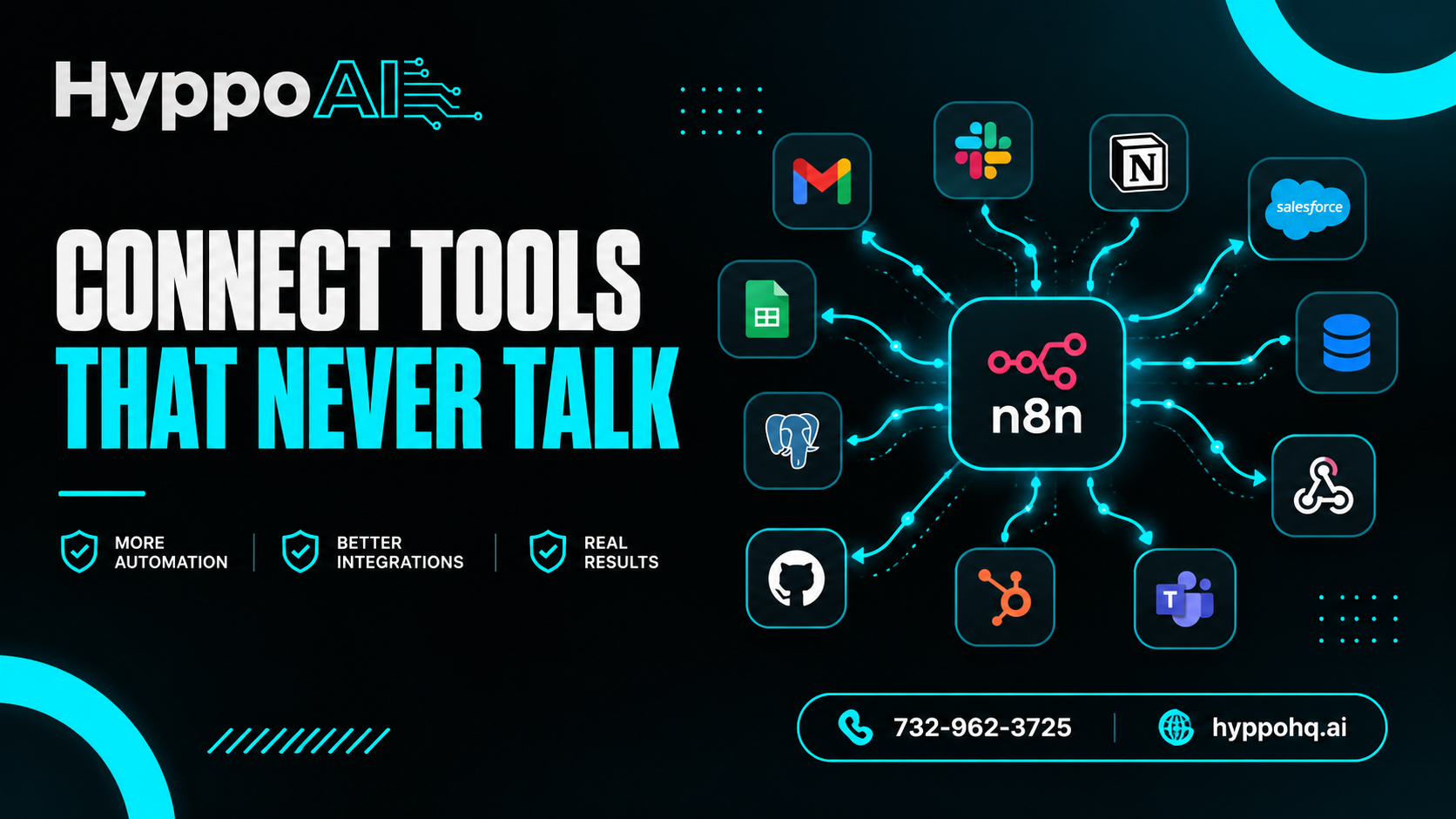
How n8n connects tools never designed to talk
Most small and midsize businesses don’t have a software problem. They have a connection problem.
Their CRM works. Their inbox works. Their forms, calendars, payment tools, and team chat all work too. The issue is that these systems were often never built to communicate with each other in a useful, reliable way.
That’s where n8n comes in.
n8n is an automation platform that acts like connective tissue between the tools your business already uses. Instead of forcing your team to copy data from one app to another, chase updates, or manually trigger routine tasks, n8n can move information automatically based on rules you define.
For SMBs, that matters because speed, consistency, and follow-up often determine whether a lead becomes revenue or disappears.
What n8n actually does
At a practical level, n8n watches for an event in one system and triggers actions in others.
A simple example:
- A prospect fills out a website form
- Their details get added to your CRM
- Your sales team gets a Slack or email alert
- A follow-up message is scheduled
- The lead is tagged based on service type or location
- A task is created so nothing gets missed
Without automation, that sequence might require three to five different tools and several manual steps. With n8n, it can become one workflow.
The value is not just convenience. It is operational reliability.
When a process depends on people remembering to do repetitive admin work, things get dropped. When the process is automated, your business becomes more consistent by default.
Why tools fail to "talk" on their own
Many business tools were built for a specific function, not for complete operational coordination.
A scheduler is built to book appointments. A CRM is built to manage contacts. An invoicing platform is built to collect payments. They may offer native integrations, but those integrations are often limited.
Common issues include:
- One-way data syncs
- Missing fields between platforms
- Delayed updates
- Rigid trigger options
- No logic for exceptions or edge cases
- Expensive custom development for simple needs
This is where n8n becomes useful. It gives businesses a flexible way to define how systems should work together instead of accepting whatever default integration exists.
How n8n bridges the gap
n8n connects apps through triggers, actions, logic, and data mapping.
In plain English, that means it can:
- Listen for something to happen
- Pull in the relevant data
- Clean or transform that data
- Make decisions based on conditions
- Send the result to the next system
- Continue the process across multiple tools
Triggers start the workflow
A trigger is the event that kicks everything off.
Examples include:
- A new form submission
- A missed call
- A new Stripe payment
- A calendar booking
- An incoming email
- A CRM record update
Once that trigger happens, n8n can take over the routine follow-up work.
Logic makes the workflow smarter
This is where n8n stands out from basic app-to-app connectors.
Instead of only doing a simple “if this, then that,” n8n can apply logic such as:
- If the lead is in a certain ZIP code, assign it to a specific rep
- If the inquiry mentions a high-intent service, mark it as urgent
- If no one responds within a set time, escalate the task
- If payment fails, notify the team and trigger a reminder sequence
That extra layer of logic is what turns automation from a novelty into a real operations tool.
Data mapping keeps systems aligned
Different platforms label information differently. One app may use “First Name,” another may use “Full Name,” and another may split names into multiple fields.
n8n helps map that data so the right information lands in the right place. That reduces duplicate records, manual cleanup, and reporting errors.
Real SMB use cases for n8n
For service businesses and lean teams, the best automations are usually the ones that remove repeated admin work and improve response time.
Here are a few strong use cases.
Lead capture and follow-up
When a lead comes in, speed matters.
n8n can instantly:
- Push the lead into your CRM
- Notify your team
- Trigger an email or SMS follow-up
- Create a task for a callback
- Log the source for reporting
That means fewer cold leads and fewer missed opportunities.
Missed call recovery
A missed call should not become a lost customer.
With the right setup, n8n can:
- Detect the missed call event
- Look up whether the caller is already in your CRM
- Create or update the contact
- Notify your team
- Trigger a follow-up text or call task
This is especially useful for businesses that rely on inbound calls and don’t have front-desk coverage at all times.
Review and reputation workflows
After a completed job or appointment, n8n can help automate the next step.
For example, it can:
- Detect a completed service status in your CRM
- Wait a set period of time
- Send a review request
- Log customer responses
- Alert the team if there is negative feedback
That creates a more consistent reputation process without adding manual overhead.
Internal operations and handoffs
Automation is not only for customer-facing tasks.
n8n can also support internal workflows such as:
- Creating onboarding tasks after a sale closes
- Notifying fulfillment teams when documents are uploaded
- Updating dashboards from multiple systems
- Sending reminders for overdue action items
When handoffs are cleaner, operations scale with less friction.
Why n8n is a strong fit for growing businesses
SMBs need automation that is practical, not bloated.
n8n is valuable because it supports customization without requiring every workflow to become a full software project. It can connect modern apps, handle logic, and adapt as your processes evolve.
That matters when your business is growing and your systems are changing.
You may start with one workflow around lead intake. Then expand into scheduling, billing, support, reporting, and retention. A flexible automation layer helps you build that step by step.
What to watch before automating everything
Automation works best when the underlying process is clear.
Before building workflows, define:
- What event should trigger the process
- What systems need to be updated
- What decisions need to happen along the way
- What the team should be notified about
- What counts as success
If the process is messy, automation can make the mess happen faster. The goal is to automate good operations, not confusion.
The bigger takeaway
n8n connects tools never designed to talk by giving your business a way to control the flow of information between them.
Instead of relying on disconnected apps and manual handoffs, you create workflows that move data, trigger actions, and keep teams aligned automatically.
For SMBs, that can mean faster response times, fewer dropped leads, cleaner operations, and more time spent on work that actually grows the business.
If your systems are working individually but failing together, the issue may not be your tools. It may be the missing layer between them.
If you want help designing smarter automations for your business, visit HyppoAI at https://hyppohq.ai or call +17329623725 to talk through what your systems should be doing automatically.
