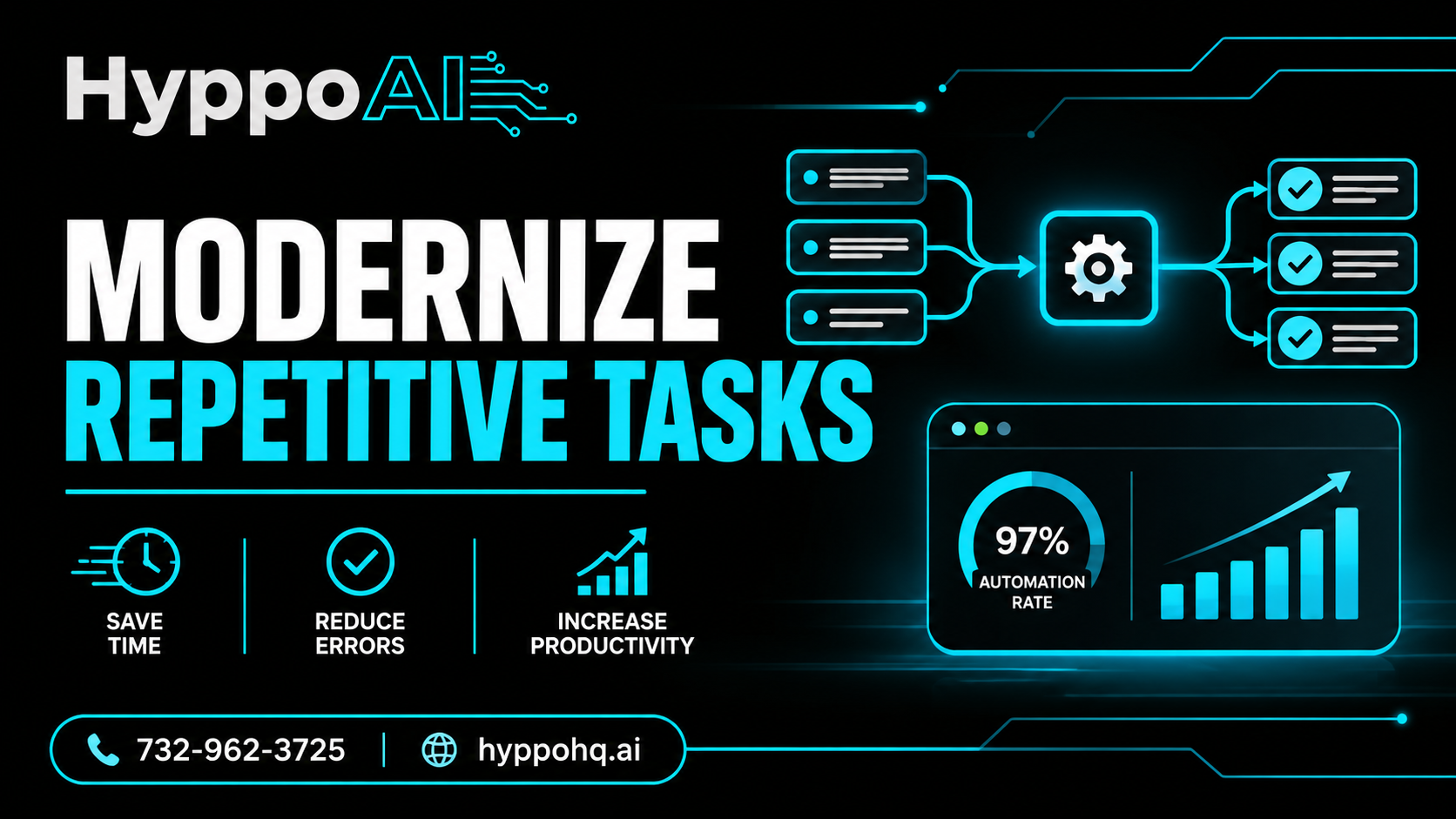
How modern businesses handle repetitive tasks differently
Repetitive work has always been part of running a business. Follow-ups, scheduling, data entry, answering common questions, routing leads, updating records, and sending reminders all keep operations moving.
What has changed is how modern businesses handle repetitive tasks differently.
Instead of hiring more people to manage every repeatable process manually, many small and midsize businesses are using AI and automation to reduce busywork, improve response times, and create more consistent customer experiences. The goal is not to remove the human element. The goal is to stop wasting human time on work that systems can handle faster and more reliably.
For SMBs, this shift matters. Time is limited. Margins matter. Missed calls, delayed replies, and inconsistent follow-up all cost money. Businesses that build smarter systems can often operate leaner while serving customers better.
Why repetitive tasks create hidden costs
Most repetitive tasks do not look expensive at first. Each one may only take a few minutes. But when those minutes stack up across a day, week, or month, they turn into a major operational drag.
Common examples include:
- Responding to the same customer questions
- Manually booking appointments
- Copying information between tools
- Sending follow-up texts or emails
- Logging call notes and lead details
- Chasing unpaid invoices or confirmations
- Routing requests to the right team member
The real cost is not just labor. It is also:
- Slower response times
- More human error
- Inconsistent customer experiences
- Burnout from low-value work
- Missed revenue opportunities
Modern businesses look at these tasks and ask a simple question: does a person need to do this every time?
The modern approach: automate first, human where it counts
Today, the most effective businesses are designing workflows around a clear principle: automate repeatable actions, and use people for judgment, problem-solving, and relationship building.
That means businesses are no longer treating repetitive work as unavoidable overhead. They are treating it as a systems problem.
What this looks like in practice
A modern workflow might include:
- AI answering common inbound questions instantly
- Automated lead capture from forms, calls, or messages
- Smart routing based on customer intent or urgency
- Appointment scheduling without back-and-forth emails
- Follow-up sequences that trigger automatically
- CRM updates happening in the background
- Notifications sent to staff only when human intervention is needed
This is a different mindset from the old approach of adding more manual steps as the business grows. Instead of scaling chaos, modern businesses scale systems.
How AI changes repetitive work
Automation has existed for years, but AI makes it more flexible and useful.
Traditional automation works well when every step is predictable. AI helps when tasks involve language, decision trees, or variable inputs. That is why more SMBs are using AI to support communication-heavy tasks that used to require constant staff attention.
Areas where AI helps most
Customer communication
AI can handle common questions, qualify inquiries, confirm appointments, and respond after hours. This helps businesses stay responsive without needing someone available 24/7.
Lead follow-up
Many leads go cold because no one responds fast enough. AI-supported systems can send immediate replies, gather basic information, and keep the conversation moving until a team member steps in.
Internal operations
AI can summarize conversations, organize notes, draft responses, and trigger next steps. That reduces admin work and helps teams focus on execution.
Task prioritization
Not every message or request deserves the same urgency. AI can help categorize requests so teams spend time where it matters most.
Why SMBs are adopting this faster
Large companies often have bigger budgets, but SMBs usually feel the pain of repetitive work more directly. A missed call or delayed response can mean a lost customer. One overloaded employee can slow down the whole operation.
That is why AI for SMBs is gaining traction. It gives smaller teams leverage.
With the right systems, a business can:
- Respond faster without adding headcount immediately
- Reduce manual errors
- Improve consistency across touchpoints
- Capture more leads that would otherwise be missed
- Free staff to focus on sales, service, and retention
The advantage is not just efficiency. It is capacity. Businesses can handle more volume without letting quality slip.
The biggest difference is consistency
One of the most overlooked benefits of automation is consistency.
People get busy. They forget steps. They handle the same situation differently depending on the day. That is normal. But it creates friction for customers and unpredictability for the business.
Modern systems help create a more reliable process.
For example:
- Every lead gets an immediate response
- Every appointment gets a confirmation message
- Every missed call triggers follow-up
- Every inquiry gets routed properly
- Every customer interaction is logged
That consistency builds trust internally and externally. Teams know what is happening. Customers know what to expect.
What businesses should automate first
Not every process needs AI on day one. The smartest approach is to start with repetitive, high-frequency tasks that affect revenue, speed, or customer experience.
Good starting points
- Missed call follow-up
- Appointment scheduling
- FAQ responses
- Lead intake and qualification
- Review requests
- Reminder messages
- Basic CRM updates
These areas usually offer quick wins because they happen often and are easy to measure.
Questions to ask before automating
- Is this task repeated daily or weekly?
- Does it follow a predictable pattern?
- Does slow execution create lost opportunities?
- Is a skilled employee spending too much time on it?
- Would customers benefit from faster response times?
If the answer is yes to several of these, it is likely a strong automation candidate.
What automation should not replace
Modern businesses are not winning by removing people from every interaction. They are winning by using people more strategically.
Human involvement still matters for:
- Complex decision-making
- Escalated customer issues
- Relationship-driven sales
- Creative problem-solving
- High-trust conversations
The best systems know when to hand off. AI should support the team, not create friction or block access to real help.
The shift from labor-heavy to system-driven growth
This is the core difference in how modern businesses handle repetitive tasks differently.
Older models relied on more manual effort as demand increased. More customers meant more admin, more coordination, and more chances for things to break.
Modern businesses build processes that absorb growth better. They use AI and automation to create a stronger operational foundation before bottlenecks become expensive.
That shift changes how leaders think.
Instead of asking, “Who can do this task?” they ask:
- Can this be automated?
- Can this be standardized?
- Can this be handled faster and more accurately by a system?
- Where does human attention add the most value?
That is a smarter way to scale.
Final takeaway
Repetitive tasks are not going away. But the way businesses manage them is changing fast.
The businesses gaining an edge are not simply working harder. They are building better systems. They are using AI and automation to reduce low-value manual work, improve responsiveness, and give their teams more time for the work that actually drives growth.
If your business is still relying on manual follow-up, scattered workflows, or staff time to handle every repeatable task, there is a better way.
To see how HyppoAI helps SMBs modernize repetitive work with practical AI systems, visit https://hyppohq.ai or call +17329623725.
