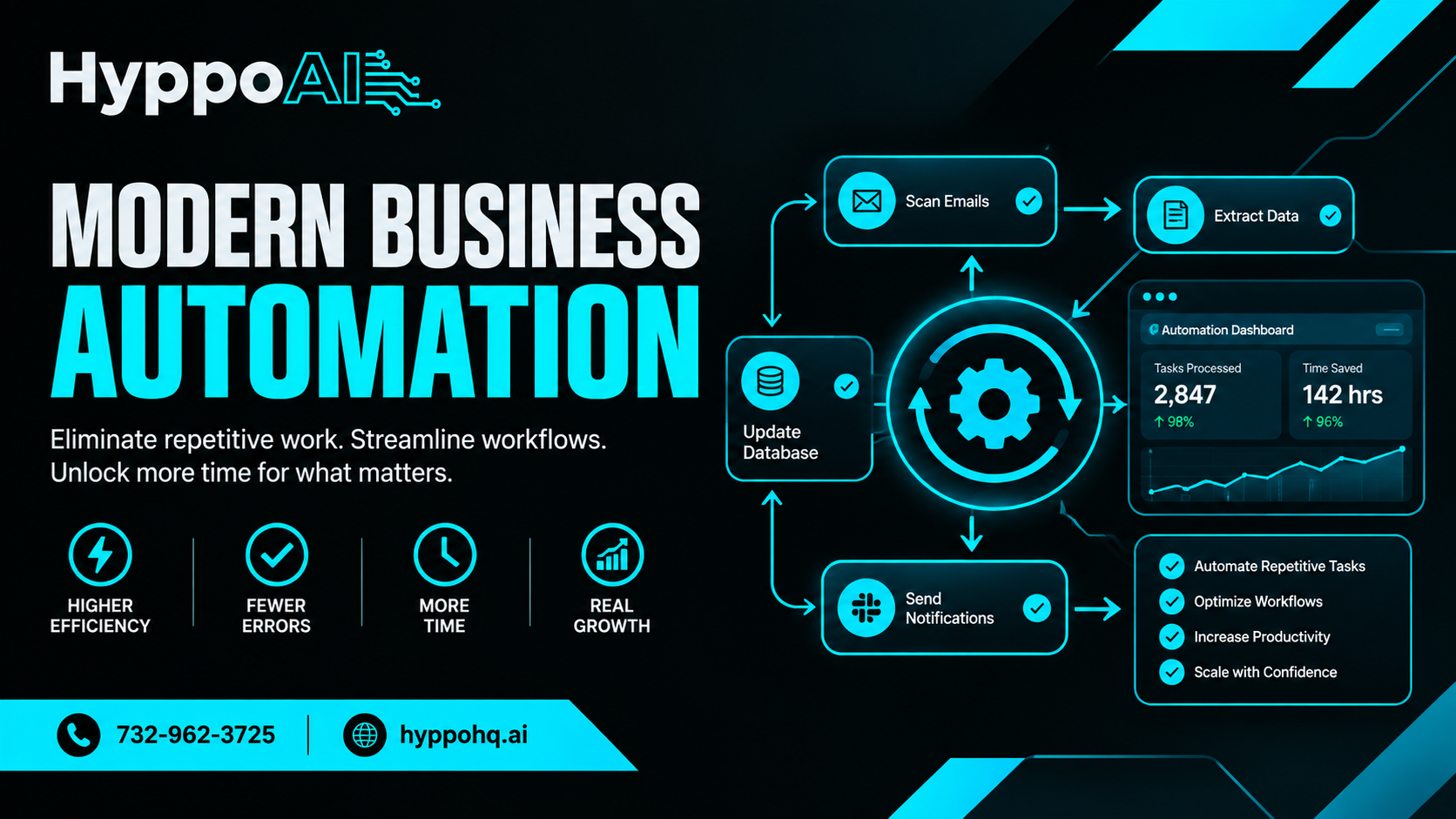
How modern businesses handle repetitive tasks differently
Repetitive tasks have always been part of running a business. The difference today is not that the work disappeared. It is that modern businesses no longer accept manual repetition as the default.
Instead of assigning every routine task to a person, growing companies are redesigning workflows around systems, automation, and AI. That shift helps teams save time, reduce errors, respond faster, and focus on work that actually drives revenue.
For small and mid-sized businesses, this matters even more. Lean teams cannot afford to spend hours copying data, chasing follow-ups, answering the same questions, or managing repetitive admin. The businesses that scale well are usually the ones that build smarter operating systems early.
Why repetitive tasks are being handled differently now
A few years ago, repetitive work was often seen as unavoidable overhead. Today, business owners have access to tools that can take on much of that load without adding headcount.
What changed?
- AI tools became more accessible for SMBs
- Automation platforms became easier to connect
- Customers started expecting faster response times
- Labor costs increased, making inefficiency more expensive
- Teams began prioritizing focus, speed, and consistency
Modern businesses are not just looking to work harder. They are looking to remove friction from everyday operations.
The old way: people doing process work all day
In many businesses, repetitive tasks still show up like this:
- Manually replying to common inquiries
- Copying lead information between systems
- Sending appointment reminders one by one
- Logging notes after every call
- Following up with prospects inconsistently
- Repeating the same onboarding steps for every client
The problem is not only the time involved. It is also the inconsistency. Manual processes depend on memory, attention, and availability. That creates delays, missed opportunities, and avoidable mistakes.
When a business grows, those issues multiply.
The modern approach: system first, manual second
Modern businesses handle repetitive tasks differently by asking a better question first:
Can this be systemized before it is delegated?
That one shift changes everything.
Instead of hiring more people to absorb repetitive work, companies are mapping routine tasks and deciding which parts can be:
- Automated
- Assisted by AI
- Triggered by rules
- Standardized through templates
- Routed through integrated systems
This does not mean removing humans from the business. It means using people where judgment, relationship-building, and strategy matter most.
What kinds of repetitive tasks are being automated
Not every task should be automated, but many routine actions are strong candidates.
Customer communication
Businesses are using AI and automation to handle:
- First-response messages
- FAQ answers
- Appointment confirmations
- Reminder texts and emails
- Lead qualification
- Basic support routing
This helps companies respond quickly without requiring someone to monitor messages all day.
Sales follow-up
One of the biggest operational gaps in SMBs is inconsistent follow-up. Modern systems can:
- Send immediate replies to new leads
- Trigger nurture sequences
- Schedule follow-up reminders
- Update CRM records automatically
- Route hot leads to the right person
That means fewer missed opportunities and a better experience for prospects.
Operations and admin
Internal repetitive tasks are also changing fast. Businesses now automate:
- Data entry
- Invoice reminders
- Status updates
- Internal notifications
- Task assignments
- Report generation
These may seem small individually, but together they can consume a huge portion of the week.
Why this shift matters for SMBs
Large enterprises have long used systems to improve efficiency. What is different now is that SMBs can do the same without enterprise-level budgets or massive internal teams.
That creates a competitive advantage.
Faster response times
Modern businesses know speed matters. A lead that waits hours for a response is more likely to move on. Automated workflows help businesses reply in minutes, not when someone finally gets to their inbox.
Better consistency
People have off days. Systems do not. When repetitive tasks are standardized, customers get a more reliable experience and teams make fewer avoidable errors.
More productive teams
When staff are buried in repeatable admin, they cannot focus on growth. Removing low-value repetition gives teams more room for sales, service, and strategic work.
Easier scaling
A business built on manual repetition becomes harder to manage as volume increases. A business built on systems can handle more activity without the same level of operational strain.
The role of AI in repetitive work
Automation is not new. What makes the current moment different is AI.
Traditional automation follows rules. AI can handle more flexible, language-based, and context-driven tasks.
Where AI adds value
AI can help businesses with:
- Drafting responses to common questions
- Summarizing conversations
- Extracting information from messages or forms
- Routing requests based on intent
- Supporting lead qualification
- Assisting with content, documentation, and internal knowledge use
For SMBs, the real value is not using AI for novelty. It is using AI where speed, clarity, and repeatability matter.
What modern businesses do before they automate
The best businesses do not automate chaos. They simplify first.
Before implementing AI or automation, they usually:
1. Identify repetitive bottlenecks
They look for tasks that happen often, follow a pattern, and consume time.
2. Document the current workflow
If the process is unclear, automation will only make confusion happen faster.
3. Standardize the outcome
They define what a successful response, handoff, or completed task should look like.
4. Choose the right tool for the job
Not every problem needs a complex AI system. Sometimes a simple workflow automation is enough.
5. Keep a human review point where needed
For sensitive, high-value, or complex interactions, human oversight still matters.
Common mistakes to avoid
Businesses often know they need efficiency, but they run into problems when they move too fast or automate without a plan.
Automating broken processes
If the workflow is messy, duplication and confusion will still exist after automation.
Using too many disconnected tools
A stack of tools without clear integration can create more friction instead of less.
Forgetting the customer experience
Fast is good, but robotic is not always better. Businesses should make sure their systems still feel helpful and clear.
Expecting instant transformation
The biggest gains usually come from improving one high-impact process at a time.
A practical way to start
If you are wondering where to begin, start small and focus on one repetitive process that affects revenue, response time, or team capacity.
Good starting points include:
- New lead response
- Appointment reminders
- Missed call follow-up
- FAQ handling
- CRM updates after inquiries
- Internal task notifications
Once one workflow is working well, it becomes easier to expand into other areas.
The businesses that win will be the ones that adapt
Modern businesses handle repetitive tasks differently because they have to. Customers expect speed. Teams need focus. Owners need systems that support growth instead of creating more operational drag.
The goal is not to automate everything. The goal is to remove unnecessary repetition so people can spend more time on work that requires judgment, creativity, and human connection.
That is where modern operations are heading, and SMBs that move early will be in a much stronger position.
If your business is ready to reduce manual work and build smarter systems, HyppoAI helps SMBs use AI and automation in practical ways. Visit https://hyppohq.ai or call +17329623725 to learn how to streamline repetitive tasks and scale more efficiently.
